Nearly half of learning and talent development professionals acknowledge a growing skills crisis. In fact, 49% agree that executives are concerned employees lack the skills needed to execute business strategy (Workplace Learning Report 2025).
One of the most critical early decisions in the LMS selection process is understanding what type of system you actually need. Many buyers compare platforms side by side without realizing they are designed for fundamentally different use cases.
Do you need a learning platform - or a true Learning Management System (LMS)?
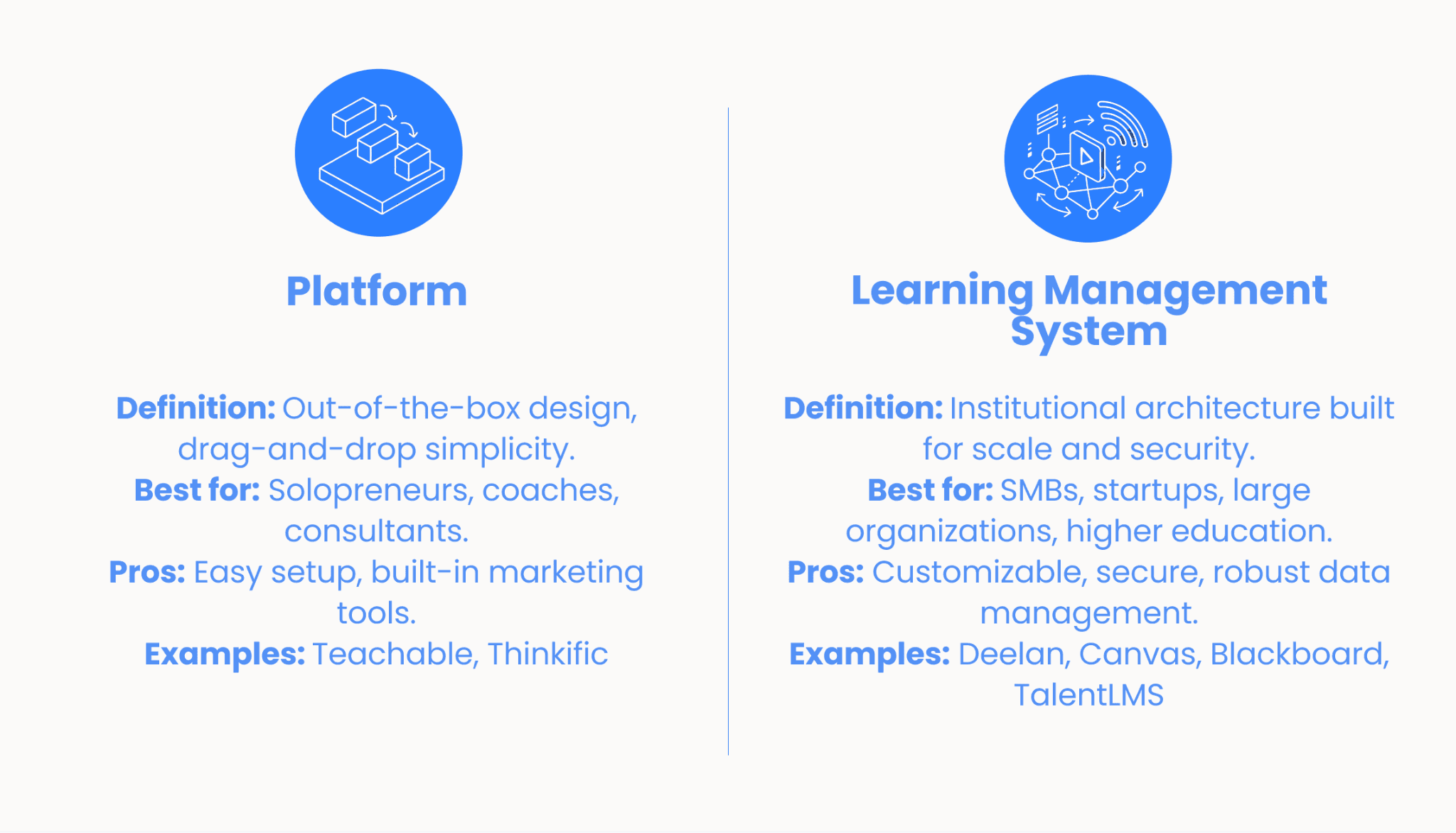
Platform vs. LMS: Know the Difference
The Platform
Definition: Out-of-the-box design, drag-and-drop simplicity.
Best for: Solopreneurs, coaches, consultants.
Pros: Easy setup, built-in marketing tools.
Examples: Teachable, Thinkific
The LMS
Definition: Institutional architecture built for scale and security.
Best for: Large organizations, complex assessments, higher education.
Pros: Customizable, secure, robust data management.
Examples: Deelan, Canvas, Blackboard, TalentLMS
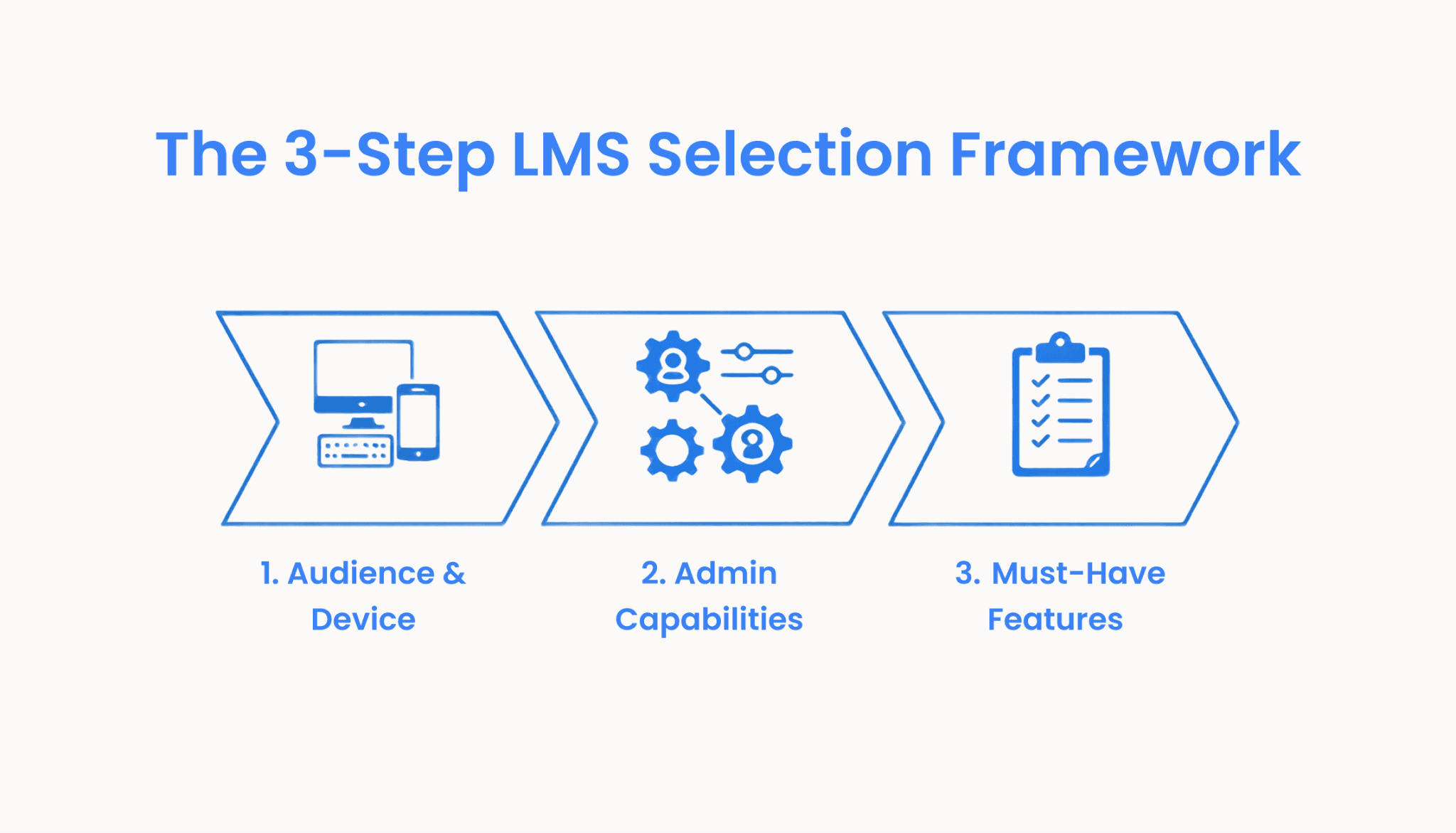
The 3-Step LMS Selection Framework
1. Audience & Device
Key Question: Are learners primarily office-based, remote, or in the field?
Will learning happen in long sessions or short, in-the-moment bursts?
2. Admin Capabilities
Key question: Power user or simplicity-first?
3. Feature Must-Haves
Key question: Basic reporting or specialized needs?
Define Your Learning Strategy Before You Shop
Before comparing vendors or booking demos, clarify why you need an LMS.
1. Training Type
Formal training: Structured courses, certifications, compliance.
Informal learning: Knowledge sharing, microlearning, just-in-time support.
Blended learning: A mix of structured programs and on-demand resources.
2. Audience Characteristics
Internal employees vs. external learners
Desk-based vs. frontline teams
Skill levels: entry-level, specialists, leaders
3. Learning Outcomes
Specify what success looks like:
Knowledge acquisition
Skill development
Behavior change
Performance improvement
4. Assessment Methods
Decide how learning will be measured:
Quizzes and exams
Practical simulations
Role-plays
Performance-based evaluations
5. Content Type
Video and multimedia
Text-based resources
Interactive workshops and simulations
Clarity at this stage prevents overbuying and underusing features later.
Identifying Must-Have LMS Features and Functionalities
Not all LMS platforms are created equal. Focus on features that directly support your goals.
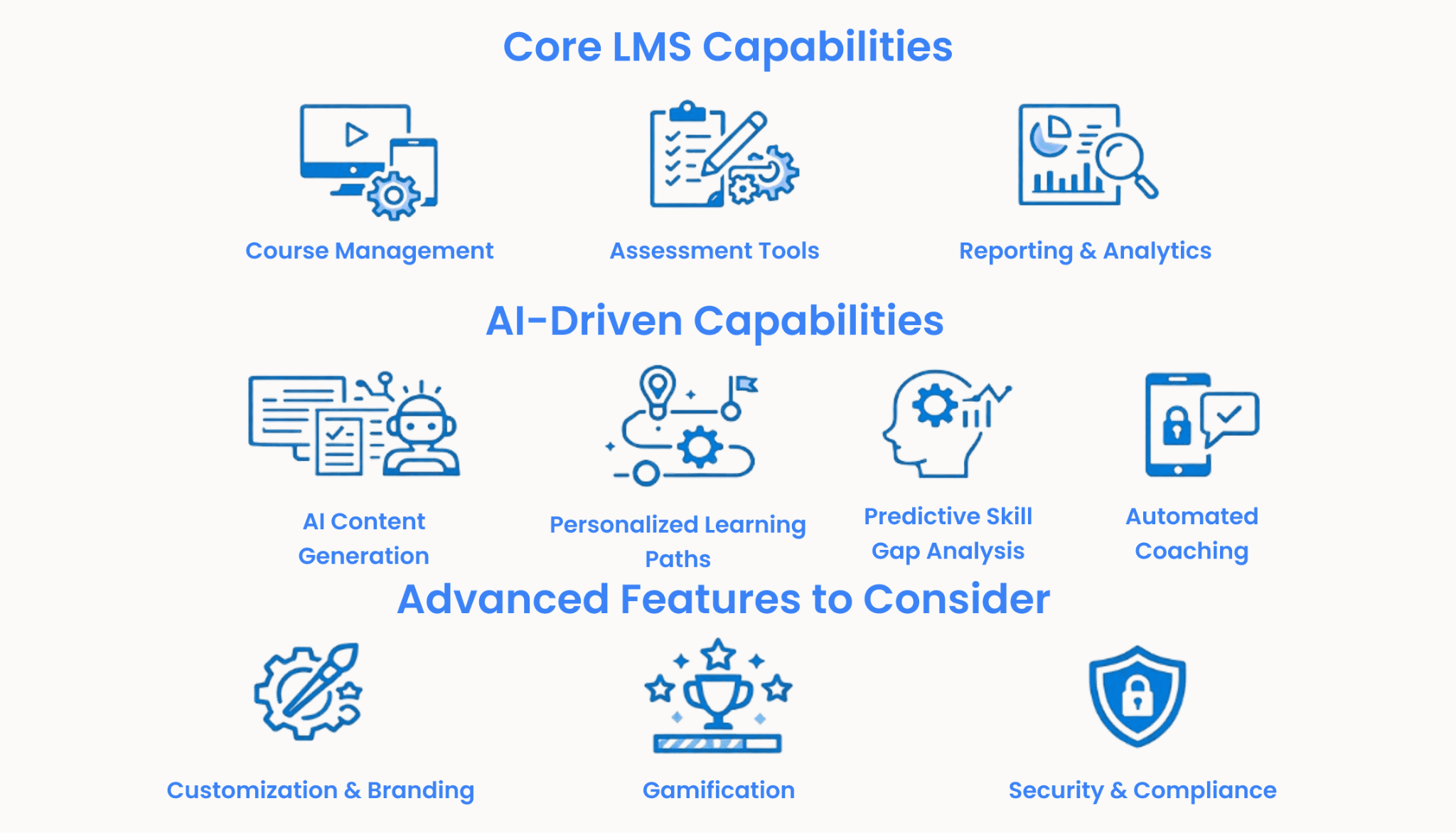
Core LMS Capabilities
Course Management: Create, organize, and update courses efficiently.
Assessment Tools: Quizzes, tests, simulations, and progress tracking.
Reporting & Analytics: Visibility into learner engagement and performance.
AI-Driven Capabilities (Now a Competitive Advantage)
Organizations no longer need to choose between personalization and scale. 71% of L&D professionals are already exploring or integrating AI into their workflows (Workplace Learning Report 2025).
Modern LMS platforms increasingly rely on AI to scale personalization:
AI Content Generation: Create full courses, workshops, quizzes, and role-plays from a single prompt - saving time for L&D teams.
Personalized Learning Paths: Automatically recommend relevant content based on role, performance, and skill gaps.
Predictive Skill Gap Analysis: Identify struggling learners and organizational capability gaps before they affect results.
Automated Coaching & Reinforcement: Real-time feedback, intelligent reminders, and microlearning to ensure knowledge retention.
Advanced Features to Consider
Customization & Branding: Align the platform with your brand identity.
Gamification: Badges, leaderboards, and challenges to boost engagement.
Security & Compliance: Data encryption, access control, and GDPR compliance.
Scalability and Flexibility
An LMS should grow with your organization.
Key questions to ask:
Can it support rapid user growth?
Can you expand course volume and complexity?
Will performance remain stable at scale?
Enterprise-grade LMS platforms are designed for massive scale, offering deep customization, localized servers, and advanced assessments - making them suitable for large organizations and higher education.
User Experience (UX) and Accessibility
Adoption depends on usability.
Evaluate:
Intuitive navigation: Can users find what they need quickly?
Responsive design: Does it work seamlessly across devices?
Ease of use: Can learners and admins operate it without extensive training?
If the admin experience is overly complex, your training program may never launch on time.
Support, Training, and Vendor Reputation
A strong vendor relationship matters long-term.
Look for:
Support channels: Chat, email, and phone availability.
Training resources: Documentation, tutorials, webinars.
Customer reviews: Real-world feedback on reliability and service quality.
Budgeting and Total Cost of Ownership
An LMS’s sticker price rarely tells the full story.
Common Cost Components
Licensing or subscription fees
User-based pricing (per seat or active user)
Add-ons and premium features
Hidden Costs to Watch For
Storage overages
Premium support fees
Advanced analytics or AI modules
Pro tip: Budget for the total lifecycle cost, not just year one.
Smart Buying Strategy: Free → Monthly → Annual
Avoid costly mistakes by staging your commitment:
Free version or trial: Learn the platform.
Monthly plan: Validate real-world fit over 3-8 months.
Annual contract: Commit only when confident.
2026 LMS Solution Landscape
Platform | Best For | Key AI Features | Pricing Model |
Startups, SMBs, Revenue Teams | AI-native content generation, personalized paths, skill gap analysis | ||
Docebo | Large enterprises & compliance | AI content curation, automation | Custom enterprise pricing |
360Learning | Collaborative learning | AI-assisted creation, peer learning | Per-user |
TalentLMS | Simple course management | Limited AI via integrations | Affordable per-user |
Fuse | Knowledge management | AI-powered content discovery | Per-user |
Beyond the Software: The Formula for LMS Success
[Content] + [Technology] + [Distribution] = Success
Benefits of a Well-Chosen LMS
New revenue streams
Stronger communities
Organizational credibility
Operational freedom
Final Advice
Don’t reinvent the wheel. Choose an LMS that aligns with your business model, learners, and growth strategy not just today, but three years from now.
Ready to Select Your LMS?
Build sales teams that win consistently with adaptive training.