Sales onboarding has quietly become one of the highest-leverage revenue drivers in modern go-to-market teams. Many organizations treat onboarding as an administrative formality - a week of slide decks, product manuals, and HR paperwork. However, it is a strategic revenue lever.
Sales onboarding is a structured process that equips new sales reps with the skills, knowledge, tools, and confidence they need to become productive quickly.
Done right, it directly impacts faster ramp time, higher win rates, better quota attainment, and more predictable revenue. Done poorly, it delays pipeline generation, erodes confidence, and creates performance gaps that can linger for quarters.
Today’s best teams no longer treat onboarding as an HR exercise. They treat it as a revenue system that blends process, practice, coaching, and AI-powered enablement to help reps sell effectively from day one.
Quick takeaways:
- Sales onboarding is a revenue lever
- One-size-fits-all onboarding fails across roles, segments, and experience levels
- AI-powered sales onboarding enables personalization, practice, and scale
- Measuring onboarding ROI is essential for predictable growth
- Deelan AI represents a shift toward adaptive onboarding built around real selling
What Is Sales Onboarding?
Sales onboarding is the structured approach to ramping new sales hires by combining product knowledge, messaging, sales methodology, tools training, and real-world selling practice into a cohesive sales onboarding process.
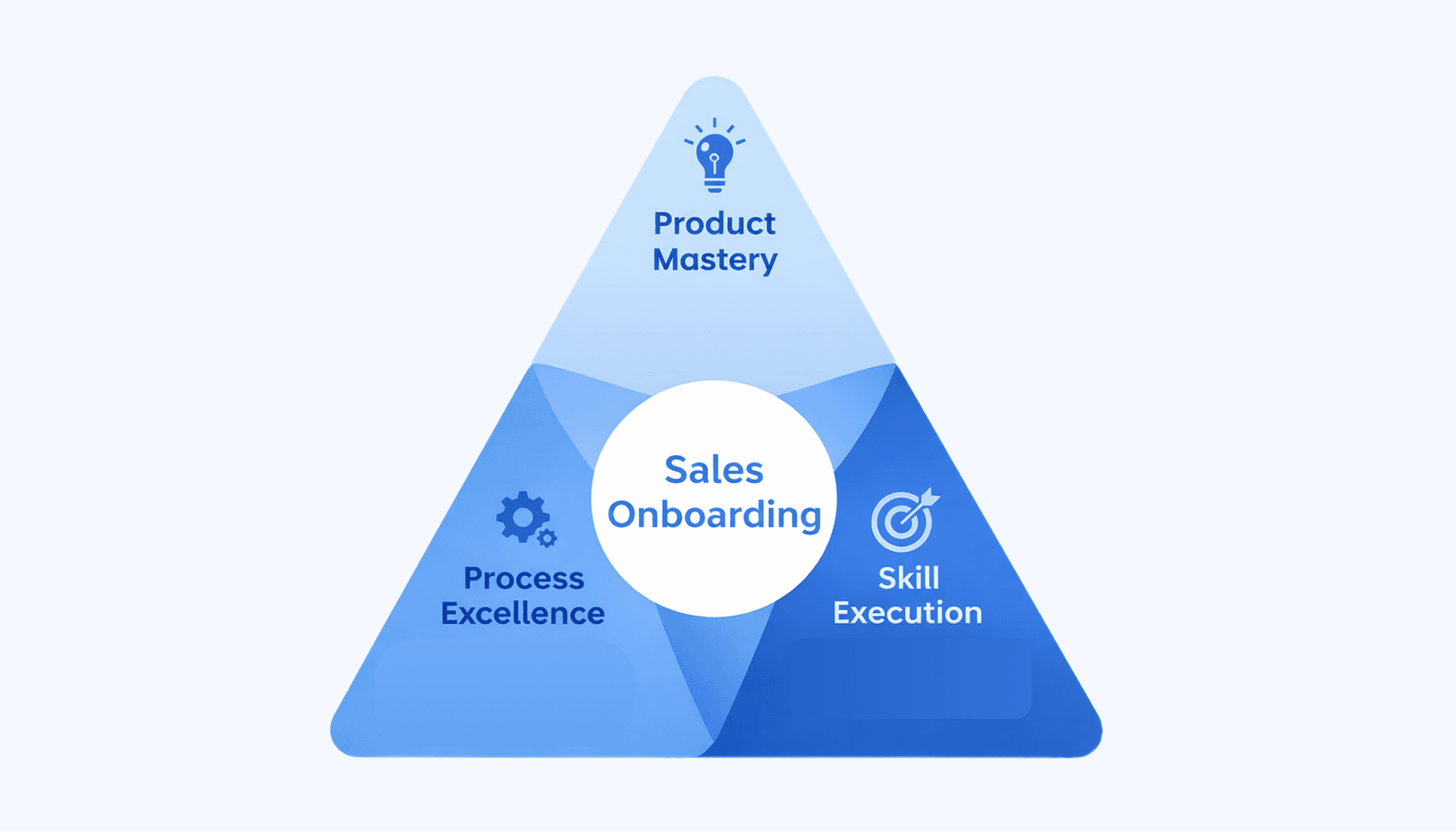
Unlike general employee orientation, sales onboarding is hyper-focused on outcomes. It involves three core pillars:
Product Mastery: Understanding the "why" behind the features and the pain points they solve.
Process Excellence: Navigating the CRM, managing the pipeline, and adhering to the legal/pricing guardrails.
Skill Execution: The ability to handle a "no," run a discovery call, and negotiate a contract.
Why Sales Onboarding Is a Revenue Lever (Not an HR Checklist)
High-performing GTM teams connect onboarding directly to revenue metrics. The logic is simple:
- Faster ramp time means reps contribute to pipeline sooner
- Higher win rates improve efficiency across the funnel
- Better quota attainment stabilizes forecasts
- Predictable revenue enables confident growth planning
When onboarding is unstructured or inconsistent, managers spend months correcting basic mistakes, enablement teams chase low adoption, and leadership absorbs the cost of delayed productivity.
Revenue-focused onboarding, by contrast, creates consistency in how reps sell, speak, and execute - long before they touch their first high-stakes deal.
The Modern Sales Onboarding Process (A Step-by-Step Framework)
An effective sales onboarding process balances structure with adaptability.
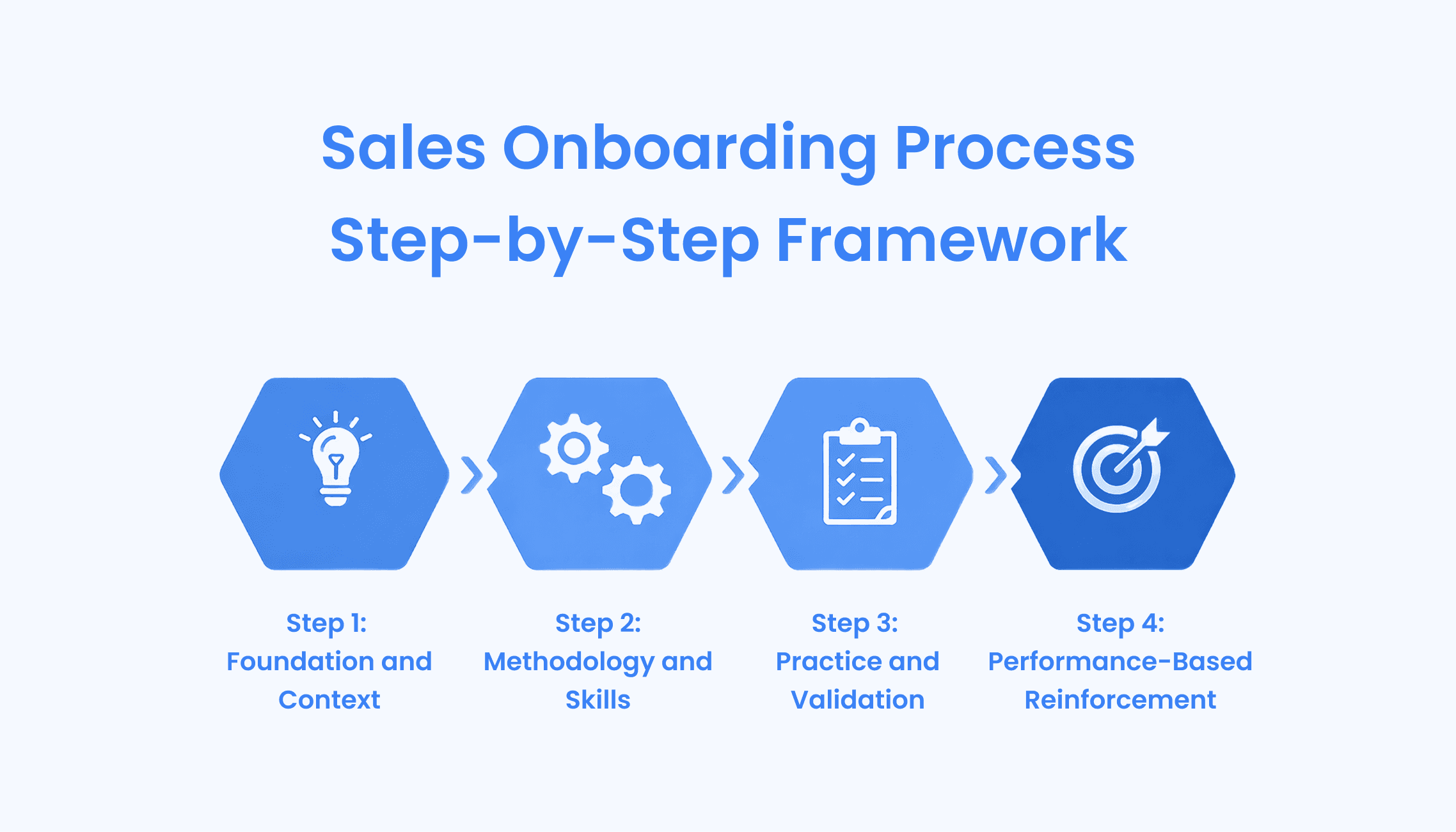
While every organization differs, modern programs typically follow a framework like this:
Step 1: Foundation and Context (Week 1)
- Market, buyer personas, and competitive landscape
- Product value, use cases, and differentiation
- Core messaging and positioning
Step 2: Methodology and Skills (Week 2)
- Sales methodology (e.g., MEDDIC, Challenger, SPIN)
- Discovery, qualification, and objection handling
- Demo flow and storytelling
Step 3: Practice and Validation (Week 3)
- AI role play and live simulations
- Pitch certifications and call reviews
- Tool fluency (CRM, enablement, forecasting)
Step 4: Performance-Based Reinforcement (Week 4)
- Targeted coaching based on dfeal data
- Skill refreshers aligned to pipeline stage
- Continuous learning embedded in the flow of work
How to Onboard a New Sales Rep (By Role: SDR vs AE)
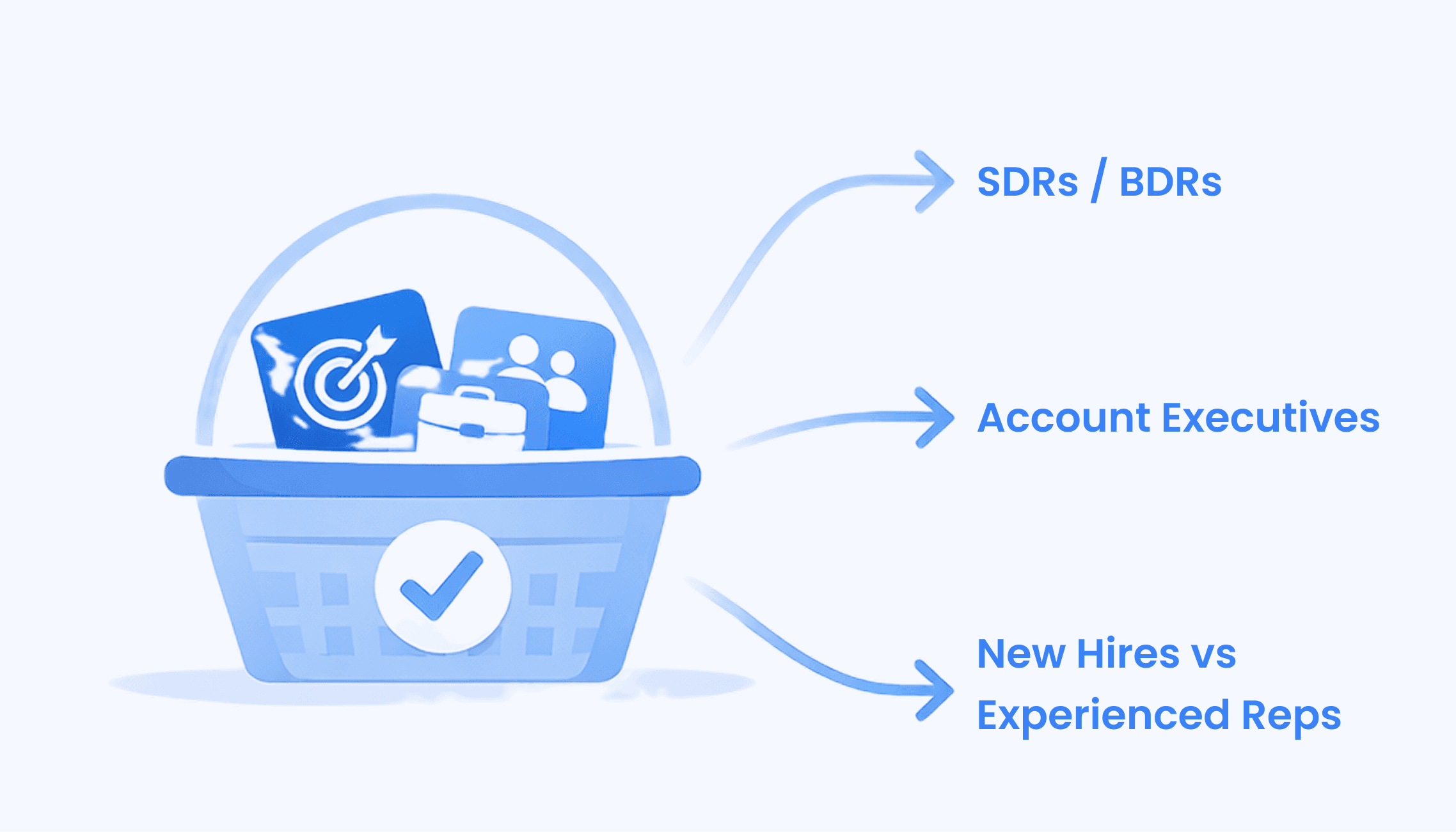
One-size-fits-all onboarding fails because selling motions differ dramatically by role, segment, and experience.
SDRs / BDRs
- Focus: prospecting, cold calls, objection handling
- Emphasis on talk tracks, email messaging, and speed
- Frequent AI-driven role play for cold outreach scenarios
Account Executives
- Focus: discovery, demos, negotiation, deal strategy
- Deeper product and competitive knowledge
- Practice handling complex buying committees
New Hires vs Experienced Reps
- New sellers need foundational skills and confidence-building
- Experienced reps benefit from gap-based onboarding that skips what they’ve mastered
Personalized learning paths ensure each rep spends time only on what moves deals.
Sales Onboarding Best Practices That Improve Win Rates
High-performing teams consistently apply these sales onboarding best practices:
- Start with outcomes, not content: Define what reps must *do*, not just what they must *know*
- Practice early and often: Role play beats reading every time
- Micro-Learning: Break training into 5-minute segments. Reps retain more when information is delivered in small, actionable bites.
- The Buddy System: Pair new hires with top performers. This provides a cultural touchstone and "unwritten" tribal knowledge that manuals can't capture.
- Embed training in real work
- Reinforce continuously: Onboarding doesn’t end after week four
- Measure everything: What isn’t measured can’t be improved
AI-Powered Sales Onboarding: Personalized Learning, Coaching, and Role Play
AI-powered sales onboarding changes how teams scale readiness and consistency.
Key capabilities include:
- Personalized learning paths based on role, seniority, and skill gaps
- AI role play that simulates real sales scenarios
- Real-time feedback on calls, pitches, and demos
- Training recommendations based on performance and deal data
Measuring What Matters: Sales Onboarding KPIs and ROI
Revenue leaders need proof that onboarding works. Here are core Sales Onboarding KPIs:
KPI | What "Good" Looks Like | Why It Matters |
Time to First Meeting | < 10 Days for SDRs | Indicates speed of tool/process mastery. |
Certification Completion | 100% within 21 Days | Ensures a baseline level of "brand safety." |
Ramp-to-Quota | Varies by Industry (e.g., 4 months) | The ultimate indicator of onboarding efficiency. |
Win Rate (New Reps) | Within 10% of Team Average | Measures the quality of the training provided. |
Pipeline Contribution | Meaningful pipeline by Month 2 | Proves the rep is sourcing/managing real value. |
The ROI of Onboarding
The financial impact of onboarding is best viewed through the lens of Ramp Time. The faster a rep reaches full productivity, the lower the "Customer Acquisition Cost" (CAC) for the deals they eventually close.
To calculate your specific timeline, use this formula:
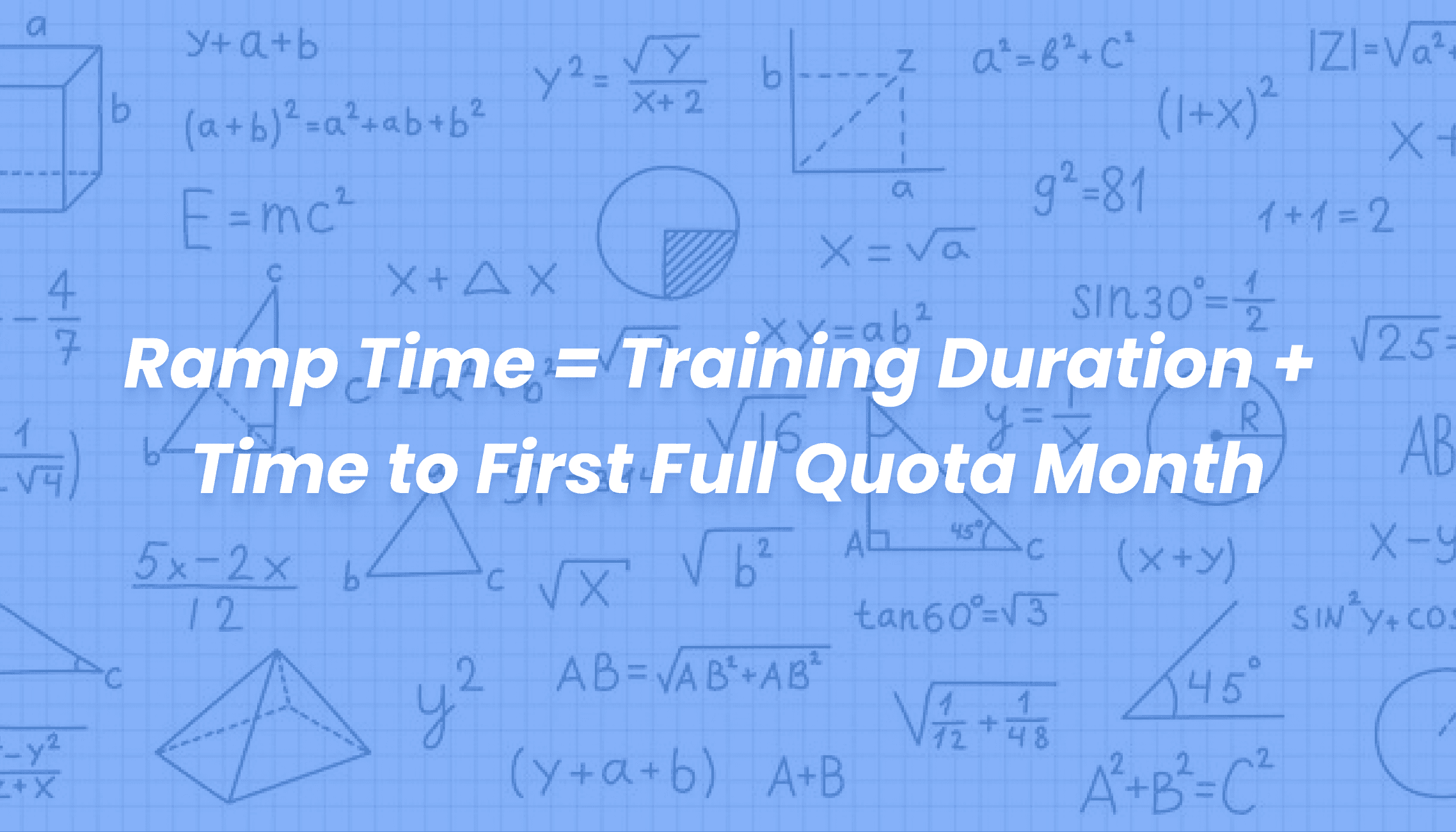
By reducing "Training Duration" through AI and automation, you pull the "Quota Month" closer to the present, resulting in a direct cash-flow benefit for the business.
How to choose Sales Onboarding Software
Not all sales onboarding software is created equal. Modern platforms should support:
- Sales onboarding software that centralizes content and tracks readiness
- LMS platforms for structured learning and certification
- Sales enablement tools for messaging, playbooks, and coaching
- CRM integrations that deliver training in the flow of work
The goal isn’t more tools - it’s fewer silos and better execution.
How Deelan AI Enables Adaptive Onboarding
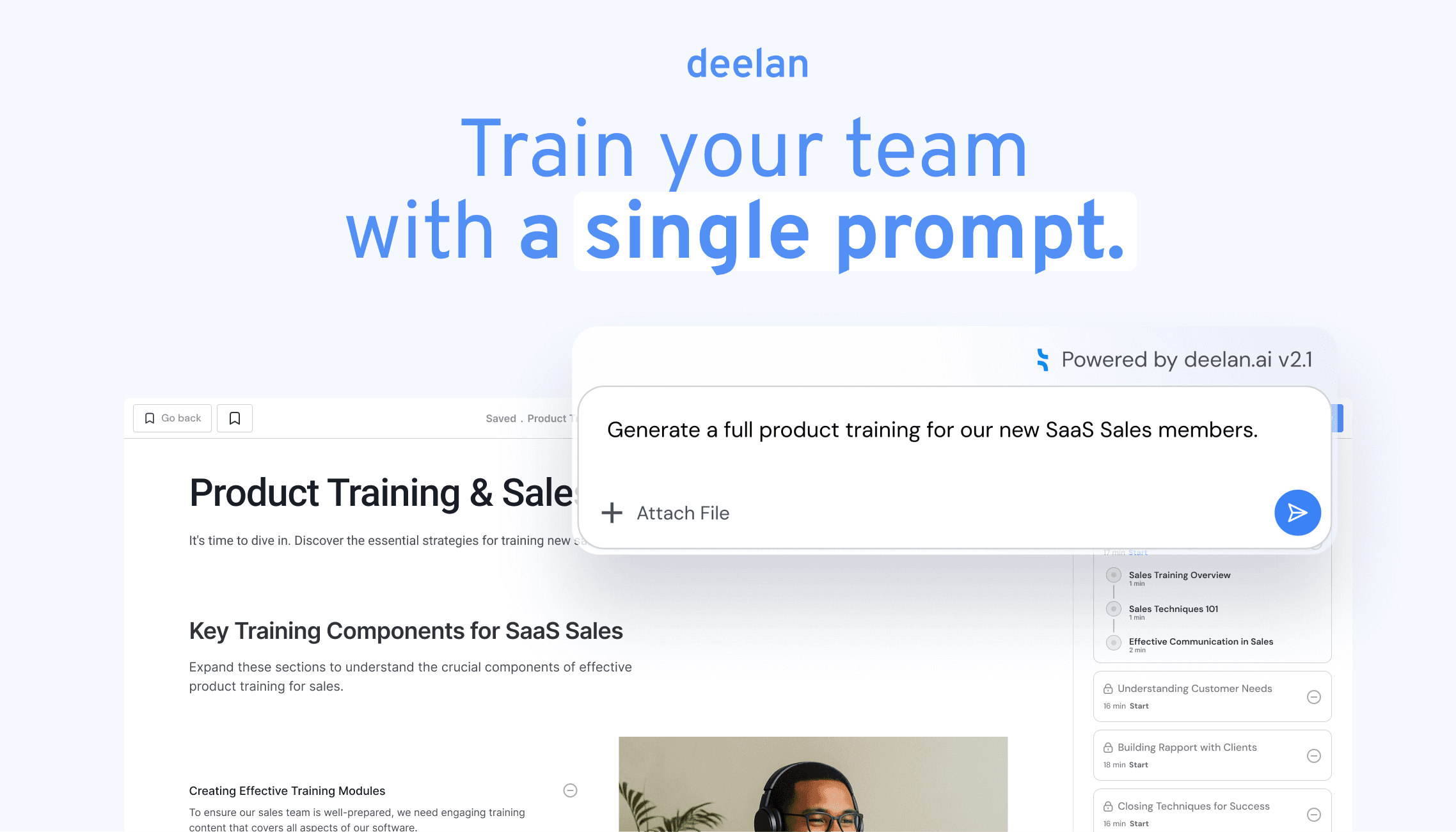
Deelan AI represents a shift from generic training to adaptive onboarding.
Training adjusts automatically by role (SDR/AE/CSM), seniority, and skill gaps — so reps spend time only on what moves deals.
From Playbooks to Training - Instantly
Deelan converts existing assets - scripts, recordings, messages, product docs - into structured training. This dramatically reduces enablement workload and accelerates onboarding creation.
Practice Over Passive Learning
With Deelan’s AI role play and AI sales coaching, reps practice:
- Cold calls
- Objection handling
- Demos
- Negotiation
- Upsells
Onboarding feels like real selling scenarios, not reading documents.
Scaling Coaching Without More Managers
One of the biggest onboarding bottlenecks is managers repeating the same coaching. Deelan’s AI coach improves reps continuously, allowing teams to scale readiness without hiring additional managers - while maintaining consistent execution.
Deelan haps with improving ramp time, win rates, and faster training creation . Reported outcomes include 55% faster ramp time, 15–25% higher win rates, 80% faster training creation, and higher pipeline quality.
Final Checklist: Onboarding New Sales Reps for Predictable Revenue
Before launching or revising your onboarding program, ask:
- Is onboarding tied to revenue metrics?
- Are learning paths personalized by role and skill gap?
- Do reps practice real selling scenarios early?
- Is coaching scalable and consistent?
- Can we clearly measure ROI?
If the answer is “no” to any of these, onboarding is leaving revenue on the table.
Conclusion
Onboarding is the foundation of your revenue engine.
By leveraging AI-powered sales onboarding and an adaptive approach, you ensure that every new hire doesn't just "join the team," but becomes a high-performing contributor to your company's growth.
Ready to see how adaptive onboarding can accelerate your revenue?
[Request a demo of Deelan AI today] and learn how to turn your playbooks into a high-performance training machine.