We have all seen the disconnect between leader expectations and meaningful AI transformation. According to a recent Accenture survey, 98% of business leaders want to adopt AI, but only 10% of companies have generative AI models in production. Even fewer can point to specific, measurable benefits.
We have officially moved from the "experimentation" phase to the "rationalization" phase. The initial excitement of the "shiny new toy" has faded. Now, CFOs and Boards are asking about impact.
Why AI Efforts Stall
Most organisations treat AI adoption as a software upgrade. They install the tool, run a few workshops, and expect the workforce to fundamentally change how they operate.
But like any habit, it requires more than just access to stick. It requires a fundamental shift in behaviour.
To understand why so many initiatives stall, we need to look at what actually drives human behaviour.
The Psychology of Adoption
From Fogg Behaviour Model, we believe three elements must converge for any new behaviour, including using AI, to take root:
Motivation means people understand why AI matters to them. It’s not enough to say AI will help the organisation; employees need to see how it reduces friction, improves outcomes, or helps them grow in their role.
Ability refers to practical confidence. People need opportunities to learn by doing - not just watching a demo or reading guidelines. They need to practice, fail safely, and improve.
Prompt and environment means the surrounding context makes AI usage easy and natural. If employees must switch tools, break routines, or start from scratch every time, adoption slows down. When AI is embedded in workflows and reinforced regularly, behaviour change becomes much more likely.
Moving From "Content" to "Capability"
For the last decade, corporate training has been about Content Consumption, tracking who watched the video or clicked "next" on the slide deck.
For real behavior changes, we need to move to Skill Simulation.
Teams need opportunities to practice real scenarios, receive feedback, and continuously improve. Role plays, coaching, and adaptive learning paths help bridge the gap between knowing and doing.
AI is starting to support this shift. Adaptive learning platforms and AI agents can act as mentors at scale, guiding learners, challenging responses, and providing real-time feedback. Instead of static training, teams receive ongoing support that evolves with their performance and needs.
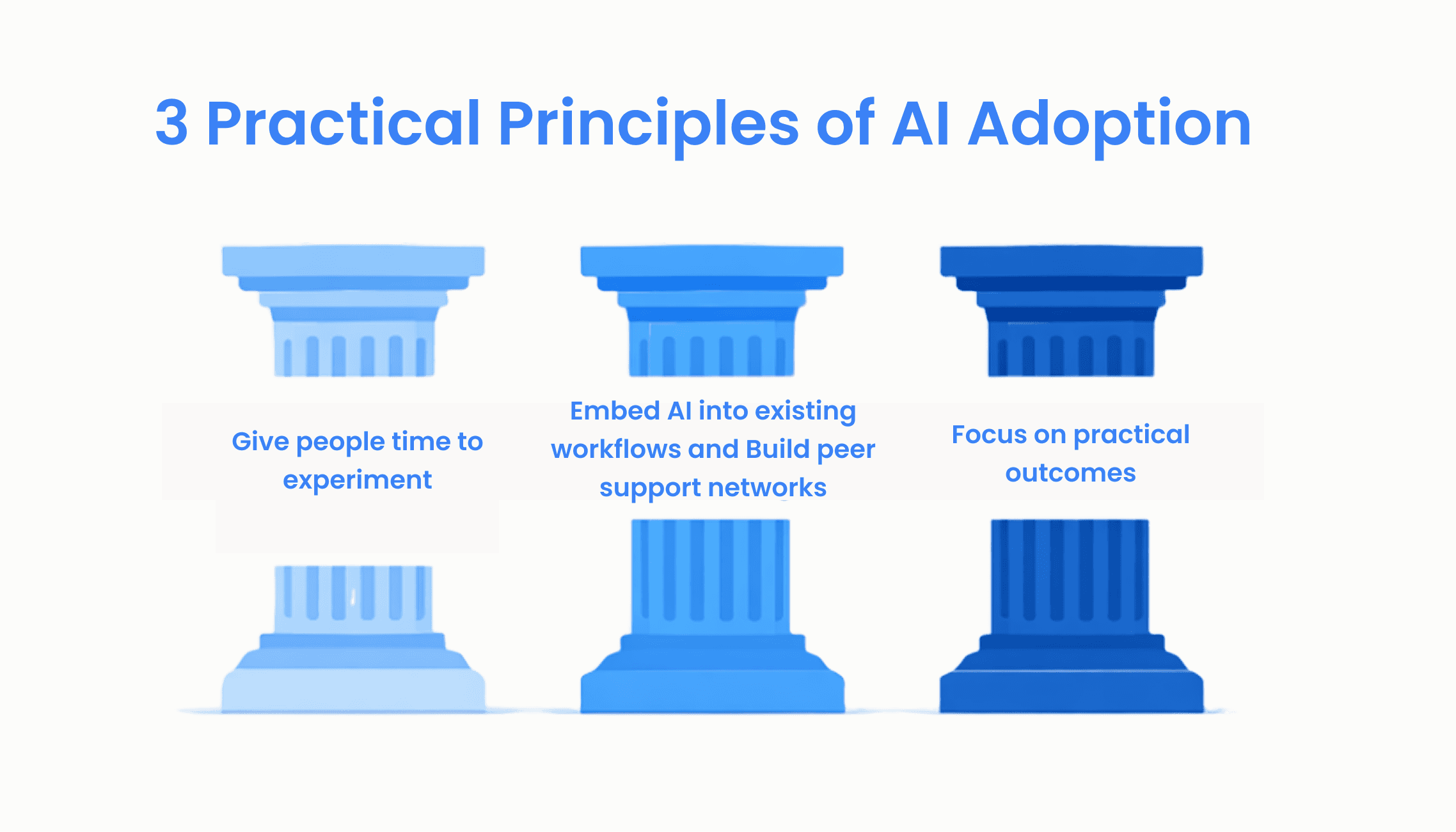
3 Practical Principles for Leaders
While every organisation is different, several practical principles consistently help AI adoption gain momentum.
Give people time to experiment
Adoption doesn’t happen when AI is added on top of already full schedules. Employees need space to explore, test, and learn without fear of immediate failure.Embed AI into existing workflows and Build peer support networks
The easier it is to use AI within everyday tools and processes, the faster it becomes habitual. Adoption grows when AI feels like part of the job, not an extra task.Formal or informal AI champions can help normalize usage. Peer influence often has more impact than top-down mandates.
Focus on practical outcomes
Show teams what success looks like in their own context. Concrete examples reduce hesitation and help people imagine how AI fits their work.
How We Can Help
At Deelan, we believe technology should amplify human capability.
We have partnered with Meres Consult to bring a holistic approach to this challenge. Maggie Sarfo and her team are experts in the Motivation and Strategy piece helping leaders design human-centred AI roadmaps that align with business growth.
Meres Consult: https://meresconsult.com/
At Deelan, we use adaptive AI to turn static playbooks into dynamic training that improves real performance.
The real measure of AI success
We often forget that behind every AI prompt is a human being trying to do their job better. If we want adoption to stick, we have to make it easier for our teams to succeed than to fail. It is a journey of behavior change.