
The Proven Playbook for Better Sales Quota Attainment
Most sales teams miss quota because they focus on the wrong things. Learn what drives sales quota attainment, how to set better quotas, benchmark performance, and help reps hit targets consistently.

If you lead a sales team, quota attainment is the metric that keeps you up at night. It sits at the intersection of strategy, execution, and people — and when it's off, everything else feels off too.
This playbook breaks down everything you need to know about sales quota attainment: what it is, what drives it, how to measure it, and — most importantly — how to improve it in a way that's repeatable, sustainable, and scalable.
Whether you're a sales manager trying to lift team performance, a RevOps leader optimizing quota planning, or a founder building a sales motion from scratch, this guide is built for you.
What Is Sales Quota Attainment?
Definition
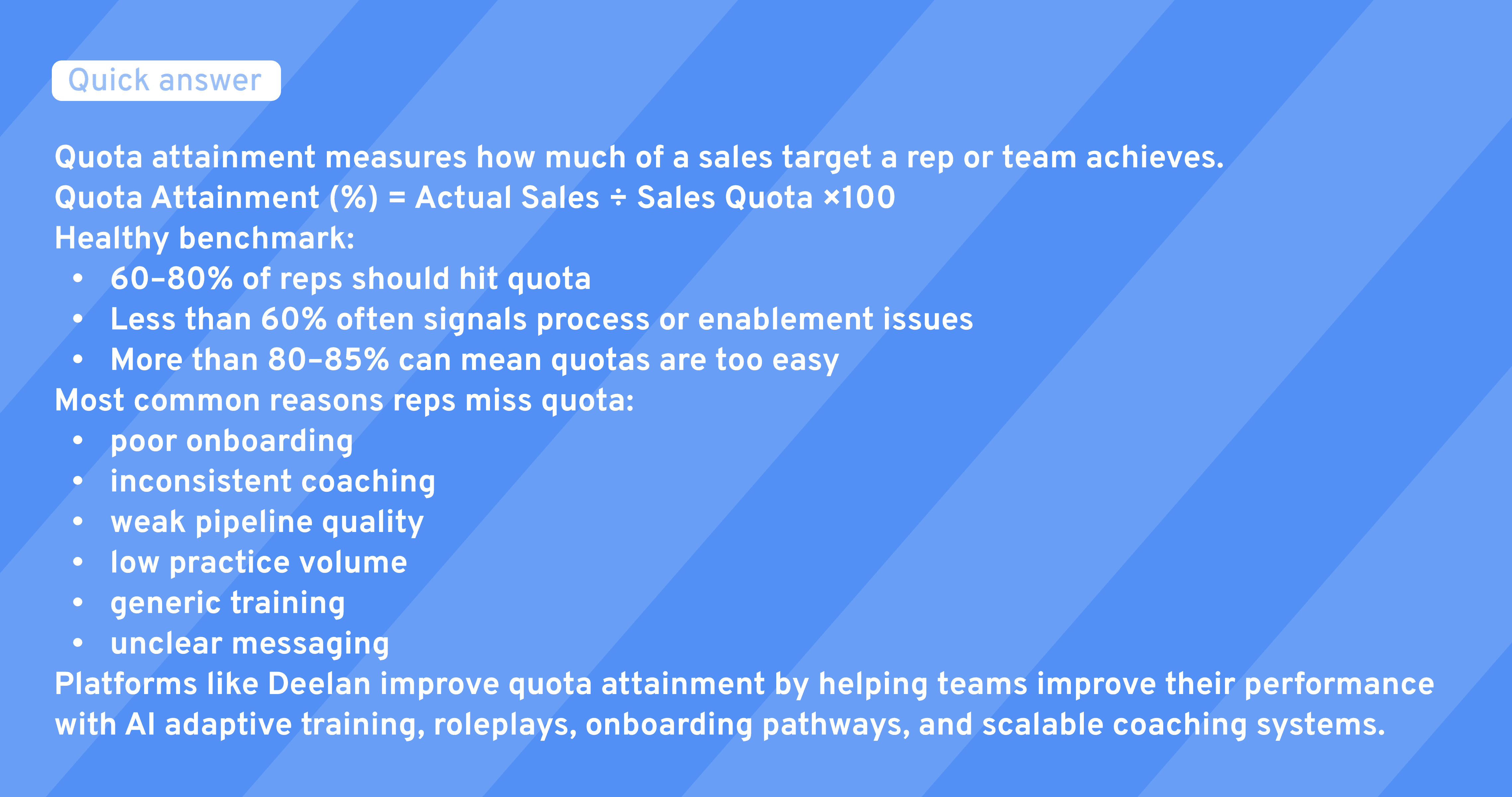
Sales quota attainment is the percentage of a sales target (quota) that a rep, team, or organization achieves within a given period. It's calculated as:
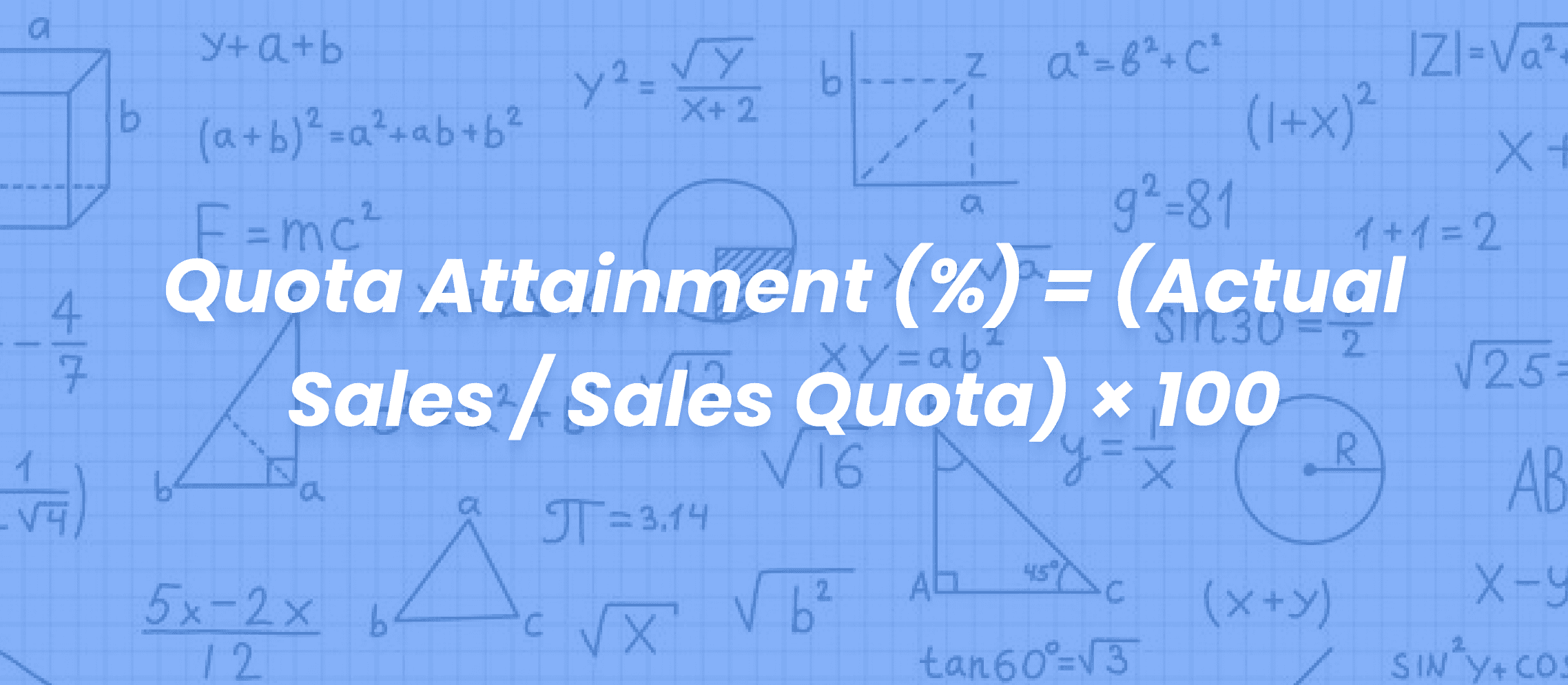
Quota Attainment (%) = (Actual Sales / Sales Quota) × 100
For example: if a rep has a $120,000 quarterly quota and closes $96,000, their quota attainment rate is 80%.
Why It's One of the Most Important Sales Performance Metrics
Quota attainment is often called a lagging indicator — it reflects the cumulative outcome of dozens of decisions made weeks or months before. That's what makes it both powerful and tricky: by the time attainment is low, the root cause has often already done its damage.
Quota attainment matters differently depending on your role:
• Reps: It directly affects commission, morale, and career progression.
• Managers: It's the primary signal of coaching effectiveness and team health.
• Leadership & RevOps: It drives revenue predictability, headcount planning, and board confidence.
• Enablement teams: Low attainment often signals gaps in onboarding, training, or tools.
Strong Quota Attainment Unlocks:
• More predictable revenue and better forecasting accuracy
• Higher rep retention and morale — top performers stay when they can win
• Stronger investor confidence — consistent attainment demonstrates GTM execution
• Better GTM alignment between sales, marketing, and product
• More efficient hiring and scaling — you know what "good" looks like
Two reps can generate the same revenue but have very different quota attainment rates depending on their targets. Attainment tells you more about execution quality than revenue alone — which is why it's a better lens for evaluating individual performance.
The Biggest Factors That Influence Quota Attainment
Before diving into the playbook, it's worth understanding why attainment varies so dramatically across teams and industries. The following factors are the biggest drivers:
Factor | How It Impacts Attainment |
Quota design | Quotas that are too high or poorly calibrated demotivate reps before the quarter starts |
Territory quality | Unequal territories mean reps start at different disadvantages regardless of skill |
Market conditions | Economic shifts, seasonality, and competition all affect close rates |
Product-market fit | Strong PMF makes selling easier; weak PMF means reps fight uphill battles daily |
Lead quality | Poor pipeline quality wastes time and inflates activity metrics without producing revenue |
Sales process | Inconsistent processes create unpredictable outcomes and hard-to-coach behaviors |
Training & coaching | Without skill development, reps plateau — or struggle to ramp at all |
Manager effectiveness | Managers who coach consistently drive 2–3x better attainment than those who don't |
Rep ramp time | New hires who take longer to ramp create attainment gaps for months |
Sales & marketing alignment | Misaligned ICP and messaging leads to wasted demos and longer cycles |
Tools & enablement | Reps without the right content, playbooks, or practice tools underperform |
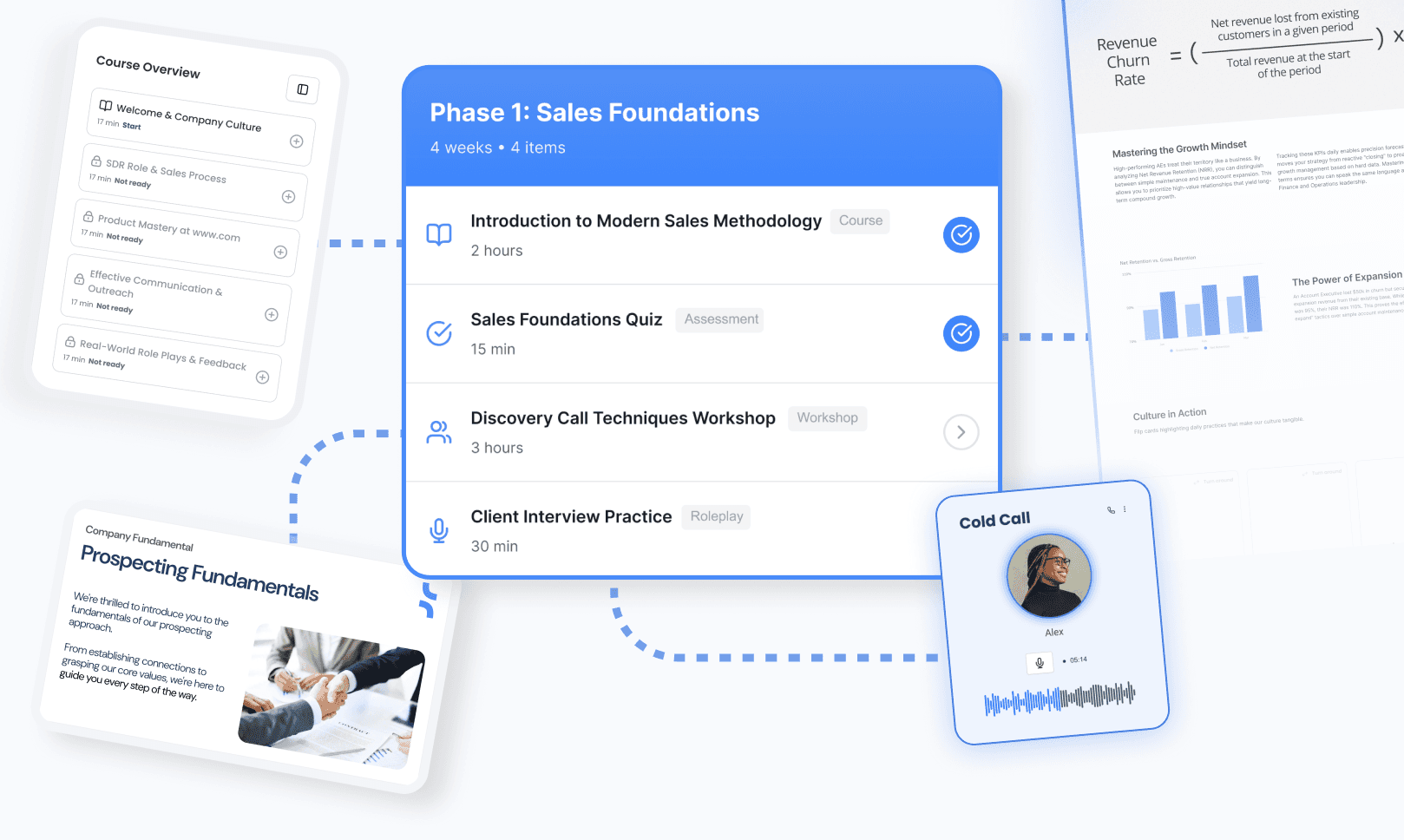
One area that is chronically underinvested in - is sales training and enablement. Deelan address this directly by turning your existing playbooks, call recordings, product documentation, and institutional knowledge into adaptive, role-specific training automatically. Instead of generic courses, reps get personalized learning paths tailored to their role (SDR, AE, CSM) and performance gaps.
Deelan also uses AI-powered roleplays and coaching simulations so reps can practice discovery, objection handling, demos, and negotiation before they ever get on a live call — helping managers scale coaching without repeating the same feedback loop week after week.
The 7-Step Playbook to Improve Sales Quota Attainment
Step 1: Set Better Quotas
The foundation of strong quota attainment starts before the quarter begins. If quotas are set arbitrarily, even high-performing reps will miss — and your attainment data becomes meaningless as a performance signal.
Best practices for quota setting:
• Use historical win rates, average deal size, and sales cycle length as inputs
• Account for rep ramp time — new hires should have lower initial quotas
• Segment by territory potential, not just company-wide revenue targets
• Aim for 60–80% of reps to hit quota — if fewer hit, quota is likely too high; if more hit, it may be too low
• Revisit quotas quarterly when market conditions shift significantly
Step 2: Break Quota Into Weekly and Daily Leading Indicators
Map quota backward to daily activity:
Lagging Metric | Leading Indicators to Track |
Monthly quota | Opportunities created, pipeline coverage ratio |
Pipeline health | # of discovery calls, demos booked, proposals sent |
Close rate | Objection frequency, stage conversion rates |
Deal velocity | Days per stage, response time, follow-up cadence |
Step 3: Improve Rep Onboarding and Ramp Time
One of the fastest ways to improve quota attainment across the team is to reduce the time it takes new reps to become productive. The average sales rep ramp time is 3–6 months — every week shaved off that number directly improves attainment.
What effective onboarding looks like:
• Structured 30/60/90 day milestones with clear benchmarks
• Role-specific training — SDRs, AEs, and CSMs need different knowledge
• Product mastery combined with messaging and ICP clarity
• Simulated discovery calls and objection-handling scenarios before going live
• Manager shadowing and call reviews in the first 30 days
AI-powered platforms like Deelan accelerate onboarding by automatically creating role-specific learning paths from existing company materials, and letting new reps practice with AI roleplays before their first real prospect call.

Step 4: Coach Based on Real Call Behavior, Not Assumptions
Most sales coaching happens based on gut feel, CRM data, or informal observation.
Better coaching frameworks:
• Review call recordings regularly — look for patterns, not one-off mistakes
• Use scorecards to evaluate discovery depth, objection handling, and next steps
• Coach to skill gaps, not just outcomes — a rep missing quota might need talk track help, not just more pipeline
• Personalize coaching by rep stage: ramp-stage reps need different support than seasoned performers
• Create accountability loops — set a specific behavior to work on, then review progress in 2 weeks
Deelan helps to identify skill gaps and generates targeted coaching recommendations based on actual rep performance in roleplays and live calls — helping managers scale coaching across a larger team without sacrificing quality.
Step 5: Create Repeatable Sales Processes and Talk Tracks
Top performers tend to have consistent habits. The goal of sales process design is to take what your best reps do instinctively and codify it for the rest of the team.
Key process elements to standardize:
• Discovery framework (e.g., MEDDIC, SPIN, BANT) — applied consistently
• Objection response library — written, practiced, and updated regularly
• Demo flow — tailored to persona and use case, not generic product walkthroughs
• Follow-up sequences — timing, channel, and messaging mapped out
• Proposal and pricing conversation guidance
Document these processes, make them easily accessible, and reinforce them through practice — not just one-time training. The difference between a playbook that collects dust and one that drives performance is whether reps have actually rehearsed it.
Step 6: Align Sales and Marketing Around Pipeline Quality
One of the most overlooked drivers of quota attainment is the quality of leads coming into the pipeline. When sales and marketing aren't aligned on ICP, messaging, or qualification criteria, reps waste time on leads that were never going to close.
Alignment checklist:
• Shared definition of a qualified lead (MQL vs. SQL vs. PQL)
• ICP alignment — who are you actually targeting, and why?
• Marketing content that maps to real sales objections
• Regular feedback loop between sales and marketing — what's converting, what's not?
• SLA on lead response time and follow-up cadence
When sales and marketing operate from the same playbook, pipeline quality improves — and reps spend more time closing deals that actually fit.
Step 7: Track Quota Attainment Continuously
You can't manage what you don't measure — and quota attainment shouldn't be a surprise at the end of a quarter.
Metrics to track continuously:
• Individual rep quota attainment (current quarter vs. target)
• % of reps at or above quota (team-level health)
• Attainment trend over time (improving, declining, or flat)
• Attainment by segment, tenure, or territory
• Pipeline coverage relative to remaining quota

The Different Types of Sales Quotas
Choosing the right quota type for your team depends on your business model, sales cycle, and what behaviors you want to reinforce.
Quota Type | What It Measures | Best For |
Revenue quota | Total revenue closed in a period | Most sales teams — clean and outcome-focused |
Activity quota | Calls, emails, demos, meetings booked | SDR teams or early-stage ramp where activity is the goal |
Volume quota | Number of deals or units sold | High-velocity, transactional sales motions |
Profit quota | Gross margin generated, not just revenue | Teams that discount heavily or sell multi-product bundles |
Forecast quota | Expected pipeline that will close | RevOps and managers focused on forecasting accuracy |
Combination quota | Mix of activity, pipeline, and revenue metrics | Teams needing balanced incentives across the funnel |
How Companies Set Sales Quotas: Top-Down vs. Bottom-Up
Top-Down Quota Setting
In the top-down model, company revenue goals are handed down from leadership and divided among teams and individual reps. This approach is fast and directly tied to business targets — but it often produces quotas that feel disconnected from market reality.
Common issues with top-down quota setting:
• Quotas are based on what the company needs, not what the market can support
• Territory differences are often ignored
• Rep ramp time and tenure aren't factored in
• Result: lower morale, higher attrition, and worse attainment
Bottom-Up Quota Setting
The bottom-up approach builds quotas from actual data: historical rep performance, territory potential, sales cycle length, win rates, and product factors. It takes more work, but consistently produces better outcomes.
Inputs for a bottom-up quota model:
• Historical quota attainment by rep and territory
• Average deal size and win rate by segment
• Sales cycle length and seasonal conversion patterns
• Market TAM and territory coverage
• Rep tenure and expected ramp progression
The best quota-setting processes blend both: start with company targets from the top, then pressure-test them against bottom-up reality and adjust to close the gap. Where you can't close the gap with attainment alone, you address it with headcount, marketing, or product changes.
What Is a Good Quota Attainment Rate? Benchmarks by Industry
A healthy sales organization typically aims for 60–80% of reps to hit or exceed quota in a given period. Rates significantly below 60% suggest systemic problems with quota design, pipeline, or enablement. Rates consistently above 80% may indicate quotas are set too conservatively.
Industry-level benchmarks vary based on product complexity, sales cycle, and buyer behavior:
Industry / Segment | Avg. % of Reps Hitting Quota | Notes |
SaaS (SMB) | 55–70% | Higher velocity, shorter cycles; strong onboarding impact |
SaaS (Enterprise) | 45–65% | Longer cycles, higher ACV — attainment takes longer to build |
Financial services | 50–65% | Highly regulated; relationship-driven sales cycles |
Manufacturing | 60–75% | Established buyers, repeat business supports attainment |
Healthcare | 50–65% | Long procurement cycles, compliance complexity |
Staffing / Recruiting | 55–70% | Activity-intensive; consistent prospecting drives results |
Media / AdTech | 55–68% | Budget seasonality heavily influences attainment rates |
Common Mistakes That Hurt Quota Attainment
Many quota attainment problems are self-inflicted. Here are the most common mistakes sales organizations make — and how to avoid them:
1. Setting quotas too high without data to support them — this is the fastest way to demoralize a team
2. Using only top-down planning that ignores territory potential, rep tenure, and market realities
3. Ignoring ramp time — holding new hires to the same quota as tenured reps sets everyone up to fail
4. Poor onboarding — when reps don't know the product, the ICP, or the process, they can't close
5. Inconsistent coaching — managers who only engage when deals are at risk can't change behaviors before they matter
6. Focusing only on activity instead of outcomes — call volume doesn't close deals; quality conversations do
7. Weak sales-marketing alignment — misqualified pipeline wastes rep time and inflates cycle length
8. Not updating quotas when market conditions, territories, or product positioning changes significantly
9. Measuring training course completion instead of real behavior change
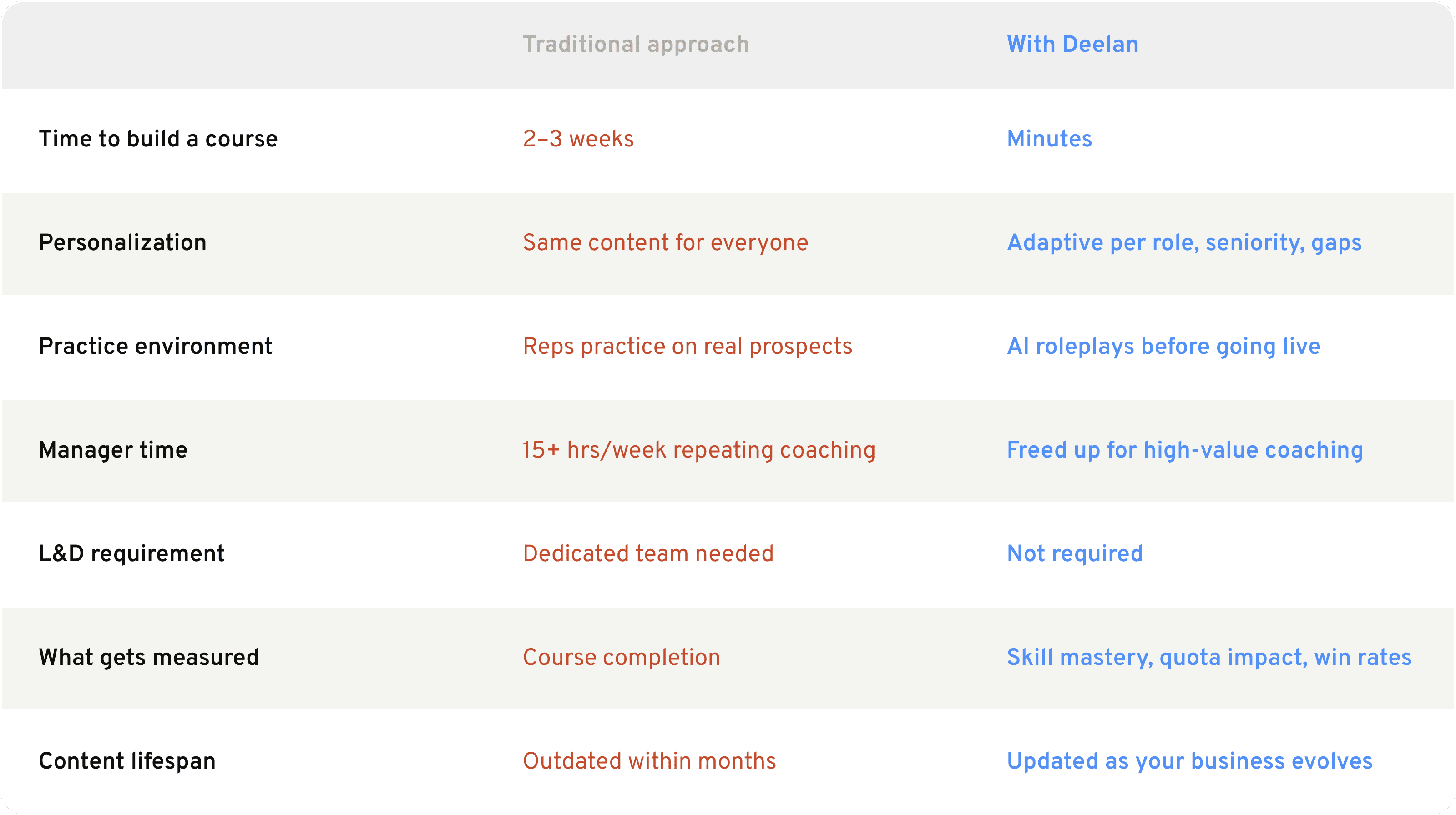
Deelan helps revenue teams go beyond course completion by measuring what actually matters:
• Skill mastery — do reps understand the concept and can they apply it?
• Practice performance — how do reps perform in AI roleplay simulations?
• Coaching impact — is manager feedback changing rep behavior over time?
• Connection to quota attainment — is training actually moving the needle on revenue outcomes?

Build Systems That Help Reps Win Consistently
The best build systems that make winning repeatable.
That means setting quotas that are ambitious but grounded in reality. It means onboarding new reps faster and coaching existing ones smarter. It means aligning sales and marketing so reps spend time on leads that actually fit. And it means measuring what's actually happening in deals — not just what's logged in a CRM.
Sales quota attainment is ultimately a reflection of how well your entire go-to-market engine is operating. When you fix the inputs — quota design, enablement, coaching, pipeline quality — the outputs take care of themselves.
The teams that win long-term are the ones that treat quota attainment not as a goal, but as a signal — and build systems that continuously improve what that signal is telling them.
Ready to Improve Sales Quota Attainment Across Your Team?
Deelan helps revenue teams build the skills, systems, and consistency that drive quota attainment — not just training completion.
Book a free demo to see how Deelan can help your revenue team improve sales quota attainment.
FAQ: Sales Quota Attainment
What is sales quota attainment?
Sales quota attainment is the percentage of a sales target that a rep, team, or organization achieves within a given period. It's calculated by dividing actual sales by the assigned quota and multiplying by 100. It's one of the most widely used metrics for evaluating sales performance.
What is a good quota attainment rate?
A healthy benchmark is 60–80% of reps hitting or exceeding quota in any given period. If fewer than 60% of reps are hitting quota consistently, it typically signals a structural problem — whether that's quota design, pipeline quality, coaching, or onboarding. If more than 80–85% are consistently hitting quota, quotas may be set too conservatively.
Why do sales reps miss quota?
The most common reasons include: quota set too high without data to support it, poor pipeline quality from misaligned marketing, insufficient onboarding or product knowledge, inconsistent sales process, lack of effective coaching, low lead quality or poor territory assignment, and long ramp time without proper enablement. Missing quota is rarely just about effort — it's usually a systems problem.
How can managers improve quota attainment?
The highest-leverage actions managers can take include: setting realistic, data-driven quotas; coaching consistently based on call behavior and skill gaps (not just deal status); onboarding new reps faster with structured programs; tracking leading indicators weekly rather than waiting for end-of-quarter results; and aligning closely with marketing on pipeline quality and ICP. Managers who coach the same rep behaviors they'd coach in week one of ramp — consistently, and over time — drive meaningfully better attainment.
What types of sales quotas are most common?
The most common quota types are revenue quotas (closed-won ARR or revenue), activity quotas (calls, demos, emails), volume quotas (number of deals), profit quotas (gross margin), and combination quotas that blend multiple metrics. Most B2B sales teams use revenue quotas as the primary measure, with activity quotas layered in for SDRs or ramp-stage reps.
How does onboarding affect quota attainment?
Significantly. Reps who ramp faster reach full productivity sooner, which means they start contributing to attainment earlier. Every week shaved off average ramp time improves team-level attainment rates. Structured onboarding — with clear milestones, role-specific training, and practice before live calls — is one of the highest-ROI investments a sales leader can make.