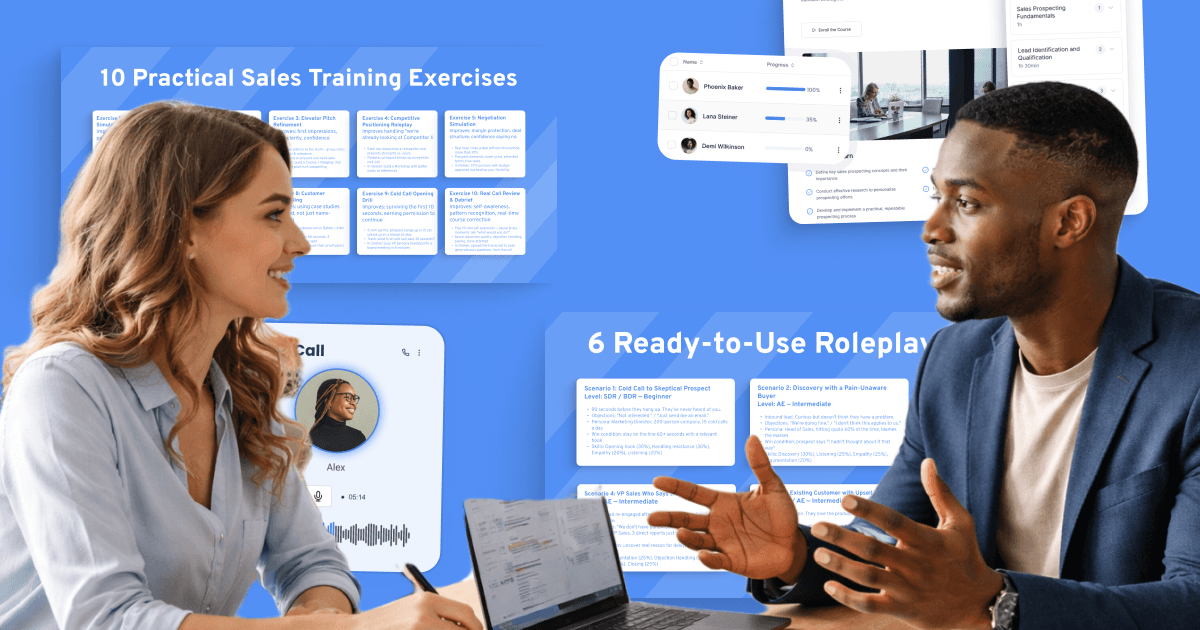
The real test of sales training is never the session itself. It is what happens later: in the first cold call, in a difficult discovery conversation, in a pricing objection, or in a deal that starts to stall. If training does not show up in those moments, it has not done its job. This toolkit, created in partnership with Rosa Yupari and Deelan AI, is designed to help revenue teams build training that is not only engaging in the moment, but genuinely useful in the field.
This guide gives you everything: exercises you can run this week, roleplay scenarios you can build in an afternoon, and programme templates you can adapt to your team's reality — whether you're a team of 5 or scaling to 50.
What Makes Sales Training Actually Stick
Most training fails because it's a one-time event. A rep sits through a session, nods, and then reverts to old habits the moment they're on a live call.
The best training embeds into the day-to-day rhythm of how reps work. Here's the framework Rosa applies with every revenue team:
The 7 Principles of Sticky Sales Training
Principle | Why It Matters | Manual Approach | How Deelan Helps |
Repetition | Skills decay without practice. A rep who role-plays once forgets 70% within a week. | Weekly team drills, repeated objection handling sessions | Assign recurring roleplays; AI re-runs scenarios until reps hit a target score |
Relevance | Generic training gets ignored. Reps need to see their exact deals, their exact objections. | Use real call recordings; reference live pipeline | Upload call recordings, messaging docs, or your own playbook — training is generated from your content |
Realism | A scenario that doesn't feel real builds false confidence. | Role-play with managers who play realistic personas | AI personas with configurable personality (difficult, skeptical, warm) and role (CFO, VP Sales, IT buyer) |
Retrieval Practice | Testing memory strengthens it more than re-reading does. | Quizzes, flashcards, debrief questions after sessions | Auto-generated assessments that extract knowledge from any training content |
Feedback | Reps improve when they understand why they lost points, not just that they did. | Manager reviews calls and gives written notes | AI scores roleplay on 5 skills with specific feedback per criterion after every session |
Manager Reinforcement | Training sticks when managers reference it in 1:1s and coaching sessions. | Shared debrief questions, coaching frameworks | Analytics show managers which reps need coaching and which specific skills are lagging |
Progression Over Time | Skills build on each other. A rep can't close well if they can't discover well first. | Structured onboarding tracks, curated reading paths | Adaptive learning paths that unlock the next module only when prerequisites are mastered |
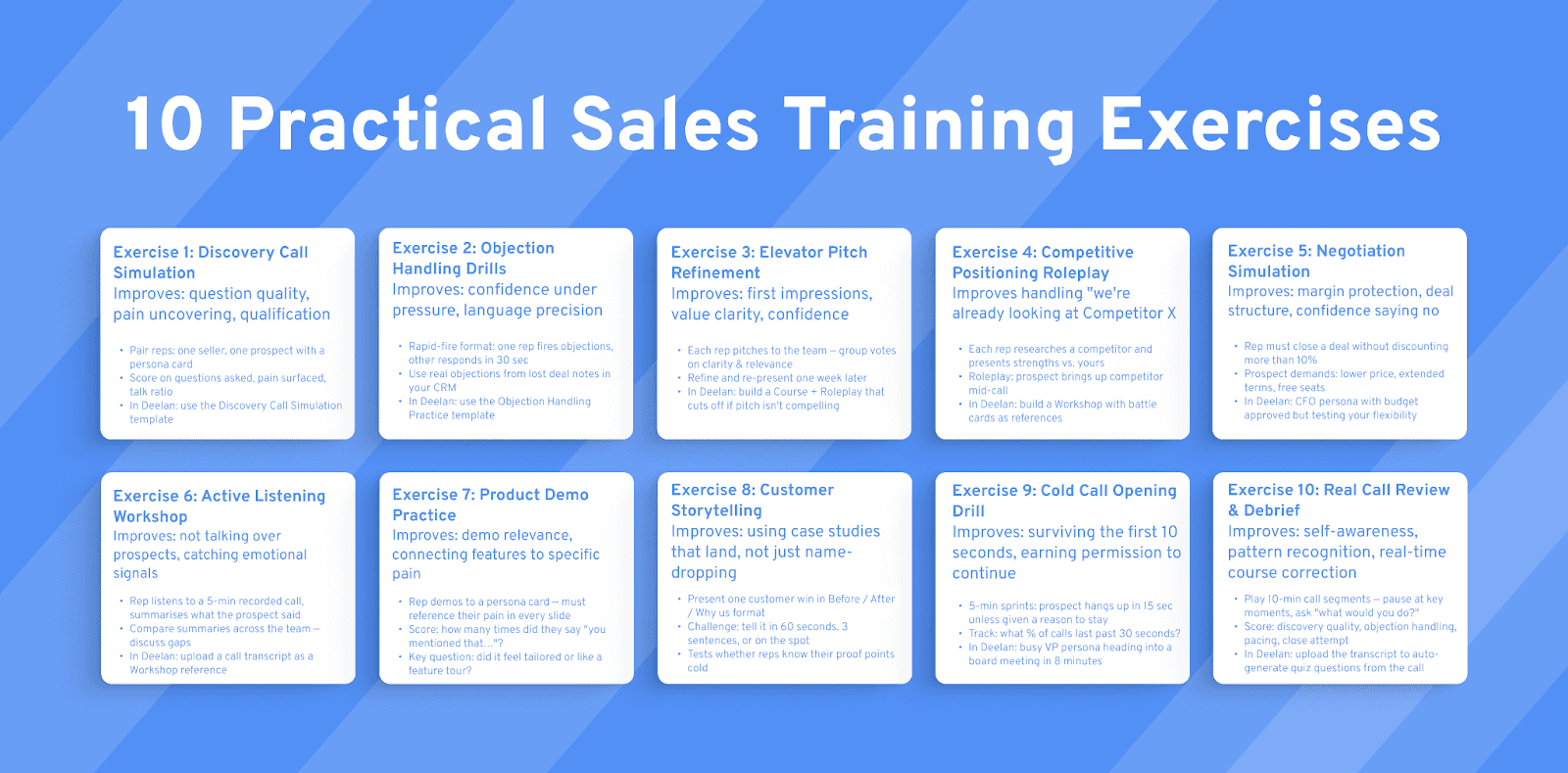
10 Practical Sales Training Exercises
Each exercise below includes what it improves, how to run it manually, debrief questions, and how to build it in Deelan.
Exercise 1: Discovery Call Simulation
What it improves: Asking great questions, uncovering real pain, qualifying prospects without sounding scripted.
How to run it manually:
Pair reps: one plays the prospect (with a prepared persona card), one plays the seller.
The seller has 15 minutes to run a discovery call from cold open to qualification.
Observers score on: quality of questions asked, pain points surfaced, whether the rep talked more than 40% of the time.
Debrief as a group.
Variations:
Run with a pain-aware buyer vs. a pain-unaware buyer.
Add a twist: the "prospect" has a competing vendor in the running.
Timer constraint: can you qualify in under 12 minutes?
Debrief questions:
Did the rep understand the prospect's business problem, not just their product problem?
What question opened the prospect up most?
Where did the rep push too fast toward a pitch?
How to build it in Deelan:
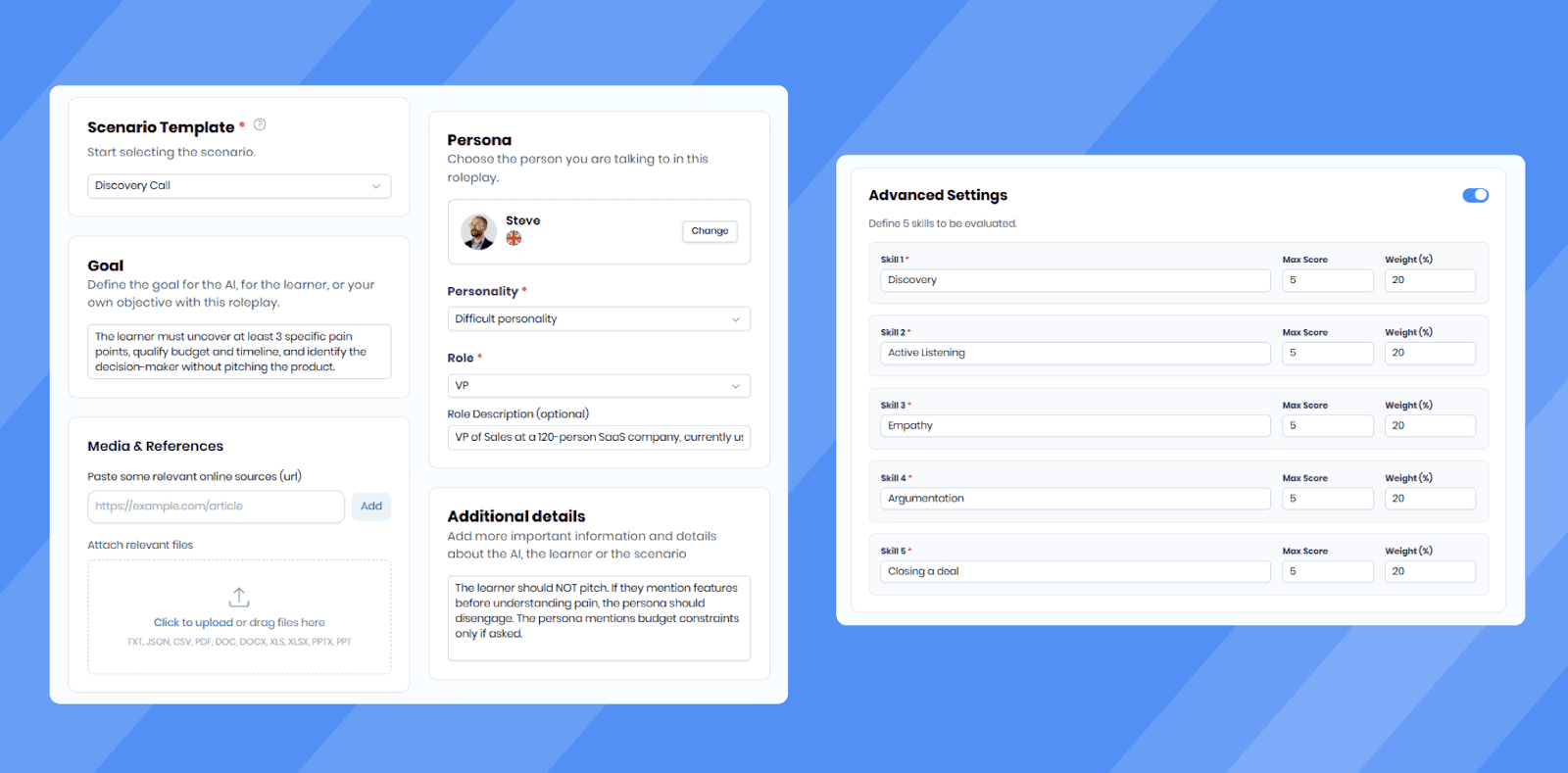
Use the Roleplay builder with the Discovery Call Simulation template (already available in Deelan's sales template library).
Sample setup:
Exercise 2: Objection Handling Drills
What it improves: Confidence under pressure, language precision, not caving on price or timeline.
How to run it manually:
List your team's top 10 most common objections.
Pair reps and run a rapid-fire format: one person fires objections, the other must respond in 30 seconds.
Rotate every 5 minutes.
Record and review the best responses as a team.
Variations:
Advance version: the prospect responds to the rep's answer with a follow-up challenge.
Use real objections pulled from lost deal notes in your CRM.
Debrief questions:
Did the rep acknowledge the objection before countering it?
Did they quantify the value they were defending?
Did they close the loop after handling the objection?
How to build it in Deelan:
Use the Objection Handling Practice template.
Sample additional details text to paste into Deelan:
"You are a procurement director at a 300-person tech company. You have seen three other vendors this quarter. You believe the product is too expensive and want a 30% discount. If the learner cannot justify the price with specific ROI data, escalate your resistance. If they acknowledge your concern and offer a business case, soften slightly but don't agree immediately. Do not close the deal in this session — end on 'I'll need to think about it.'"
Skills to score: Objection Handling (30%), Argumentation (30%), Empathy (20%), Active Listening (20%).
Exercise 3: Elevator Pitch Refinement
What it improves: First impressions, clarity under time pressure, confidence communicating value in 30 seconds.
How to run it manually:
Each rep writes a 30-second pitch for your product.
Present to the team. Time with a stopwatch.
Group votes on: clarity, credibility, relevance.
Each rep refines and presents again one week later.
Variations:
Run in a cold call opener format (you have 10 seconds before they hang up).
Industry-specific pitches: fintech vs. HR tech vs. logistics.
Persona-specific: pitch to a CFO vs. a VP Engineering.
Debrief questions:
Did the rep lead with value or with features?
Could a non-expert understand it in one listen?
Was there a clear reason to keep talking?
How to build it in Deelan:
Create a Course with this briefing:
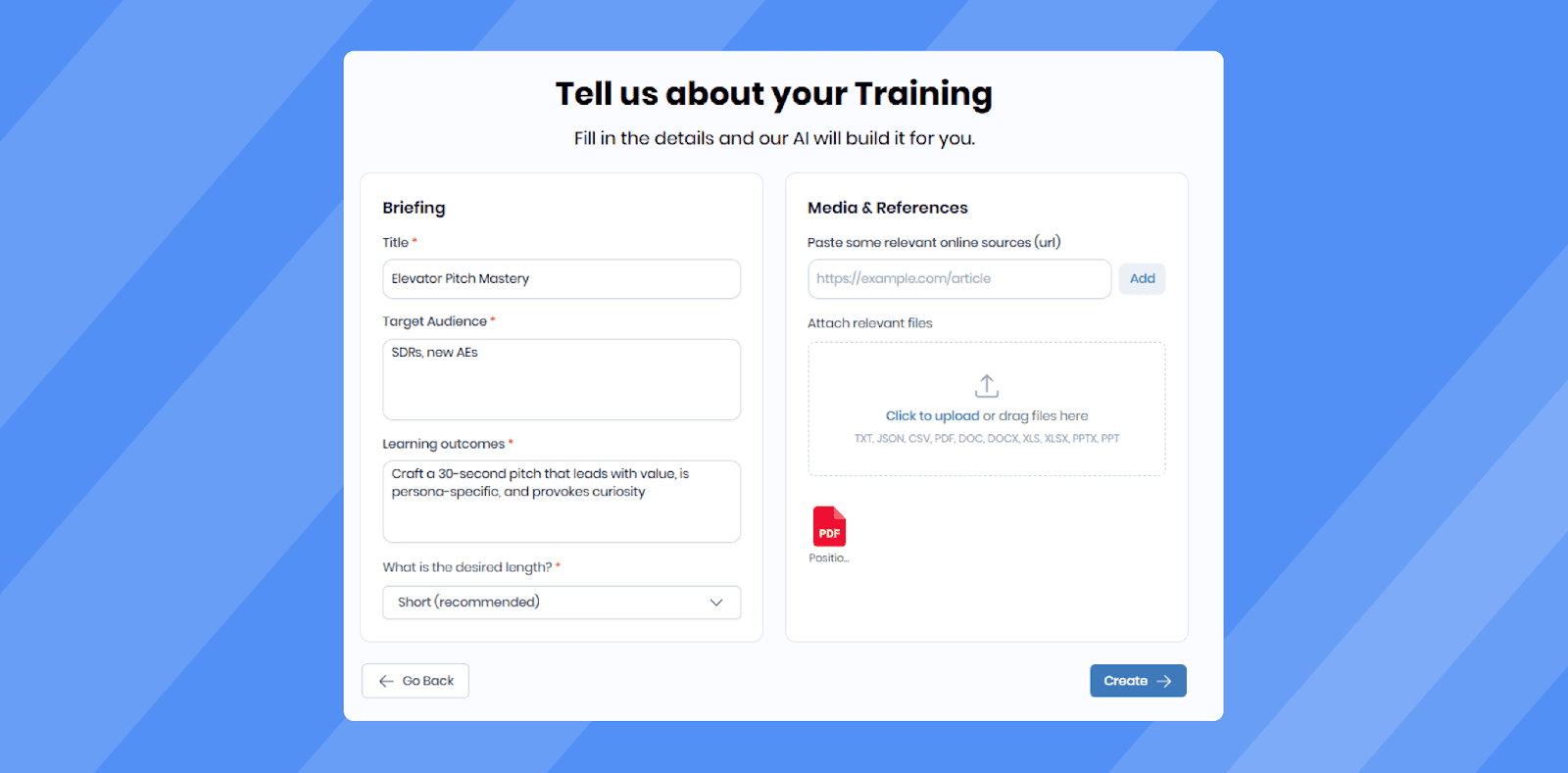
Then pair it with a Roleplay where the AI interrupts after 10 seconds if the pitch isn't compelling.
Exercise 4: Objection Roleplay — Competitive Positioning
What it improves: Handling the "we're already looking at [Competitor X]" moment confidently.
How to run it manually:
Assign each rep a competitor to research (1 hour of desk research).
Each rep presents: what the competitor does well, where your product wins, and one killer differentiator question.
Roleplay: the prospect brings up the competitor mid-discovery call.
Variations:
The rep can only respond with questions, never direct comparisons.
The prospect has already signed a contract with the competitor — how do you plant seeds for renewal?
Debrief questions:
Did the rep make the competitor sound weaker, or did they elevate the conversation?
What question reframed the evaluation criteria?
Did the rep stay customer-focused rather than product-focused?
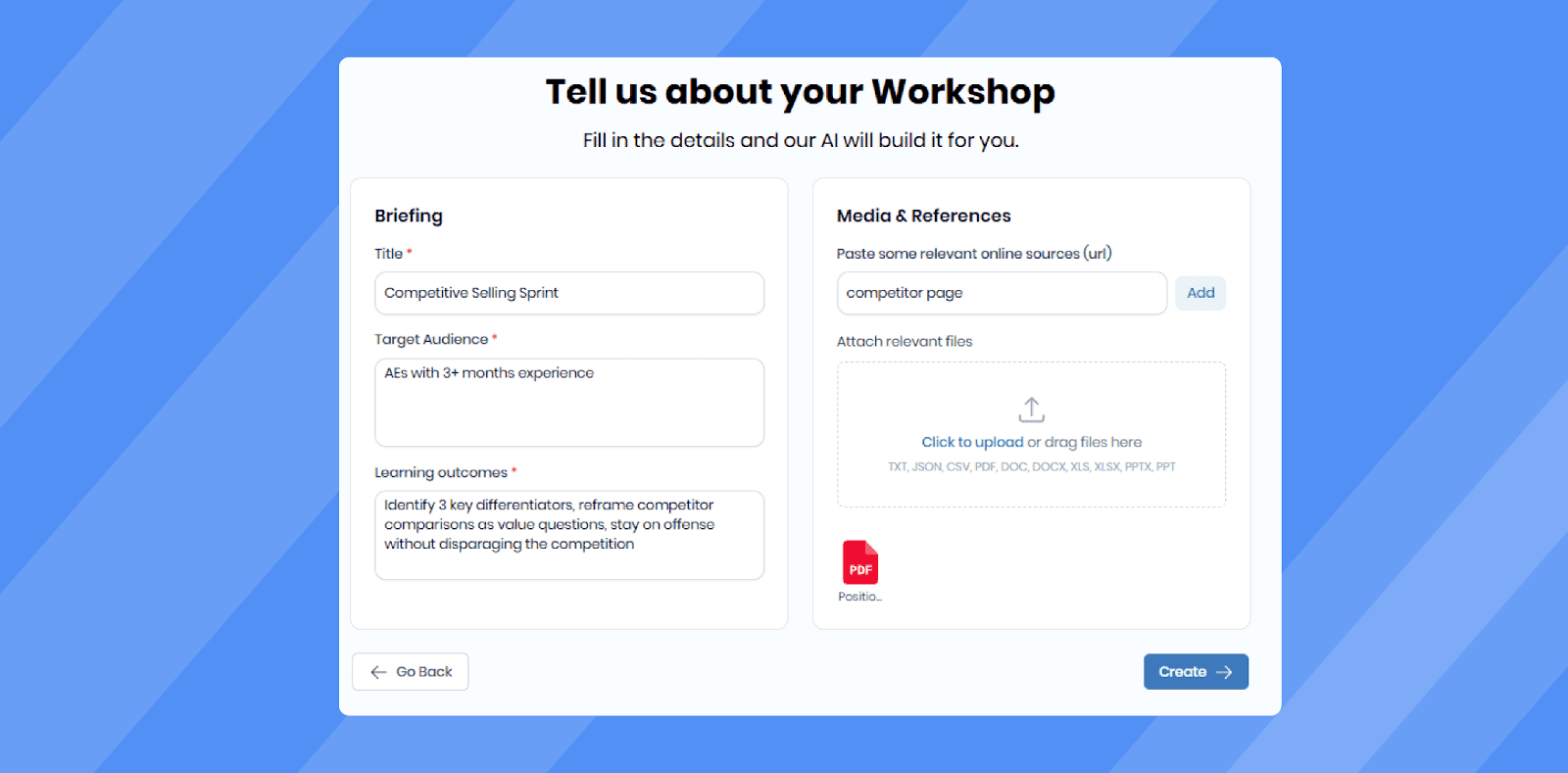
How to build it in Deelan:
Build a Workshop with this briefing:
Exercise 5: Negotiation Simulation
What it improves: Margin protection, deal structure creativity, confidence saying no.
How to run it manually:
Create a deal scenario (annual contract, multi-seat, known budget constraint).
The rep must get to a signed deal without discounting more than 10%.
Give the "prospect" a list of demands: extend payment terms, add free seats, reduce onboarding cost.
Score on: final margin, concessions made, speed to close.
Debrief questions:
What did the rep give away first? Why?
What concession did the rep get in return for every concession they gave?
Did they reframe cost as investment at any point?
How to build it in Deelan:
Roleplay additional details: "You are a CFO at a 500-person company. You want a 25% discount and 90-day payment terms. You have budget approved but are testing the vendor's flexibility. If the rep offers a discount without getting anything in return, push harder. If they offer a multi-year deal instead of a discount, consider it. You will not sign a one-year deal today."
Exercise 6: Active Listening Workshop
What it improves: Not talking over prospects, catching emotional signals, summarising accurately.
How to run it manually:
One rep shares a 3-minute personal story about a challenge at work.
The listener must repeat back 5 specific details without notes.
In the sales version: play a 5-minute recorded sales call (with permission). Reps summarise what the prospect said — not what the rep said.
Compare summaries. Discuss gaps.
Debrief questions:
What did you actually hear vs. what did you assume?
What emotion was behind the prospect's stated concern?
What would you have asked next?
How to build it in Deelan:
Create a Workshop:
Field | What to enter |
Title | Active Listening in Sales |
Target audience | All revenue roles |
Learning outcomes | Summarise prospect concerns accurately; identify emotional signals; ask follow-up questions that deepen understanding |
References | Upload a recorded discovery call transcript |
Exercise 7: Product Demo Practice
What it improves: Relevance of demos, connecting features to specific pain, avoiding the "feature tour."
How to run it manually:
Give reps a persona card (role, pain, one key goal).
They have 20 minutes to run a demo that references the persona's pain in every slide.
Observers rate: how many times did the rep say "you mentioned that..." or "based on what you told me..."
Debrief questions:
Did the rep demo what the prospect cares about, or everything the product does?
Did the demo feel tailored or generic?
Was there a clear next step proposed at the end?
Exercise 8: Customer Storytelling
What it improves: Using case studies effectively, making social proof feel relevant, not just name-dropping.
How to run it manually:
Each rep picks one customer success story.
They present it in the "Before / After / Why us" format: what was the customer's situation before, what changed, and what specifically about your product drove the result.
Group challenge: can they tell the story in 60 seconds? In 3 sentences? In response to "give me an example"?
Exercise 9: Cold Call Opening Drill
What it improves: Surviving the first 10 seconds of a cold call, getting permission to continue.
How to run it manually:
Run 5-minute cold call sprints: one rep calls another's desk.
The "prospect" must hang up in 15 seconds unless given a reason to stay.
Track: what percentage of calls last past 30 seconds?
How to build it in Deelan:
Roleplay additional details: "You are a busy VP of Revenue who just picked up a random number thinking it was a colleague. You are about to go into a board meeting in 8 minutes. You will hang up after 15 seconds unless the rep gives you a very specific, relevant reason to stay. Do not be rude — just genuinely busy."
Exercise 10: Real Call Review and Debrief
What it improves: Self-awareness, pattern recognition, the ability to course-correct in real time.
How to run it manually:
Select a recorded call (from Gong, Otter, or any recorder) — with rep's permission.
Play 10-minute segments to the team.
Pause at key moments. Ask: what would you have done here?
Score: discovery quality, objection handling, pacing, close attempt.
How to build it in Deelan:
Upload the call recording or transcript as a reference when creating a Course or Assessment. Deelan will extract key moments and generate quiz questions or reflection exercises based on the actual content.
Roleplay Toolkit — Frameworks and Ready-to-Use Scenarios
The Roleplay Design Framework
Most roleplays fail because they're vague. "Practice a sales call" tells a rep nothing. Great roleplay design has five components:
Element | Best Practice | Example |
Scenario | Specific moment in the sales cycle, not the whole cycle | "End of quarter pricing conversation with a stakeholder who wasn't in the discovery call" |
Learner goal | What specific skill or outcome the rep must demonstrate | "Defend the price without discounting more than 10% and schedule a next step" |
Persona | Role, personality, and emotional state — not just job title | "VP Finance, skeptical, under budget pressure, hasn't seen a demo yet" |
Objections | 2–3 specific challenges the persona will raise | "Too expensive. We already have something for this. Now isn't a good time." |
Scoring criteria | 5 skills with defined weighting | Objection Handling 30%, Argumentation 25%, Empathy 20%, Closing 15%, Active Listening 10% |
6 Ready-to-Use Roleplay Scenarios
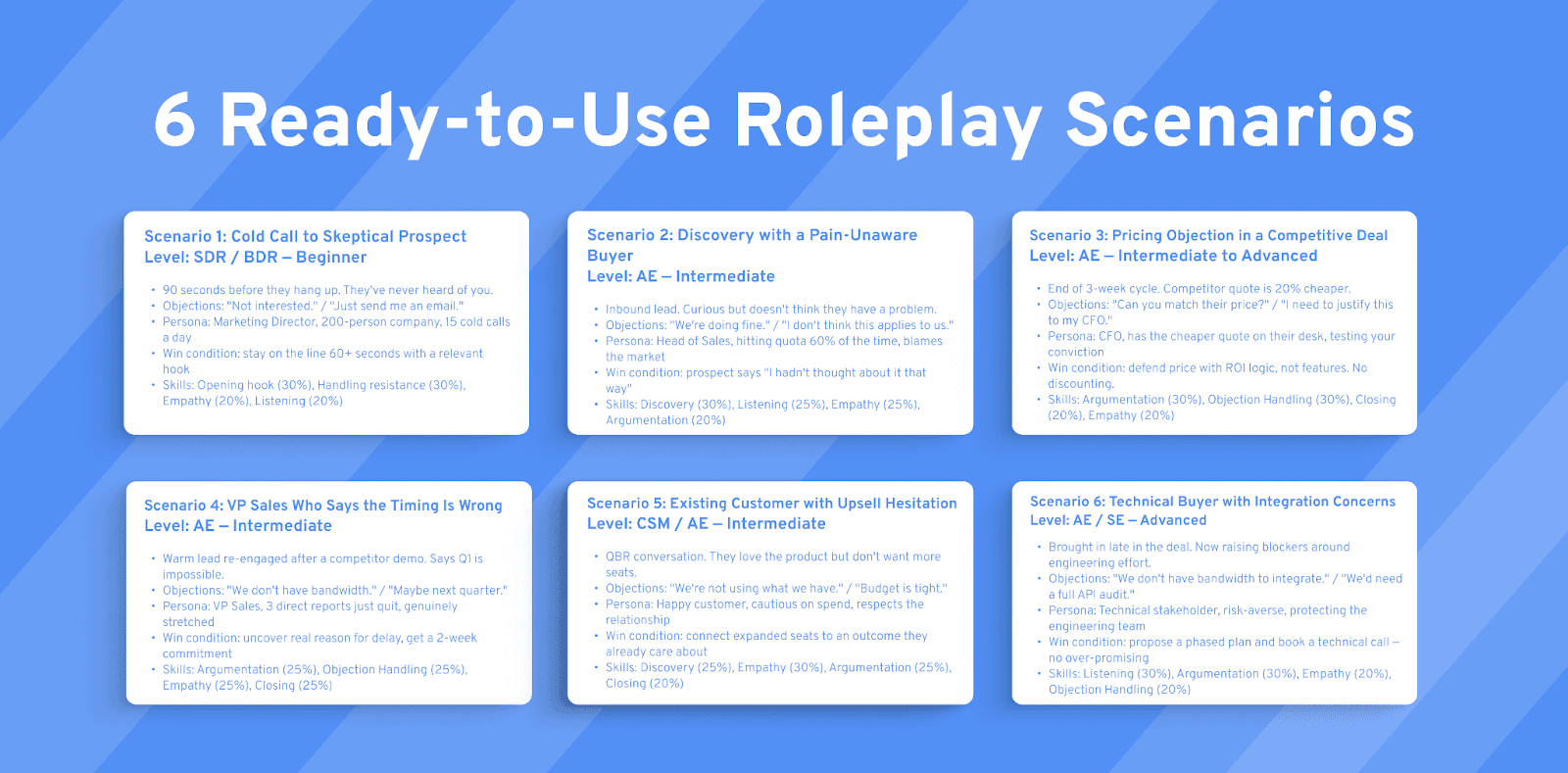
Scenario 1: Cold Call to Skeptical SDR-Level Prospect
Element | Details |
Objective | Book a meeting with a prospect who didn't ask for the call |
Learner level | SDR, BDR — beginner to intermediate |
Scenario | The rep has 90 seconds before the prospect hangs up. The prospect has never heard of the company. |
Likely objections | "I'm not interested." / "Just send me an email." / "We already have a solution for that." |
Skills to score | Opening hook (30%), Handling resistance (30%), Empathy (20%), Active Listening (20%) |
AI persona setup | Personality: Difficult. Role: Marketing Director. Role description: Marketing director at a 200-person B2B company, gets 15 cold calls a day, is politely dismissive by default. |
Goal field | The learner must keep the prospect on the line for at least 60 seconds by delivering a relevant value statement and asking a question that provokes curiosity. |
Additional details | Do not agree to a meeting in the first 45 seconds no matter what. If the rep uses a generic pitch, stay disengaged. If they mention a specific business pain relevant to marketing directors (pipeline visibility, content ROI, attribution), show brief interest and ask a follow-up. |
Scenario 2: Discovery Call with a Pain-Unaware Buyer
Element | Details |
Objective | Help the prospect articulate a problem they haven't framed as a problem yet |
Learner level | AE — intermediate |
Scenario | Inbound lead from a webinar signup. The prospect is curious but doesn't think they have an urgent problem. |
Likely objections | "We're doing fine, really." / "I just wanted to see what you do." / "I don't think this applies to us." |
Skills to score | Discovery (30%), Active Listening (25%), Empathy (25%), Argumentation (20%) |
AI persona setup | Personality: Neutral. Role: Head of Sales. Role description: Head of sales at a 60-person software company. Team is hitting quota about 60% of the time. Doesn't see training as the root cause. Blames market conditions. |
Goal field | The learner must help the prospect connect their quota shortfall to a specific skill or process gap — without pitching the product. Success = the prospect says something like "I hadn't thought about it that way." |
Additional details | Do not volunteer problems. If asked directly, you'll mention the quota issue but frame it as a market problem. Only if the rep asks a second-level probing question (asking about what would happen if the problem continues, or what they've tried already) should you open up. |
Scenario 3: Pricing Objection in a Competitive Deal
Element | Details |
Objective | Defend the price, avoid discounting, reframe value |
Learner level | AE — intermediate to advanced |
Scenario | End of a 3-week sales cycle. The prospect has a competing quote that's 20% cheaper. |
Likely objections | "Your competitor is significantly cheaper." / "Can you match their price?" / "I need to justify this to my CFO." |
Skills to score | Argumentation (30%), Objection Handling (30%), Closing a deal (20%), Empathy (20%) |
AI persona setup | Personality: Difficult. Role: C-level. Role description: CFO at a 300-person SaaS company. Has a competing quote on the desk. Is genuinely considering the cheaper option. Will test whether the rep can justify the premium. |
Goal field | The learner must defend the price using ROI-based arguments (not feature lists), get the prospect to acknowledge at least one risk of going with the cheaper option, and propose a next step. |
Additional details | You have a quote that is 20% cheaper. You will reveal this only if the rep asks about competition. If the rep immediately offers a discount, become more skeptical — a vendor who discounts immediately signals desperation. If they hold the price and build a business case, soften your position. Do not agree to buy in this session. |
Scenario 4: Busy VP Sales Who Thinks the Timing Is Wrong
Element | Details |
Objective | Move the deal forward despite a "not now" timeline objection |
Learner level | AE — intermediate |
Scenario | A warm lead from 3 months ago has re-engaged after a competitor demo. They're interested but say Q1 is impossible. |
Likely objections | "We just don't have bandwidth right now." / "Maybe next quarter." / "I need to get through our planning cycle first." |
Skills to score | Argumentation (25%), Objection Handling (25%), Empathy (25%), Closing a deal (25%) |
Goal field | The learner must uncover the real reason for the timing objection, quantify the cost of waiting, and get a specific commitment to a next step within the next 2 weeks. |
Additional details | You are genuinely busy — 3 direct reports just quit. The timing objection is real but also a little bit of avoidance. If the rep empathises and then asks what would need to be true to move forward, you'll open up. If they push without acknowledging your situation, get defensive. |
Scenario 5: Existing Customer with Upsell Hesitation
Element | Details |
Objective | Expand an account without damaging the relationship |
Learner level | CSM, AE — intermediate |
Scenario | QBR conversation with a customer who loves the product but isn't sure they need the additional seats being proposed. |
Likely objections | "We're not using all our current seats." / "Budget is tight right now." / "Can we revisit in 6 months?" |
Skills to score | Discovery (25%), Empathy (30%), Argumentation (25%), Closing a deal (20%) |
Goal field | The learner must identify why existing seats are underutilised, propose a solution to that problem, and connect the expanded seats to a business outcome the customer has already said they care about. |
Scenario 6: Technical Buyer with Integration Concerns
Element | Details |
Objective | Unblock a deal stalled at technical evaluation |
Learner level | AE, SE — advanced |
Scenario | A technical stakeholder was brought in late in the sales cycle and is now raising integration blockers. |
Likely objections | "We don't have engineering bandwidth to integrate this." / "We'd need a full API audit." / "What happens if your system goes down?" |
Skills to score | Active Listening (30%), Argumentation (30%), Empathy (20%), Objection Handling (20%) |
Goal field | The learner must validate the technical concerns without dismissing them, propose a phased integration plan, and get agreement on a technical call with a solutions engineer. Do not promise anything not in the product roadmap. |
Deelan Roleplay Prompts
These are ready to paste into Deelan's roleplay builder fields.
Prompt Set A: SDR Cold Call (Beginner)
Goal:
The learner must open the call with a value-led statement relevant to the prospect's role, survive the first objection without caving, and ask a question that earns 30 more seconds of conversation. Success is not booking a meeting — it's staying on the call for 90 seconds with a clear reason to follow up.
Role description:
Director of Revenue Operations at a 150-person B2B SaaS company. Gets 10+ cold calls per day. Politely dismissive by default. Will engage for 30 extra seconds if given a very specific, relevant reason.
Additional details:
Do not agree to a meeting unless the rep (a) mentions a specific problem relevant to RevOps (pipeline accuracy, tool sprawl, rep ramp time), and (b) asks a question that references their company's situation. If the opening is generic ("I'd love to tell you about…"), say "Not interested, please remove me from your list" and end. If the rep uses a hook specific to their company stage or role, give them 60 more seconds. Simulate a natural human response — hesitate, interrupt if needed, express mild surprise if something lands well.
Prompt Set B: AE Discovery Call (Intermediate)
Goal:
The learner must run a 20-minute discovery call that surfaces at least 3 specific business pains (not product requirements), confirms the prospect has budget authority or knows who does, and earns a commitment to a next step. The rep should not pitch the product. If they mention features before minute 15, reduce the score.
Role description:
VP of Sales at a 200-person Series B SaaS company. Team of 22 AEs and 8 SDRs. Ramp time is 5 months and leadership wants it at 3. Open to having the conversation but not sold on whether training is the lever. Prefers directness. Doesn't like fluffy consultants.
Additional details:
Answer questions directly but don't volunteer information. If the rep asks surface-level questions ("What are your biggest challenges?"), give a surface-level answer. If they ask second-level probes ("What have you tried already, and what happened?"), open up more. Mention you've looked at a competitor product only if asked. Your biggest unspoken concern: you don't want another tool your team won't use. Surface this concern only if the rep asks about adoption or past training experiences.
Prompt Set C: Objection Handling Sprint (Advanced)
Goal:
The learner must handle five consecutive objections without caving on price, timeline, or product scope. Each response must (a) acknowledge the concern, (b) reframe it, (c) support it with evidence or logic, and (d) redirect to a next step. The session ends after the fifth objection regardless of outcome.
Role description:
CFO at a 500-person company. Has been burned by SaaS tools that didn't deliver ROI. Has a board meeting in 3 weeks where spend is being scrutinised. Will push back on every claim.
Additional details:
Objection sequence: (1) "This is too expensive." (2) "We tried something similar two years ago and it didn't work." (3) "I'd need to see data on ROI before I can consider this." (4) "Our sales team is already busy — I don't want to add another thing." (5) "We'd need sign-off from Legal before anything moves forward." Fire each objection regardless of how well the previous one was handled. Do not agree or disagree at the end — simply say "I'll need to review this internally" and close the session.
Programme Design Templates
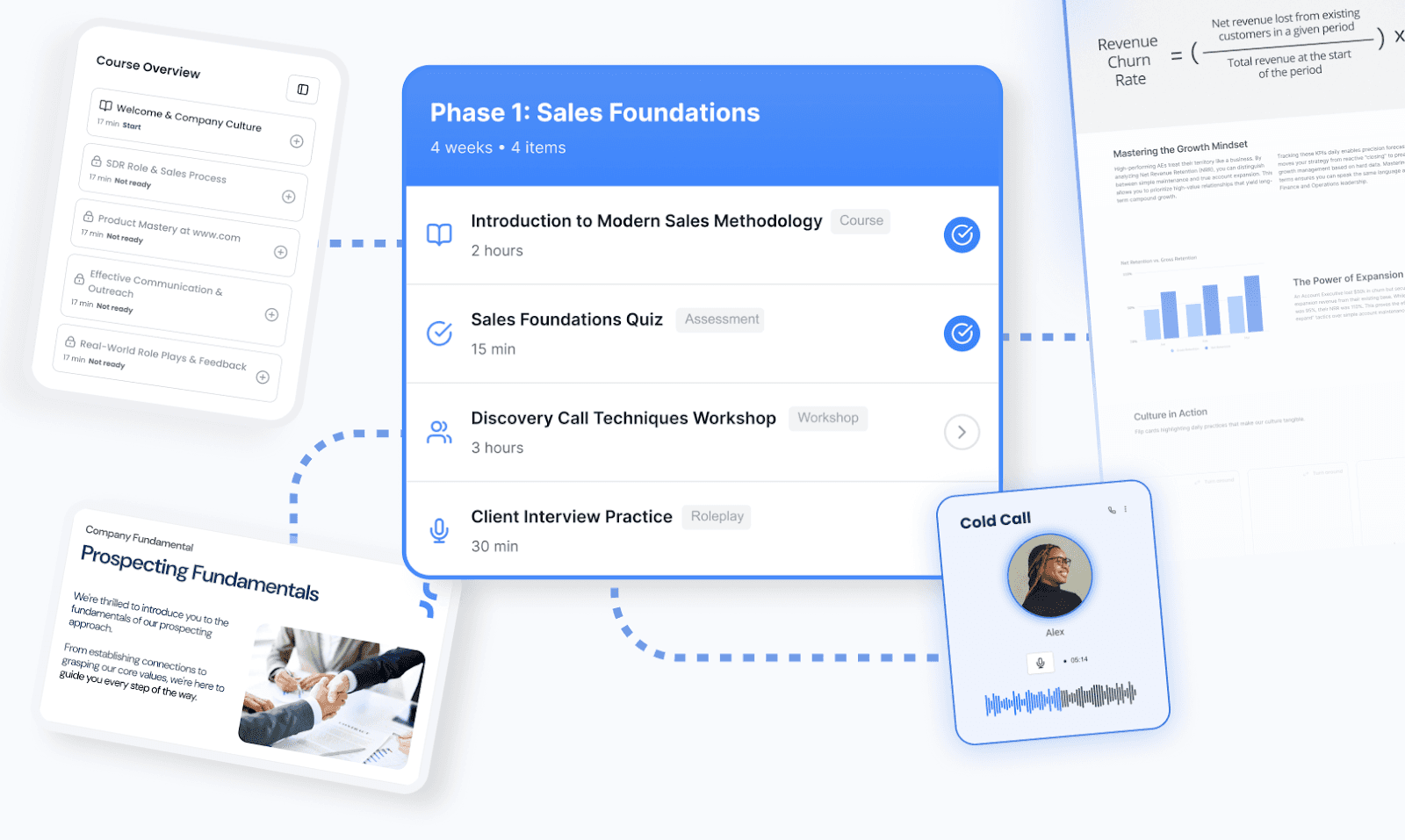
One-off training sessions have minimal lasting impact. Programmes create real change — because they build skills in sequence, repeat what matters, and give managers checkpoints.
Here's how to build three common programme types.
Programme 1: New SDR Onboarding (30-Day Ramp)
Audience: SDRs in their first 30 days Duration: 4 weeks, ~3 hours per week Objective: Get SDRs to first booked meeting by day 21. Consistent messaging. No random pitches.
Week-by-Week Plan
Week | Format | Topic | Goal | Deelan Feature |
Week 1, Day 1–2 | Course | Company, product, ICP | Understand who we sell to and why | Generate from product docs + ICP doc |
Week 1, Day 3–5 | Course | Sales process & methodology | Know the stages, know the playbook | Use MEDDIC/MEDDPICC template |
Week 2, Day 1–3 | Roleplay | Cold call opening | Survive the first 30 seconds | Beginner difficulty, neutral persona |
Week 2, Day 4–5 | Roleplay | Objection handling (basic) | Handle "not interested" and "send me an email" | 3 objection types, max score 5 each |
Week 3, Day 1–3 | Course | Live call listening + debrief | Hear what great looks like | Upload recorded calls as references |
Week 3, Day 4–5 | Roleplay | Full cold call to meeting booked | End-to-end SDR simulation | Difficult persona, C-level role |
Week 4 | Assessment | SDR Readiness Check | Confirm minimum bar before going live | Auto-generated from Week 1–3 content |
Learning outcomes:
Can articulate value proposition in under 30 seconds for 3 different personas
Handles 5 most common cold call objections without discounting or caving
Books first meeting before end of week 3
Manager reinforcement ideas:
Listen to 2 live calls per week with rep in week 3–4
Review roleplay AI scores together in weekly 1:1
Use Deelan analytics to track roleplay score improvement week over week
How to build this in Deelan:
Create a Programme that sequences: Course (product) → Course (methodology) → Roleplay (cold call beginner) → Roleplay (cold call advanced) → Assessment. Deelan's adaptive paths unlock each module only after the previous one is completed above a defined minimum score. Use the Sales Fundamentals & Pipeline Management template as your starting point and customise from there.
Programme 2: AE Discovery-to-Close Improvement (2-Week Bootcamp)
Audience: AEs who are hitting pipeline targets but underperforming on win rate Duration: 2 weeks, ~4 hours per week Objective: Improve win rate by improving discovery quality and deal navigation.
Week | Format | Topic | Goal | Deelan Feature |
Week 1, Day 1 | Course | Discovery frameworks (SPIN, MEDDIC) | Understand the theory | MEDDIC/MEDDPICC template |
Week 1, Day 2–3 | Roleplay | Discovery with pain-unaware buyer | Practice second-level questioning | Pain-unaware persona, neutral |
Week 1, Day 4 | Assessment | Discovery Quality Check | Identify specific gaps per rep | Extract from Training |
Week 1, Day 5 | Roleplay | Discovery with competitive context | Navigate when a competitor is already in play | Difficult persona, competitive details in references |
Week 2, Day 1–2 | Course | Objection handling + negotiation frameworks | Build the language for difficult conversations | Generate from your negotiation playbook |
Week 2, Day 3–4 | Roleplay | Pricing objection, competitive deal | Advanced full-scenario simulation | C-level, difficult, competitive framing |
Learning outcomes:
Asks at least 5 probing questions before pitching in any discovery call
Can handle pricing pushback without offering a discount in the first response
Closes more follow-up meetings at end of each call
Programme 3: Objection Handling and Competitive Selling Sprint (Ongoing Monthly)
Audience: Full sales team (SDRs and AEs) Duration: 4 hours per month (can be split into weekly 1-hour sessions) Objective: Keep competitive positioning and objection handling skills sharp as the market evolves.
Session | Format | Topic | Goal |
Session 1 | Course | Competitive landscape update | Align team on current competitor positioning |
Session 2 | Roleplay | Competitive deal scenario (rotating) | Practice the specific objections your team is hearing this month |
Session 3 | Assessment | Objection handling quiz | Identify who has gaps |
Session 4 | Group debrief | Best responses from the month | Share what worked in real deals |
In Deelan: Update roleplay references monthly with fresh battle cards or new call recordings. Deelan's knowledge base keeps your competitive content current so AI personas reflect what prospects are actually saying right now.
Templates
Template 1: Turning a Real Call into Training with Deelan
Step | What to do | In Deelan |
1 | Select a high-quality call (win or instructive loss) | Export transcript from Gong or Otter |
2 | Identify 2–3 moments worth teaching (great question, handled objection, missed opportunity) | Highlight in the transcript |
3 | Create a course or workshop using the call as a reference | Upload transcript in Media & References field |
4 | Let Deelan extract learning points and generate exercises | Use "Extract from Training" for assessment |
5 | Build a roleplay that mirrors the scenario on the call | Set up persona to match the prospect type |
6 | Assign to reps with a specific goal | Adaptive path: course → roleplay → assessment |
Template 2: Measuring Whether Training Changed Behaviour
Fill this in 30 days after any training programme.
Metric | Before training | 30 days after | Change |
Average discovery call duration (mins) | |||
Objections handled without discounting (%) | |||
Demo-to-proposal conversion rate (%) | |||
Cold call to booked meeting rate (%) | |||
Average ramp time to first deal (days) | |||
Roleplay average score in Deelan |
Rosa's tip: If you can't measure it, you can't improve it. Pick two metrics per training programme and track them. The rest is noise.
How Deelan Helps You Operationalise This Toolkit
Everything in this guide is possible without Deelan. Managers can run roleplays manually. You can design programmes in spreadsheets. You can quiz reps with Google Forms.
The average sales manager spends 4-6 hours per week on repetitive coaching and training prep. Deelan removes the friction so managers can spend those hours on the conversations that actually require them.
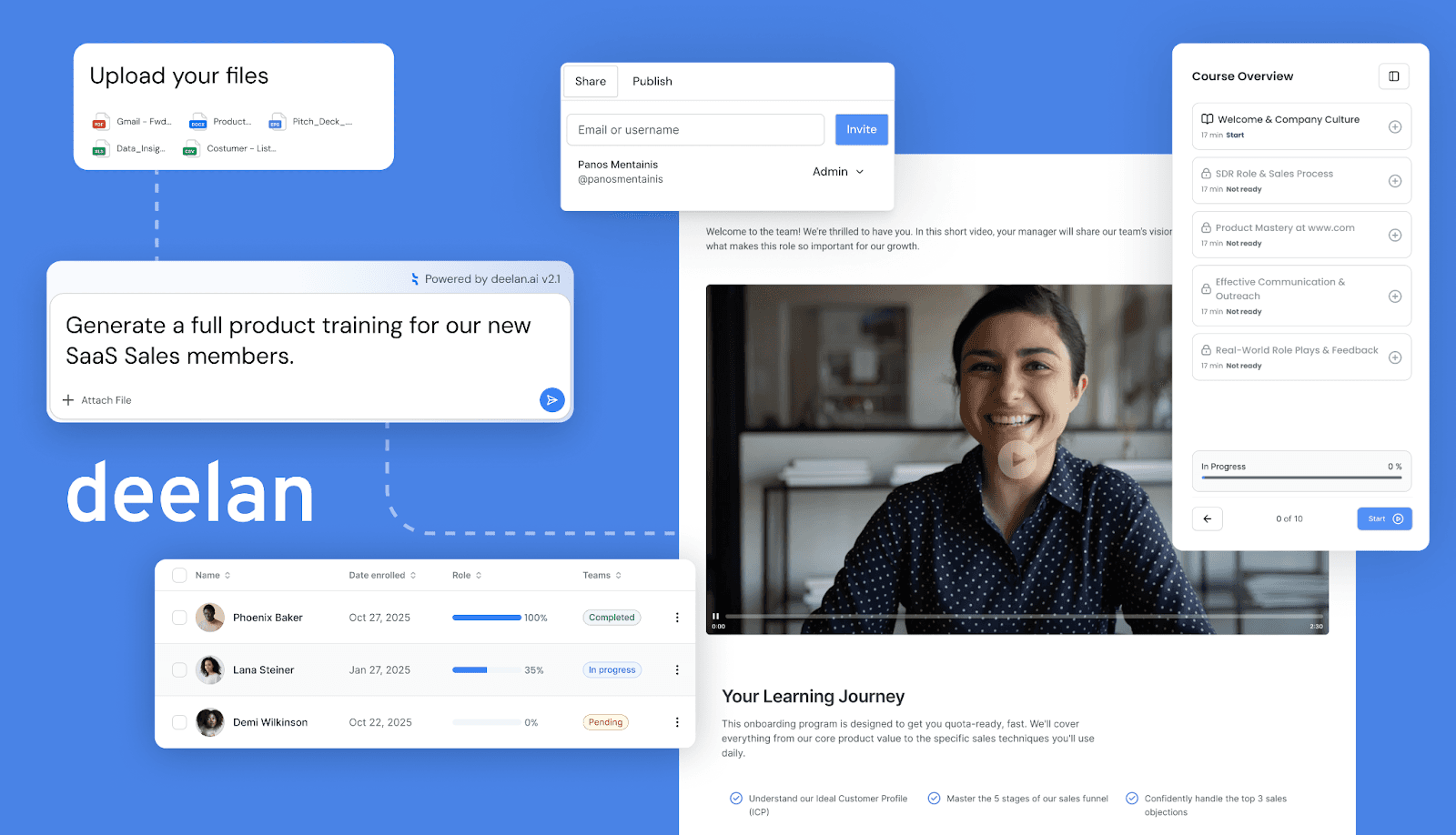
From existing content to live training in minutes: Upload your call recordings, scripts, battle cards, or product docs. Deelan converts them into structured courses, roleplay scenarios, and assessments — without a template, a designer, or a week of work.
Adaptive paths by role, seniority, and skill gap: An SDR in week 1 and an AE with 2 years of experience need different training. Deelan adapts automatically — adjusting content, difficulty, and sequence based on each rep's profile and performance.
Roleplays that give reps real feedback: Instead of waiting for a manager to debrief a call, reps get immediate, scored feedback on every roleplay. They know which skill cost them points and how to improve — without scheduling a 30-minute session.
Analytics that show what's actually happening: Not course completion rates. Actual skill mastery scores, gap analysis by rep and by team, and leading indicators of quota performance. Managers walk into 1:1s knowing exactly what to address.
Scale without adding managers: A team of 20 reps can't get personalised coaching from one manager. Deelan scales the coaching layer — giving every rep consistent feedback every time they practice, so managers can focus their time on the reps and deals that need them most.
Training Only Works When It's Applied
Reading this guide won't improve your win rate. Running one roleplay won't either.
What works is a system: relevant practice, realistic scenarios, immediate feedback, consistent reinforcement, and managers who connect training to real deals.
Deelan makes the habit easier to build. The exercises are already here. The scenarios are ready to customise. The programme templates give you a 30-day head start.
The only thing left is to start.
Ready to Put This Toolkit into Action?
Book a free demo with Deelan AI and see how your revenue team can turn playbooks, real sales scenarios, and coaching insights into adaptive training that ramps reps faster, improves win rates, and scales across your entire organisation.
Book Your Free Deelan Demo →
Built with Rosa Yupari, Fractional CRO & B2B SaaS Sales Coach, and the Deelan AI team.
Rosa works with B2B SaaS founders and revenue leaders to build, scale, and optimise their go-to-market organisations.