
Sales coaching is the single highest-impact lever a sales leader can pull — and yet it consistently ranks as the weakest skill among managers. Teams that coach 2–3+ hours per week hit 107% of quota. Those that don't average 90%. The gap isn't talent. It's coaching.
This guide gives you a practical, step-by-step playbook for how to coach a sales team, develop individual reps, and build a culture where performance compounds over time.
What Is Sales Coaching?
Sales coaching is a structured, ongoing process where managers guide individual reps to self-diagnose their gaps, build skills, and take ownership of their improvement. It's not a one-time training event — it's a discipline.
The concept originated in sports. In the 1980s, tennis coach Sir John Whitmore realized the techniques he used on the court could be applied in the workplace. He became a consultant, collaborated with firms like McKinsey, and defined coaching as creating a relationship of trust in which a person is guided toward the full exploitation of their potential.
It's worth distinguishing it from two related — but different — approaches:
Training | Coaching | Mentoring | |
|---|---|---|---|
Scope | Universal / group | Personalized / individual | Individual / long-term |
Focus | Knowledge transfer | Behavioral change | Career development |
Timing | Event-based | Ongoing | Ongoing |
Driven by | Curriculum | Performance data | Relationship |
Why Sales Coaching Is the Highest-ROI Investment You Can Make
The data is unambiguous. Companies with strong coaching programs see 28%+ higher win rates than competitors. AI-guided coaching improves win rates by 36%. And yet, 45% of reps rate their manager's coaching as "below average" — which means the opportunity gap is enormous for any team willing to close it.
McKinsey research confirms that the most productive sales teams do two things simultaneously: they identify the key factors behind their commercial success, and they offer targeted, individual coaching focused on each rep's specific gaps. Not group training. Not generic feedback. Personalized development.
The downstream effects go beyond quota attainment. Strong coaching reduces rep turnover, increases deal size, shortens sales cycles, and creates a culture of continuous self-improvement — where reps don't wait for their manager to tell them what to fix.
The Mirror Test Holding Sales Managers Accountable
When a rep isn't hitting goal, the instinct is to focus on the rep. But sales leader John McMahon reframes the question entirely: "Go to the bathroom, look yourself in the mirror, and ask — am I a bad hirer or a bad coach?"
Because as long as that manager hired that rep and managed that rep, they carry responsibility for the outcome.
How to Coach a Sales Team, Step-by-Step Guide
Step 1 — Run a Quarterly Coaching Kickoff
On day 2 of every quarter, every manager should sit down with each direct report for a 60–90 minute session. The agenda is the same for every rep: identify the one skill to work on this quarter, define how you'll coach it, and set a measurable KPI goal.
For example: "Matt's average sales cycle is 108 days versus the team average of 72. This quarter, we're focusing on urgency development. Goal: get Matt to 48 days."
This meeting cascades through the entire org. VPs meet with Directors the morning of day 2. Directors prep with Managers. Managers meet with Reps that afternoon. By end of day, every salesperson in the organization has a defined coaching focus for the quarter.
Step 2 — Use the Collaborative Coaching Conversation
There are two ways to start a coaching conversation. One works. One doesn't.
Wrong: "I looked at your numbers and you're bad at urgency. Bring me two recordings each month."
Right: Start with what went well. Review the data together. Let the rep diagnose the problem themselves. Co-create the plan. Schedule follow-ups before leaving the room.
The collaborative approach wins for three reasons: reps are far more bought into plans they helped create, self-diagnosis builds the long-term habit of self-improvement, and the manager may learn something they didn't see coming. The rep was on every one of their own calls — the manager wasn't.
Step 3 — Focus on ONE Area of Improvement at a Time
Coaching multiple areas at once dilutes attention, frustrates reps, and produces no measurable change in anything. Pick one skill per cycle and go deep.
Understand the difference between leading indicators (behaviors and effort: number of calls made, discovery questions asked, follow-up cadence) and lagging indicators (outcomes: close rate, deal size, cycle length). Coaching should change the leading indicators first — the lagging indicators follow.
Step 4 — Create a Concrete Action Plan Together
Before the meeting ends, document:
The specific steps the rep will take
The metric that will confirm improvement
The timeline for hitting the goal
The dates of follow-up coaching sessions — scheduled in the calendar before anyone leaves the room
These sessions should never be cancelled. If something urgent comes up, reschedule. Moving coaching is acceptable. Cancelling it signals that it isn't a priority — and your team will notice.
Step 5 — Facilitate Self-Evaluation, Not Criticism
Open every coaching session with the same three questions before offering any feedback of your own:
How do you feel things went?
What did you do well?
What would you do differently?
Reps who identify their own gaps are dramatically more likely to change them. They own the diagnosis, so they own the solution. A manager who walks in and immediately lists what the rep did wrong will get compliance at best and resentment at worst.
Step 6 — Measure, Iterate, and Recognize Progress
Track KPIs every month: sales cycle length, close rate, pipeline self-generated, conversion rate by stage. Celebrate improvements publicly — even incremental ones. A rep who moves from a 108-day sales cycle to 85 days deserves recognition, even if the goal was 48.
Expect the full impact of a coaching program to take 6–18 months to appear. The variable that separates programs that deliver from those that don't isn't technique — it's consistency.
Effective Sales Coaching Techniques That Actually Work
Call recording review. Don't wait for a rep to bring their best recordings. Pull recent calls at random and review them together. The goal isn't to shame — it's to identify patterns in what's working and what isn't. Practical tip: time the talk-to-listen ratio. Most reps talk too much.
Role-play and simulation. Practice objection handling, discovery questions, and urgency development in a low-stakes environment before the rep faces a real buyer. Practical tip: have the manager play a skeptical buyer, not an easy one.
Peer modeling. Share top performers' call clips with the team and let reps reverse-engineer what made them work. Practical tip: annotate the clip with timestamps pointing to the specific moments worth studying.
The SPIN questioning method. Coach reps to move through four question types: Situation → Problem → Implication → Need-Payoff. The Implication questions — "What's the cost of leaving this problem unsolved?" — are the hardest to master and the most powerful. Practical tip: have reps write out their SPIN questions before every major discovery call.
The Challenger approach. Train reps to teach, tailor, and take control. Rather than reacting to what the buyer says they need, a Challenger rep introduces a new perspective and leads with insight. Practical tip: build a library of industry-specific commercial insights reps can customize per account.
Data-driven 1:1s. Use CRM data, pipeline reports, and conversion metrics as the backbone of every coaching conversation — not gut feel or anecdote. Practical tip: pull the data before the meeting so you're coaching the numbers, not the vibe.
AI roleplay simulations. The newest and fastest-growing technique in modern sales coaching — letting reps practice real scenarios with AI before going live. More on this below.
How to Be a Good Sales Coach
The best coaches share a consistent set of behaviors — none of which require formal authority or years of experience.
They listen first and advise second, asking open questions before offering opinions
They develop a rep's capacity to self-diagnose, not dependency on the coach to spot every issue
They focus energy on middle performers — the 60% of the team with both room to grow and motivation to do so — rather than only on stars or struggling reps
They balance empathy with accountability: they never shame, but they always challenge
They treat every rep as an individual with different learning styles, different motivators, and different gaps
The underlying philosophy is simple: there are no bad salespeople, only bad coaches. A great coach's job is to understand exactly what each rep needs — and then deliver it.
How Technology Is Transforming Sales Coaching
AI doesn't replace coaching. It scales it.
Modern sales teams use call intelligence tools to automatically surface coachable moments — flagging calls where a rep talked too much, missed an objection, or failed to establish next steps. Adaptive learning platforms personalize training content by role, seniority, and skill gap, so a new SDR and a seasoned AE aren't receiving the same material. And AI roleplay tools let reps practice cold calls, discovery, and objection handling before they ever face a real buyer — with immediate, specific feedback on what to improve.
This is exactly the problem Deelan was built to solve.
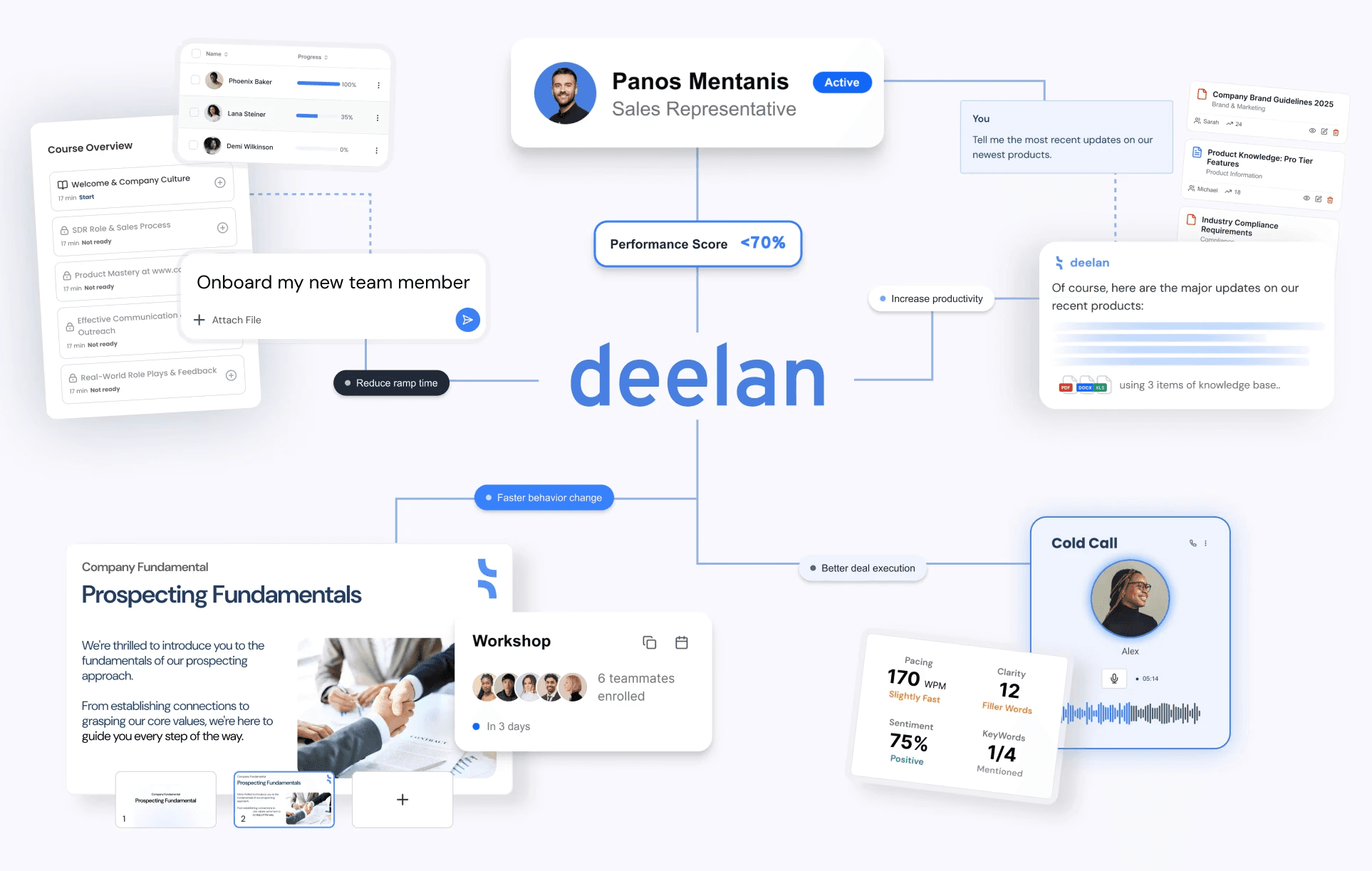
Deelan is the all-in-one AI training platform for modern revenue teams — designed to help sales managers build structured, customizable coaching programs in minutes, not weeks.
With Deelan, you can:
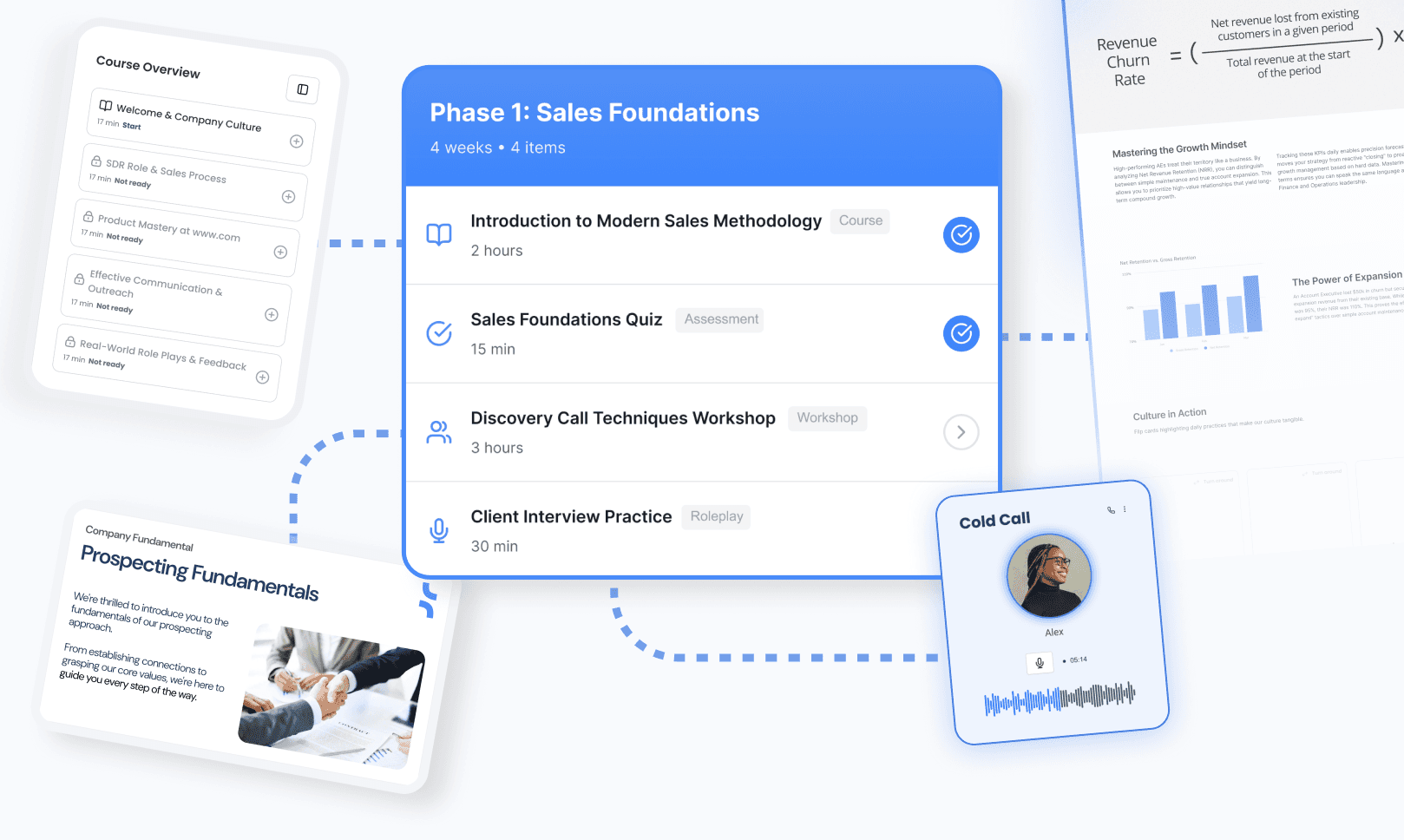
Generate full sales training courses from your existing playbooks, call recordings, and product docs
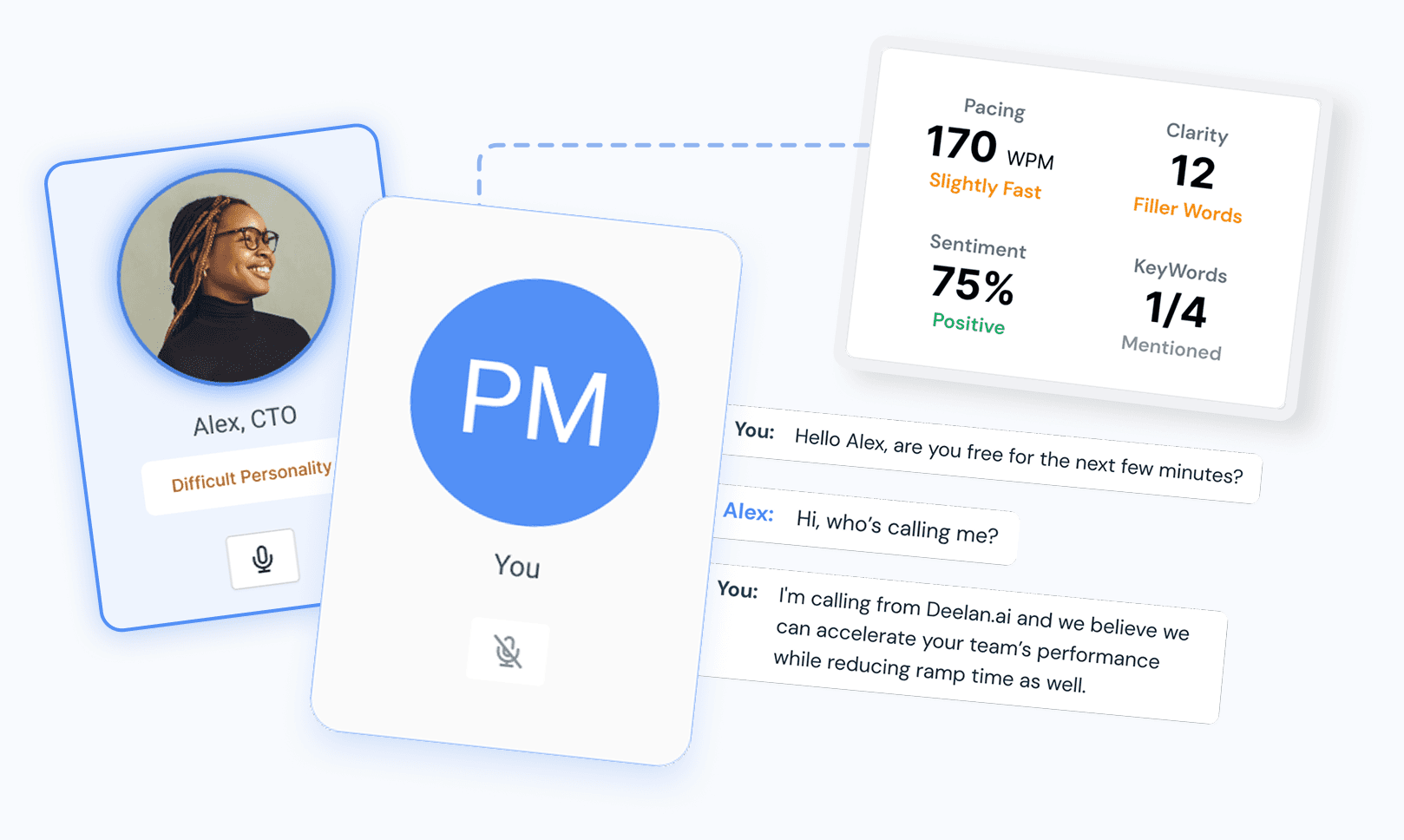
Run AI-powered roleplay simulations where reps practice cold calls, objection handling, and discovery — with AI audio that analyzes tone, clarity, strengths, and improvement points
Assign adaptive learning paths by role (SDR, AE, CSM) and skill gap, so every rep trains on what they actually need
Track learner progress with simple, actionable analytics — always knowing who is ready and who needs support
Create training 10× faster without design skills or complex tools
Teams using Deelan have reduced ramp time by 30%+ and saved dozens of hours of manual coaching per month. Whether you're managing a 10-person startup team or leading a 200-person revenue org, Deelan gives you the infrastructure to coach at scale — without burning out your managers.
Book a demo → or take a free tour to see it in action.
How to Measure Sales Coaching Effectiveness
Measure pre- and post-coaching — never against absolute targets in isolation. A rep improving from 75% to 88% quota attainment is a coaching win, even if the company goal is 100%.
Track KPIs across three categories:
Performance metrics
Quota attainment %
Win rate
Average deal size
Sales cycle length
Upsell and cross-sell frequency
Activity and observational metrics
Call quality scores
Pipeline self-creation rate
Conversion rate by stage
Talk-to-listen ratio on recorded calls
Culture metrics
Rep retention rate (rolling 12 months)
Employee Net Promoter Score (eNPS)
Promotion rate within the team
Rep satisfaction scores from 1:1 surveys
Common Sales Coaching Mistakes to Avoid
Coaching everyone the same way — one-size-fits-all feedback fits no one
Waiting until quota is missed — intervene early, when the leading indicators slip
Focusing only on laggards and stars — the middle 60% is where coaching moves the overall number
Canceling 1:1s when things get busy — this signals coaching isn't real; reschedule, never cancel
Giving feedback without data — opinions are debatable; pipeline metrics aren't
Prescribing solutions instead of guiding self-discovery — reps don't own what they didn't choose
Measuring coaching by completion — finishing a module isn't the same as changing behavior
Sales Coaching FAQs
How often should sales coaching sessions happen? Weekly or bi-weekly 1:1s are the standard for high-performing teams. Quarterly kickoffs set the focus; monthly check-ins track progress; weekly sessions reinforce habits. Frequency matters more than duration — short, consistent sessions outperform occasional marathons.
What makes a sales coach effective? An effective coach listens more than they speak, uses data to anchor conversations, focuses on one improvement area at a time, and creates an environment where reps feel safe enough to be honest about what's not working. The goal is self-sufficient reps, not reps who need the coach to function.
How does AI help with sales coaching? AI tools like Deelan surface coachable moments automatically, generate training content from existing company materials, and let reps practice real scenarios through roleplay simulations before going live. The result: managers spend less time on admin and more time on the coaching conversations that actually change behavior.
How long does it take to see results from sales coaching? Early behavioral changes can appear within 4–8 weeks. Meaningful metric shifts — win rate, cycle length, quota attainment — typically take 6–12 months of consistent coaching to fully materialize. The programs that fail are almost always the ones that stopped too early.
Conclusion
Sales coaching isn't a nice-to-have. It's the infrastructure that turns a team of capable individuals into a high-performing revenue machine. It doesn't require more hours in the day — it requires structure, consistency, and the discipline to prioritize development over the reactive pull of daily deal management.
The managers who commit to it see higher win rates, lower turnover, and teams that improve quarter over quarter without needing to be told how.
If you're ready to build that kind of coaching culture — and do it without burning out your managers — Deelan gives you the tools to get there. Create adaptive training programs, run AI-powered roleplays, and track every rep's progress in one platform designed specifically for revenue teams.