Most teams rush to create training before they understand what problem they are actually trying to solve.
They run objection-handling workshops because a LinkedIn post suggested it. They follow the latest sales enablement trend, copy what another company is doing, or buy a generic training programme.
Guesswork is expensive.
Before creating any training, you need to understand where the problem sits and what is actually causing it. You need to know your context, your team, and what is holding performance back.
Most teams skip the step that comes before training: figuring out why reps are underperforming in the first place.
Sometimes the issue is not the rep at all. Sometimes the problem sits in the business, the manager, the role design, or the process.
That is why diagnosis has to come first.
A useful starting point is the Symbiotic Sales Performance Diagnostic. It walks through four layers — business, leadership, role design, and individual execution — to help you separate system failures from individual ones before deciding what to do.
The same logic applies more broadly to your go-to-market engine. If you are not sure whether the issue is structural or executional, the GTM Gap Assessment from Symbiotic evaluates five dimensions:
GTM strategy and ICP clarity
Pipeline and sales execution
Marketing effectiveness
Revenue operations and data
AI in GTM
In under ten minutes, it gives you a personalised breakdown of where the real problem sits.
How to Diagnose Before You Train: A Practical Framework
1. Define the Specific Behaviour That Is Not Working
What exactly is happening?
Discovery calls are weak
Reps are not handling objections effectively
Opportunities stall after the first meeting
New hires take too long to ramp
Qualification is inconsistent
Reps know the messaging but cannot apply it in conversations
The more specific the behaviour, the easier it becomes to identify the real cause — and later, to build the right training.
2. Do a 360-Degree Review
Review:
CRM activity
Conversion rates at each funnel stage
Call recordings
Email response rates
Manager feedback
Peer feedback
Pipeline quality
Ask questions like:
Are they logging activity but not creating outcomes?
Are they having conversations but not moving opportunities forward?
Are they performing well in one stage of the funnel but failing in another?
3. Map the Problem to the Funnel
Most underperformance happens at a specific stage.
For example:
Lots of meetings booked, but poor qualification
Strong discovery, but weak proposals
Good pipeline, but poor close rates
Strong activity, but low response rates
When you know where the problem appears, you stop wasting time training the wrong thing.
4. Observe Directly
Listen to calls. Watch meeting recordings. Run roleplays. Observe how the rep actually behaves at the moment.
You may discover:
The rep does not know how to ask good discovery questions
They struggle to explain value clearly
They cannot handle objections
They rush through qualification
They know exactly what to do, but they are not doing it consistently
If you want to make this process faster and more structured, tools from Symbiotic Resource Hub can help you identify the likely root cause before you build any training.
What Happens After the Diagnosis
Only once the diagnosis is clear should you move to course correction.
But if your diagnosis shows that the rep genuinely lacks the skills to succeed, then it is time to build personalised training.
You need training that is:
specific to the exact gap
adapted to the rep’s current level
reinforced through practice
easy to update as the team evolves
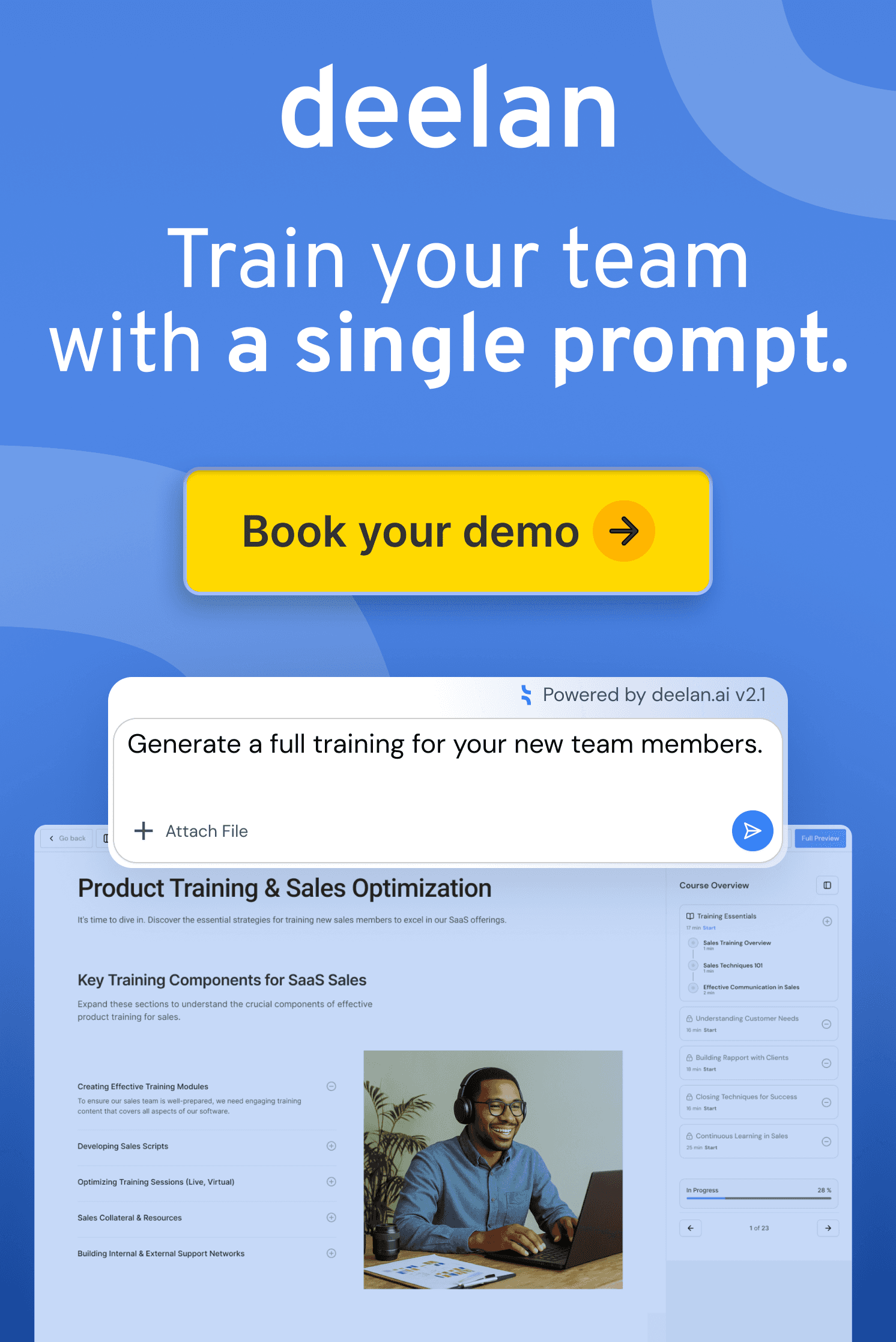
Once you have identified where someone is struggling, you can use Deelan AI to create the exact training they need.
For example:
Build or assign an adaptive course focused on the specific skill gap — discovery, objection handling, qualification, value proposition, negotiation, or onboarding.
Use AI-powered roleplays so reps can practise in a safe environment before it matters. Deelan’s roleplays include AI audio analysis that evaluates tone, clarity, confidence, and technique.
Run a targeted workshop that turns the diagnosis into action with live exercises, discussion, and coaching.
Add assessments to check whether the rep actually understands the skill, rather than simply completing the training.
Combine everything into a structured learning programme that reinforces the behaviour over time.
Deelan AI supports multiple training formats — including courses, workshops, roleplays, assessments, micro-learning, and learning programmes — so you can match the training to the exact problem you identified.
You can also start from templates built around common sales and GTM issues, which makes it much faster to turn diagnosis into action.
The Cost of Skipping Diagnosis
The biggest mistake revenue teams make is building training too early.
If you skip diagnosis:
You train the wrong skill
You frustrate good reps
You waste manager time
You increase ramp time
You spend money without changing behaviour
The result is that the team completes the training, but nothing changes in the field.
The most effective revenue teams work differently. They build a habit of diagnosis before every training intervention.
The best teams treat this as a continuous loop:
Diagnose. Train. Observe. Diagnose again.
That is how training becomes more than a one-time event. That is how it changes behaviour.