If your team can’t explain what the product does, why it matters, and how to use it in real scenarios, deals stall, support tickets grow, and onboarding drags on. Product training fixes that.
This guide shows you how to build product knowledge that’s easy to learn, easy to maintain, and measurable plus a copy/paste template you can use today.
What is Product Knowledge Training? (And Who Needs It)
Product knowledge training is the structured process of educating your team not just on what your product is, but why it matters to your customers. . The goal is simple: make people confident enough to use, explain, demo, support, and sell the product without guessing. High-performing organizations treat it as a continuous cycle.
What it includes
At minimum, product knowledge training should cover:
What the product does (and doesn’t do)
Who it’s for (ideal customers and use cases)
How it creates value (outcomes, not just features)
How it compares (differentiators + competitive landmines)
How to handle real questions (FAQs, objections, escalation paths)
Who needs it
Sales Teams: They need product knowledge for sales - specifically, how to map features to pain points and handle complex objections on the fly.
Customer Success & Support: Their goal is to reduce time-to-value and resolve tickets without escalating every issue to engineering.
Marketing: If marketing doesn't understand the product's nuances, the messaging becomes "fluffy" and attracts the wrong leads.
Partners & Resellers: To represent your brand effectively, external partners need the same level of basic product knowledge as your internal staff.
Why It Matters: The importance of product knowledge
Faster Sales Cycles: Knowledgeable reps close deals faster because they don't have to "get back" to prospects.
Higher Retention: Customers stay when support teams can proactively help them enhance product knowledge and find more value in the tool.
Reduced Support Costs: Well-trained users (and staff) mean fewer "how-to" tickets.
The 7 Elements of Effective Product Knowledge
If your training consists of a 50-page PDF, it might not be the best, but a bit outdated idea. To truly empower your team, your training must cover these seven areas:
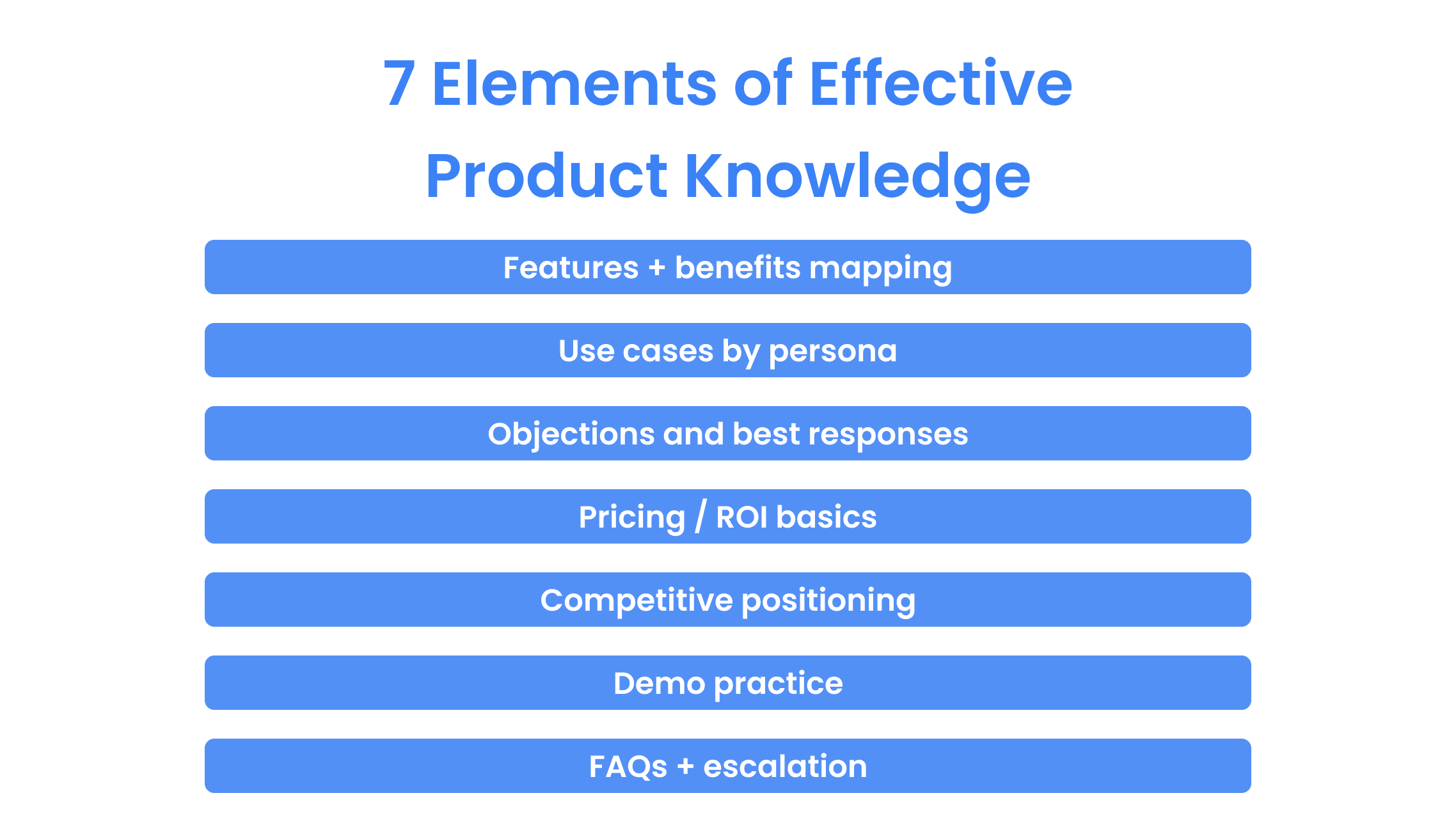
Features + benefits mapping
Not a list of features—an explanation of why each feature matters.Use cases by persona
“For a CFO…” “For an Ops lead…” “For a compliance team…” (use your real ICPs).Objections and best responses
Especially: price, integrations, implementation effort, and switching costs.Pricing / ROI basics
Enough to explain value clearly and route deeper pricing questions correctly.Competitive positioning
Differentiators, where you win, where you don’t—and how to handle comparisons.Demo practice (not just demo decks)
A demo checklist + “golden path” flow + what to do when something breaks.FAQs + escalation
The top questions people ask, and when to escalate to product/engineering.
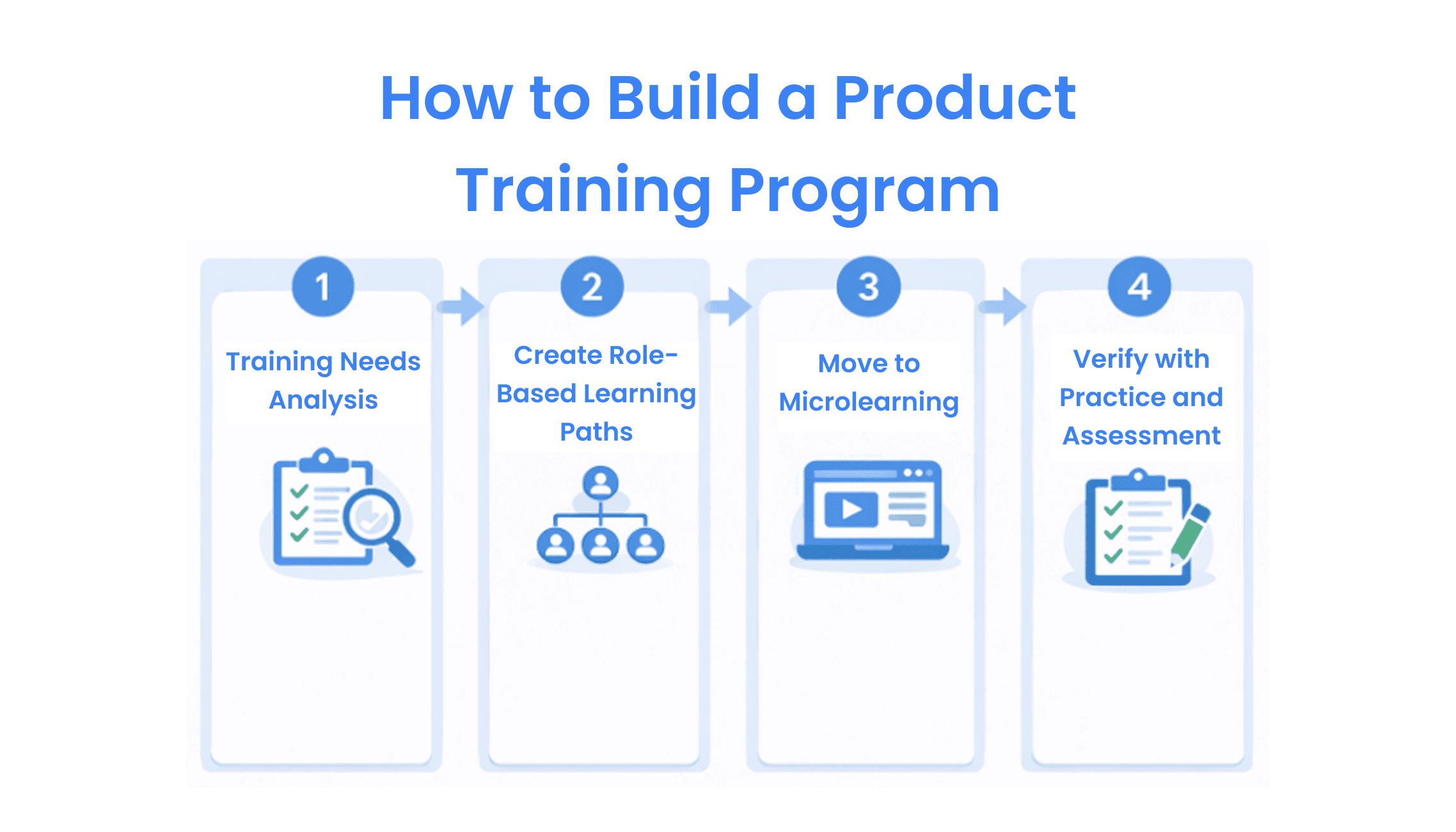
How to Build a Product Training Program
Building a program from scratch feels daunting. Use this step-by-step framework to keep it structured and scalable:
1. Training Needs Analysis
Start by identifying the gaps. Talk to your support lead -what are the most common questions? Talk to sales -where do deals stall? Use this data to prioritize your curriculum.
2. Create Role-Based Learning Paths
A junior SDR doesn't need the same technical depth as a Senior Solutions Architect. Create "tracks" that deliver the right information at the right time.
3. Move to Microlearning
Nobody retains a 4-hour lecture. Break your product training into 2- to 5-minute modules. It’s easier to consume and much easier for you to update when a new feature drops.
4. Verify with Practice and Assessment
Don't assume they "got it." Use quizzes, role-plays, and certification checklists to verify readiness before they go live with customers.
Product Knowledge for Sales
For sales, product knowledge is a weapon.
Sales product knowledge isn’t memorizing features. It’s the ability to connect the product to a buyer’s problem, fast.
A simple talk track formula (works on calls and demos)
The Formula:
"You mentioned you struggle with [Pain Point]. Our [Feature] solves this by [Action], which means you'll see [Quantifiable Result]."
Example:
"You mentioned you struggle with slow onboarding. Our Deelan AI-course generator solves this by turning your raw docs into interactive lessons in seconds, which means your new hires are productive in 3 days instead of 3 weeks."
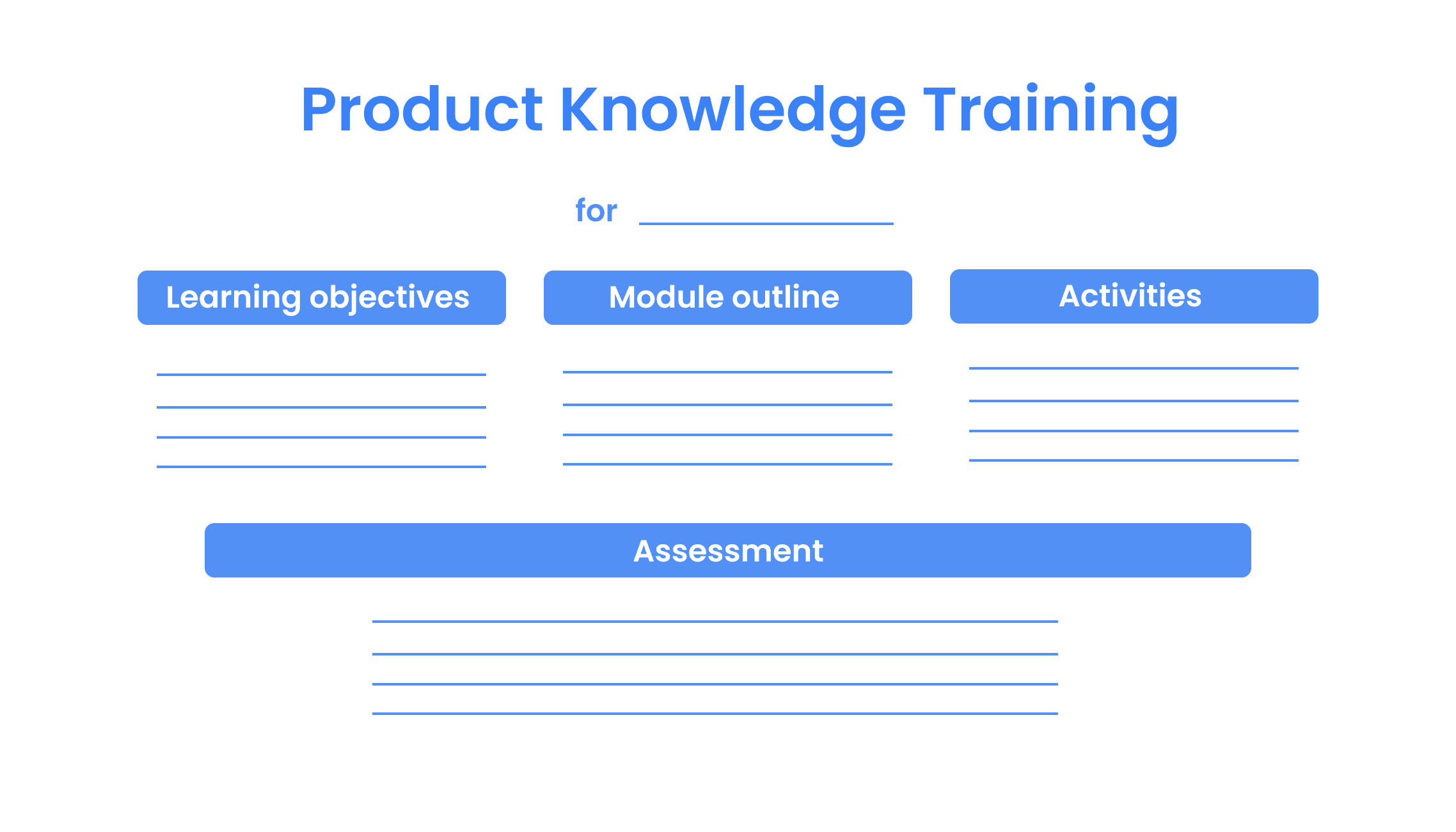
Product Knowledge Training Template
Learning objectives (example)
By the end, learners can:
Explain the product value proposition in one sentence
Match top features to outcomes (benefits)
Demo the “golden path” without help
Answer the 10 most common questions
Handle 5 core objections with confidence
Module outline (5–8 modules)
Product overview + positioning (what/for whom/why now)
Core workflows (how it works end-to-end)
Top features → benefits mapping
Use cases by persona/industry
Pricing + ROI basics
Competitive positioning (battlecards)
FAQs + escalation rules
Role practice: demos / tickets / role-plays
Activities (pick 2–3 per role)
Course, workshop
Role-play: discovery call + one objection
Customer scenario: “Which feature solves this, and how do you explain it?”
Assessment checklist
Quiz (10–15 questions)
Scenario-based test (3 short scenarios)
Certification checklist:
Can deliver 30-second value prop
Can demo core flow
Can answer FAQs accurately
Knows when to escalate
Also, don't forget to update the process, so it doesn’t rot.
Ready-to-Use Product Knowledge Checklist (simple table)
Use this per feature/use case:
Section | What to write |
The “What” (Features) | What it does, how it works, limits/constraints |
The “So What” (Benefits) | Outcome for the user (time saved, risk reduced, revenue gained) |
The “Proof” (Case Studies/ROI) | One metric, story, or ROI note that supports it |
Competitor Kill-Sheet (Differentiators) | Where you win, what’s unique, how to position it fairly |
To summarize, use this product knowledge training template to structure your next module.
Module | Topic | Objective | Activity |
1 | The Problem | Understand the customer's pain point. | Review 3 "lost deal" notes. |
2 | The "What" | Explain the core features. | Identify 3 key features. |
3 | The "So What" | Map features to specific benefits. | Write 3 benefit-led talk tracks. |
4 | The "Proof" | Use case studies and ROI metrics. | Present a 1-minute success story. |
5 | The "Win" | Differentiators vs. Competitors. | Role-play a competitive objection. |
6 | The "How" | Technical setup and escalation. | Set up a trial account. |
Assessment Checklist:
[ ] Can the learner explain the product in 30 seconds?
[ ] Can the learner handle the "It's too expensive" objection?
[ ] Can the learner perform a basic demo without errors?
Enhance Product Knowledge with AI-Driven Training
When training is manual, the bottleneck is always the same: creating content, updating it, and making sure people actually learned it. That’s where AI-driven enablement helps teams enhance product knowledge without doubling workload.
Deelan allows you to build structured product training 10x faster. Instead of starting from a blank page, you can:
Upload & Chat: Upload your latest playbooks, technical docs, or knowledge base. You can chat with your own data to instantly generate specific learning paths.
AI Course Generation: From a single prompt, Deelan generates complete training modules, including workshops and role-plays.
Interactive Role-plays: Test knowledge in a safe environment. Let your team practice objection handling with an AI that mimics a skeptical CFO.
Gap Analysis: Use AI-driven assessments to see exactly where your team’s knowledge is lagging, so you can fill the gap before it hits your revenue.
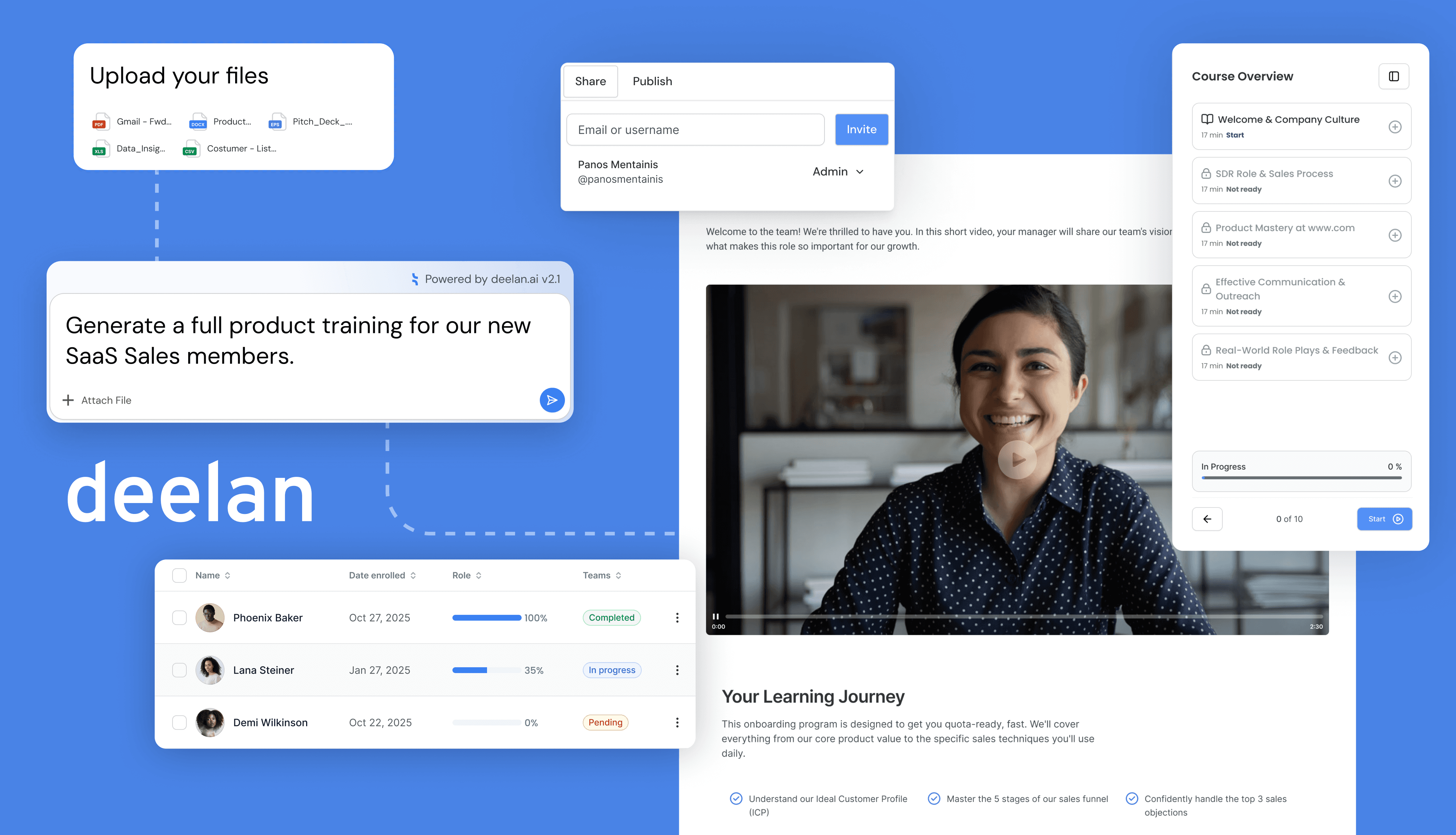
Whether it’s a new hire onboarding or a sudden product launch rollout, Deelan ensures your team is "customer-ready" in a fraction of the time.
Frequently Asked Questions
Q: What’s the difference between product knowledge and product knowledge training?
A: Product knowledge is the information (features, use cases, FAQs). Product knowledge training is the program that delivers it with practice and assessments.Q: How often should we update our product training?
Q: How do I measure if the training worked?
A: Look at "Ready-to-Sell" time for new hires, win rates on competitive deals, and the frequency of product-related support escalations.
Q: Can I use AI for basic product knowledge?
A: Absolutely. AI is best at summarizing complex technical specs into digestible "benefit" bullets, which is perfect for foundational training.
Build effective product training 10× faster with Deelan
When your team has mastered their product knowledge, they sell with more confidence, support with more empathy, and represent your brand with more authority.
Ready to build effective product training 10x faster?
[Explore Deelan today] and turn your static docs into a high-performance training machine.