Role-based sales training — personalized to each rep's role, seniority, and skill gaps — is the most effective way to ramp reps faster, close more deals, and scale coaching without burning out your managers. Here's the complete playbook.
An SDR prospecting cold outbound and a Customer Success Manager navigating a renewal conversation have almost nothing in common in terms of the skills they need in the field. Yet most revenue organizations run both through the same onboarding modules, the same product courses, and the same LMS completion checklist.
True role-based sales training has three structural differences from generic programs:
Content aligned to role-specific conversations — cold calls for SDRs, discovery frameworks for AEs, renewal playbooks for CSMs.
Learning paths adapted to seniority — a junior SDR in week two and a senior AE with three years of tenure do not share training needs.
Skill gap detection built in — not assumed. You find where each cohort is actually weak before you build content, not after.
Generic Training | Role-Based Training |
|---|---|
✗ One curriculum for all roles | ✓ Custom learning paths per role |
✗ Measures completion rates | ✓ Measures skill mastery & KPI impact |
✗ Static content that goes stale | ✓ Adapts to performance data in real time |
✗ Weeks to build a single course | ✓ From prompt to published in minutes |
✗ Ignores seniority differences | ✓ Layers by role AND seniority level |
Why Generic Sales Training Fails Revenue Teams
You can recognize generic training failure by a familiar pattern: high completion rates, flat quota attainment. Reps finish the modules. Nothing changes in the field. The problem isn't the team — it's that the training was never built for them.
The average sales rep forgets 87% of training content within 30 days — not because they're lazy, but because it wasn't relevant to their daily job.
Here's exactly where generic programs break down:
1. SDRs get AE-style training
Most onboarding programs are built around the Account Executive motion — closing techniques, negotiation tactics. They needed cold call scripts, gatekeeper handling, and pipeline hygiene.
2. AEs don't get enough discovery coaching
AEs need nuanced, scenario-based practice on multi-threading, economic buyer navigation, and technical validation. What they usually get is a framework slide and a role-play that lasts twelve minutes in a kickoff session.
3. CSMs are forgotten entirely
Renewal conversations, expansion plays, executive QBRs, escalation handling — these require entirely different skills than new-business selling.
4. Seniority is ignored
A rep who joined last month and a rep with three years in seat do not need the same training. Forcing a senior AE through a "What Is a Discovery Call?" module is a fast way to lose their trust in your enablement function entirely.
5. Skill gaps are never actually diagnosed
Most organizations build training based on what managers assume reps need — not what assessment data, call recordings, or performance metrics actually reveal. When training is built on assumptions, it misses the real gaps.
The 5 Sales Roles That Need Distinct Training Programs
Here's what role-specific training actually looks like for each function in a modern revenue organization.
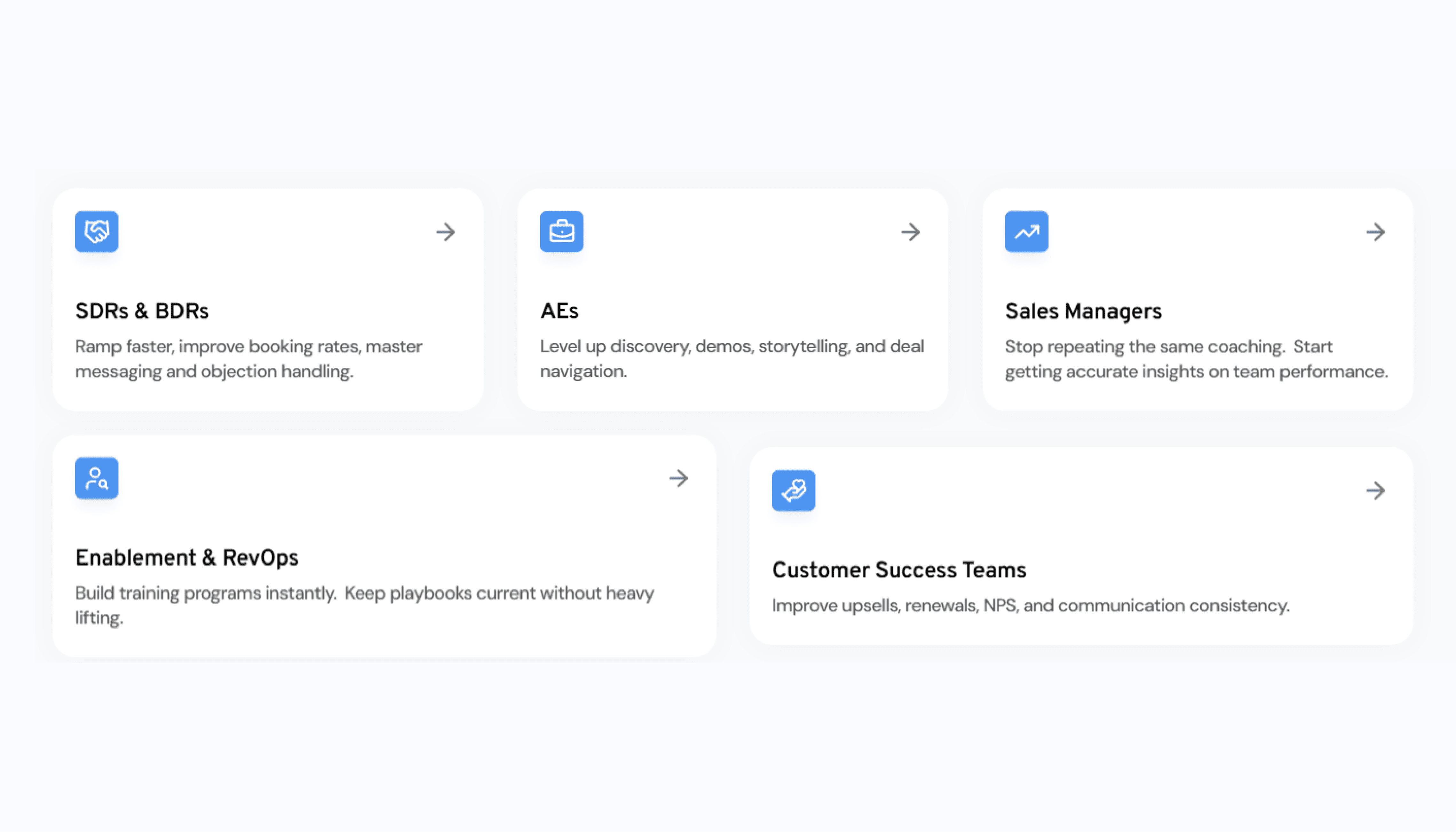
SDRs & BDRs
What They're Measured On
Meetings booked · Connect rate · Pipeline generated
Skills Training Must Build
Cold call confidence and tonality
Email sequencing and subject lines
Top-of-funnel objection handling
ICP qualification and research
Common Gaps
Messaging clarity under pressure
Handling "I'm not interested"
Multi-channel follow-up discipline
Great Training Looks Like
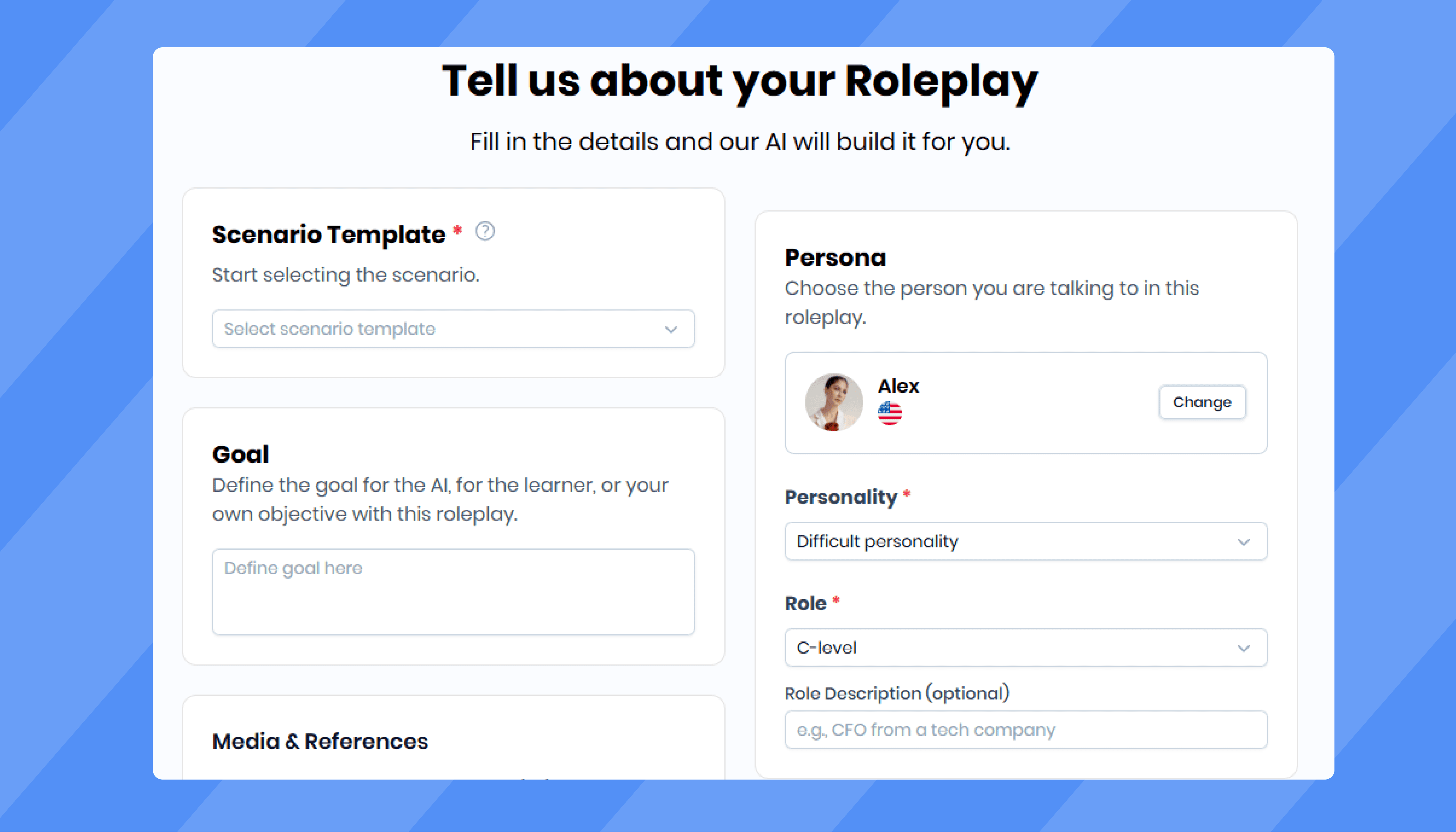
AI roleplay for live cold call reps
Objection libraries by persona
Cadence-building workshops
Account Executives
What They're Measured On
Win rate · Deal size · Sales cycle · Quota attainment
Skills Training Must Build
Discovery depth and active listening
Demo storytelling and value framing
Multi-threading across buying committees
Negotiation and economic buyer access
Common Gaps
Presenting before understanding pain
Losing to "no decision"
Single-threaded deal management
Great Training Looks Like
Scenario-based deal review simulations
Persona-specific talk tracks
Objection handling under real pressure
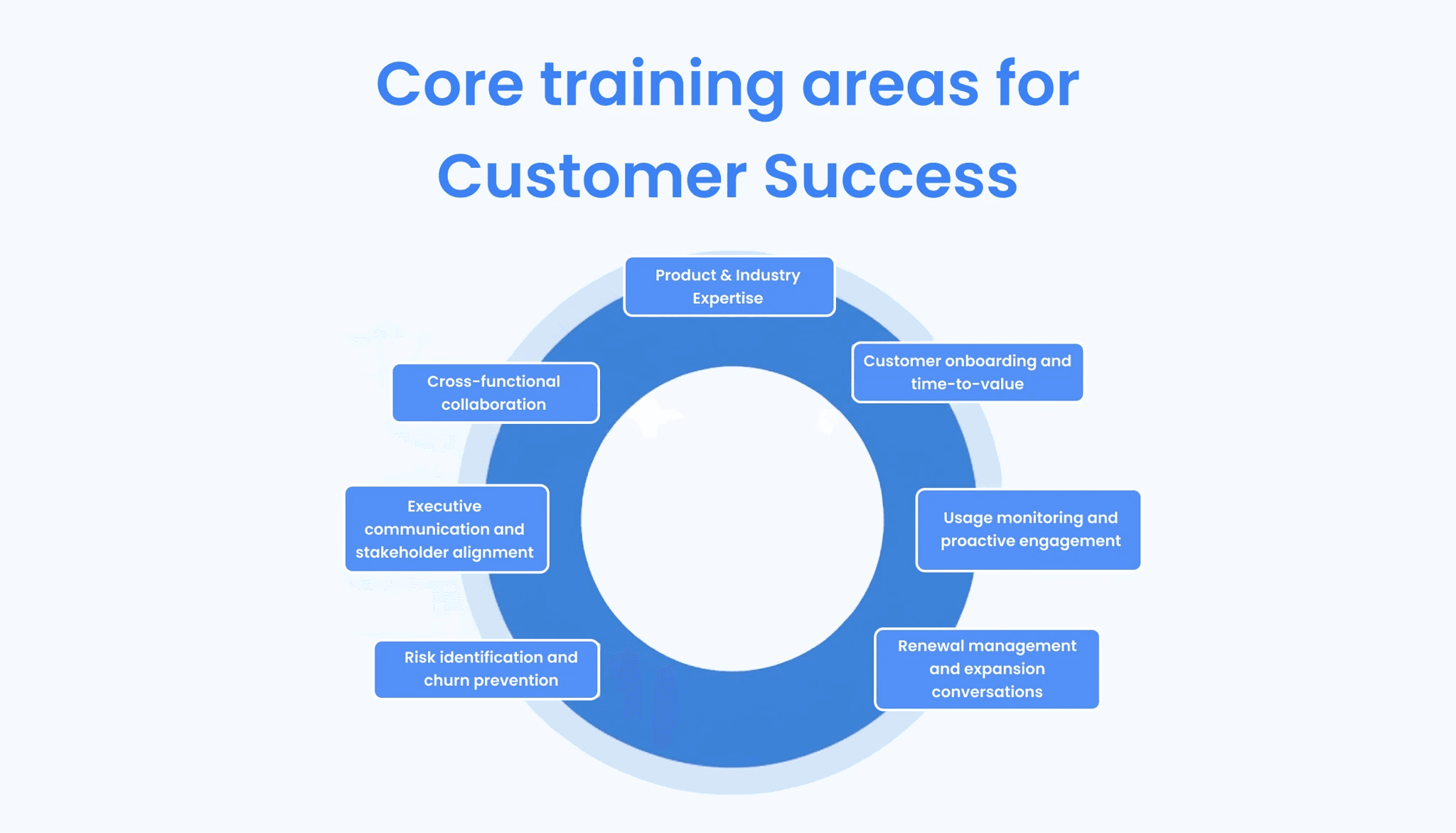
Customer Success Managers
What They're Measured On
NRR · Churn rate · NPS · Expansion revenue
Skills Training Must Build
Renewal conversation frameworks
Escalation handling and de-escalation
Identifying expansion signals early
QBR facilitation with executives
Common Gaps
Treating every account identically
Missing upsell signals in calls
Poor executive-level communication
Great Training Looks Like
Expansion playbook with trigger scenarios
Escalation conversation simulations
Customer communication frameworks by tier
Sales Managers
What They're Measured On
Team attainment · Ramp time · Rep retention
Skills Training Must Build
Coaching (not just directing or inspecting)
Pipeline inspection with data-backed rigor
Identifying individual rep skill gaps
Running high-impact 1:1s
Common Gaps
Coaching by intuition, not data
Repeating the same feedback loops
Promoting top reps without manager training
Great Training Looks Like
Coaching frameworks and rubrics
Call review methodologies
Rep development plan templates
Enablement & RevOps
What They're Measured On
Training adoption · Time-to-productivity · Content velocity
Skills Training Must Build
Rapid, scalable content creation
Playbook maintenance workflows
Performance data analysis and reporting
Common Gaps
Month-long content creation cycles
Training content going stale quickly
No link between training and quota data
Great Training Looks Like
Role-specific program design frameworks
Analytics tied directly to KPIs
How to Build a Role-Based Sales Training Program
Here's a practical seven-step framework for moving from generic training to a role-based program that actually moves revenue metrics.
Audit your current training by role
Pull up every training asset you have and ask one question: does each role have a distinct learning path? If SDRs and AEs share the same onboarding curriculum, you're starting from a generic baseline. Map what exists, what's missing, and what's misfired.
Define role-specific skill profiles
For each role, identify the 5–7 skills that directly drive their KPIs. These aren't generic soft skills — they're specific behaviors. "Runs effective discovery calls" is a skill. "Communication skills" is not. Tie every skill to a measurable outcome.
Diagnose skill gaps before building content
Use call recordings, performance data, manager input, and role-specific assessments to find where each cohort is actually weak. Building content based on assumptions wastes everyone's time and kills adoption before it starts.
Build adaptive learning paths by role AND seniority
A new hire SDR and an SDR who's been in seat six months need different content depth and different skill development priorities. Layer your programs by role first, then by seniority. The more precise the path, the higher the adoption.
Use realistic practice, not just passive consumption
Reps learn by doing, not by watching. Every program needs built-in practice: AI-powered cold call roleplays, simulated discovery conversations, objection handling drills with feedback. Passive video consumption produces passive skill development.
Measure skill mastery, not completion rates
Connect training activity to the metrics that actually matter: pipeline quality, win rate, ramp time, quota attainment. If your training analytics dashboard shows completion percentages and nothing else, you're measuring the wrong thing.
Update training continuously as your process evolves
Your ICP shifts. Your product changes. Your competitive landscape moves. Training built once and left static is a liability within six months. Build update cycles into your enablement workflow — or use an AI platform that does it automatically.
Pro Tip
The biggest ROI jump comes from combining steps 3 and 5: diagnosing the real skill gap first, then routing each rep to the specific practice scenario that addresses it. That's what adaptive training actually means in practice.
What Makes Role-Based Training Most Effective — The 3 Dimensions
Most enablement teams get the first dimension right. Very few get all three. The gap between good and exceptional role-based training comes down to how deep you go on each one.
01
Personalization by Role
Each role gets a curriculum mapped to their daily conversations, typical objections, and KPIs — not a shared module library that everyone picks from. The SDR's path and the AE's path are built differently from the ground up.
02
Personalization by Seniority
A new AE and a senior AE need different content depth and different skill priorities. Adaptive paths recognize where a rep is in their career arc and serve content that's appropriately challenging — not insultingly basic or overwhelmingly advanced.
03
Personalization by Skill Gap
The most powerful training knows what each individual rep needs to improve based on performance data, assessments, and call analysis — and automatically routes them to the right content. No manual assignment. No guesswork from managers.
This is the core advantage of AI-powered training platforms for revenue teams: the system reads performance signals, identifies the gap, and routes the rep to the right content — without a manager having to diagnose it, find the asset, and assign it manually every time.
Built for Revenue Teams
Deelan — Role-Based Sales Training at Every Level of Personalization
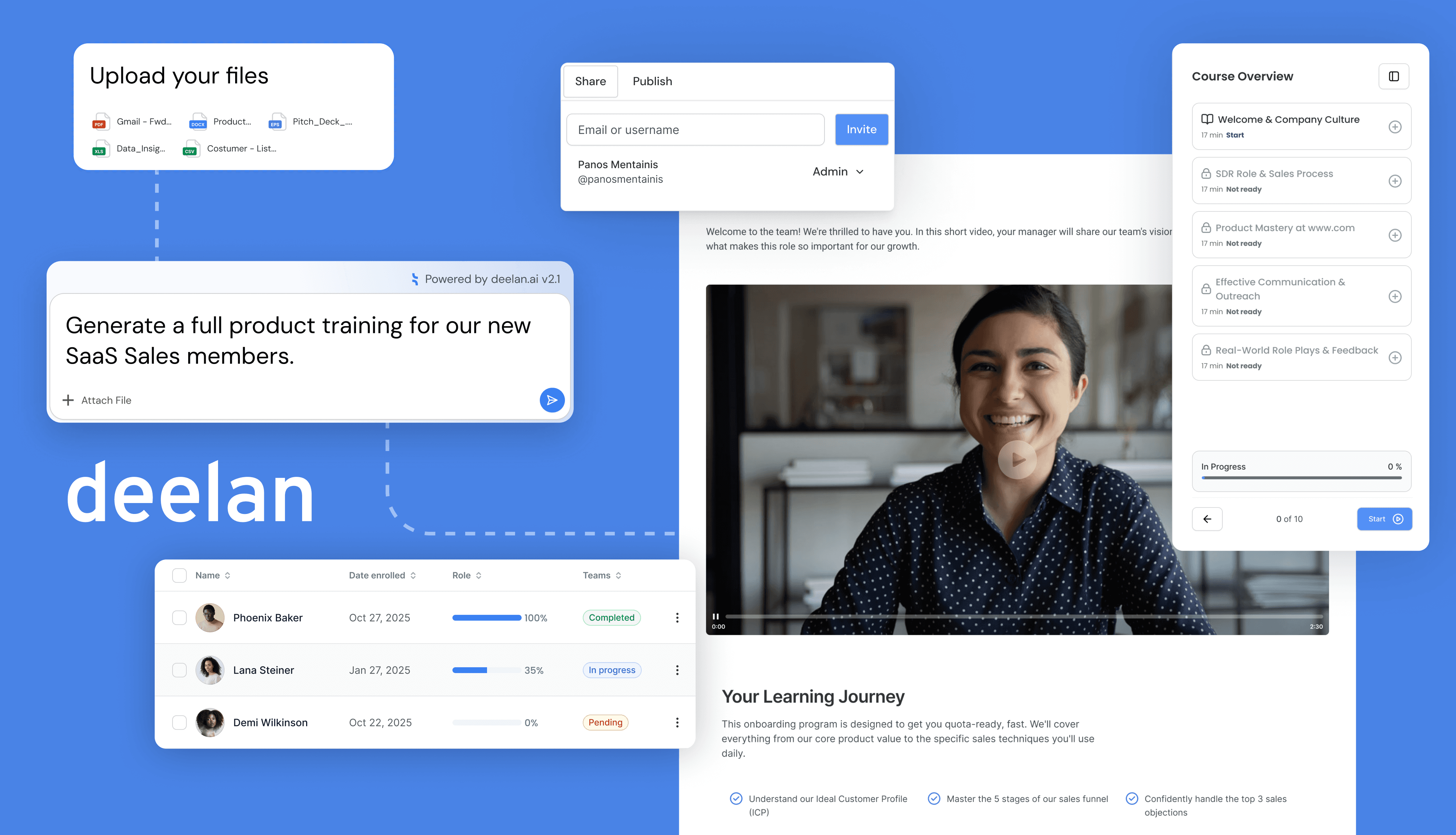
Deelan is an AI training platform that generates adaptive, role-specific training from your existing playbooks, call recordings, and product docs — and automatically adjusts each rep's learning path based on their role, seniority, and skill gaps as they develop.
For revenue teams that need to ramp faster, coach smarter, and scale without adding headcount to enablement, Deelan is purpose-built for all three dimensions of personalization:
Adaptive paths for SDRs, AEs, CSMs, and managers — automatically updated by seniority and skill gaps
AI Roleplay — realistic simulations for cold calls, discovery, objection handling, and renewals
AI-generated content — from a single prompt to a publish-ready course in minutes, not weeks
Real-time skill analytics — track mastery and improvement, not just whether someone clicked through a module
Build personalized training for your whole revenue organization
Role-based sales training — built around the specific conversations, KPIs, and skill gaps of each role and seniority level — is how modern revenue organizations actually move the needle. The three dimensions of personalization (role, seniority, skill gaps) are not optional features. They're what separates training that drives performance from training that drives completion percentages.
If you're ready to see what adaptive, role-specific training looks like for your SDR, AE, and CS teams, book a free Deelan demo.