
Sales objections are inevitable. Whether a prospect says “It’s too expensive,” “We already use another tool,” or “Now isn’t a good time,” every sales rep eventually faces resistance during conversations.
The difference between average sales teams and high-performing ones isn’t whether objections appear — it’s how confidently reps handle them.
When sales teams practice real scenarios, understand the reasoning behind objections, and develop strong response frameworks, they can turn hesitation into meaningful conversations and opportunities. Strong sales training for objection handling does more than teach responses. It helps reps stay calm under pressure, ask better questions, and guide prospects toward solutions.
When done well, objection handling training increases win rates, builds confidence in sales calls, and shortens deal cycles.
How Strong Objection Handling Increases Win Rates and Confidence
When reps know exactly how to navigate friction, their entire demeanor on a call shifts. Strong objection handling isn't about arguing with the buyer or forcefully "overcoming" their concerns. It is about actively listening, validating the prospect's reality, and smoothly guiding them toward a new perspective.
When you invest in sales objection training, the results are immediate:
Higher Win Rates: Reps learn to uncover the root cause of an objection, allowing them to salvage deals that would otherwise be lost.
Shorter Sales Cycles: Handled correctly early on, objections don't fester and derail late-stage negotiations.
Increased Rep Confidence: Reps stop dreading the word "no" and start viewing it as a roadmap to the buyer's actual pain points.
Key Issues Sales Teams Face With Objections
Here are the most common problems sales teams experience.
Reps freeze during calls
In training sessions, responses may sound perfect. But when a prospect suddenly says:
“Your product seems too expensive.”
Many reps hesitate. Without practical experience, it becomes difficult to respond confidently in the moment.
Reps know scripts but haven’t practiced them
Sales teams often memorize objection responses during onboarding. They learn scripts like:
“Let me explain the value.”
“Many of our clients felt the same way.”
However, knowing a script is different from handling a live conversation. Without realistic objection handling exercises, these responses rarely feel natural.
Managers repeat the same coaching
Sales managers frequently hear the same objections in call reviews. They repeat advice such as:
“Focus more on discovery.”
“Explain the ROI more clearly.”
But without structured overcoming objections training, this feedback rarely leads to lasting improvement.
Only top performers know how to handle objections
In most teams, the best reps naturally develop strong objection-handling skills. They ask better questions and navigate conversations smoothly.
The challenge is that this knowledge often stays in their heads instead of becoming a repeatable training process for the rest of the team.
Practice-based training is far more effective
The most effective sales training objection handling programs focus on practice instead of theory.
When reps practice realistic scenarios regularly, they:
build confidence
improve response speed
understand buyer concerns
develop stronger conversations
That’s why many modern teams include objection handling workshops and roleplay exercises in their training programs.
Simple Objection Handling Exercises to Improve Sales Calls
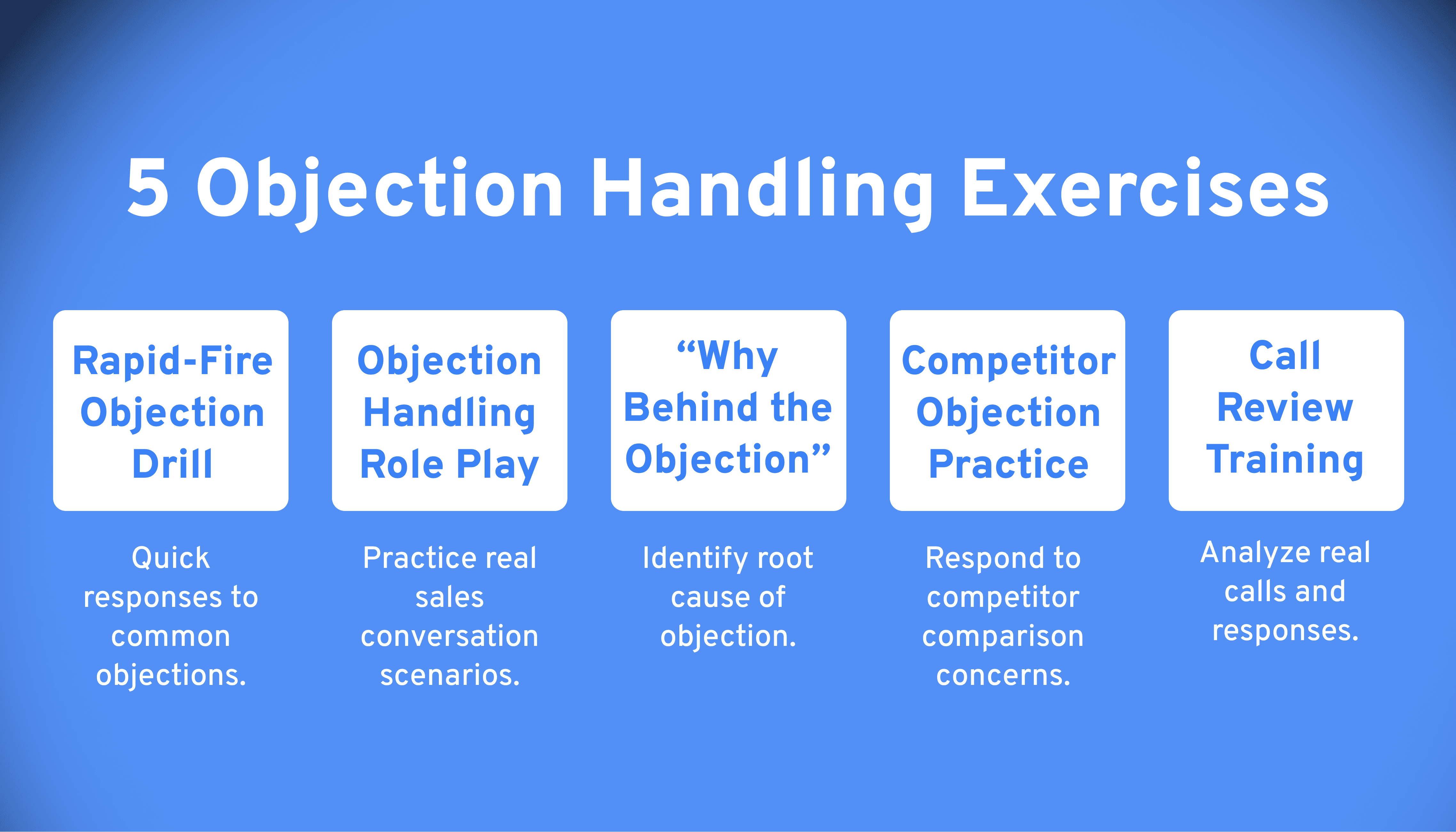
The following objection handling exercises can be used in:
sales onboarding programs
objection handling workshops
weekly team training sessions
coaching sessions with managers
These exercises help sales reps develop the confidence and skills needed to navigate real conversations.
Exercise 1 – Rapid-Fire Objection Drill
The rapid-fire drill is designed to improve response speed and confidence.
In this exercise, a manager or team leader presents objections quickly, and the rep must respond immediately.
Common objections to practice include:
“Your product is too expensive.”
“We’re happy with our current solution.”
“Send me an email.”
“I don’t have time right now.”
“We tried something like this before.”
The goal is not to deliver a perfect answer but to develop quick thinking and comfort with objections.
This exercise works best when done in short bursts — for example, 5–10 minutes at the beginning of a training session.
Benefits of this exercise:
improves reaction time
builds conversational confidence
helps reps stay calm under pressure
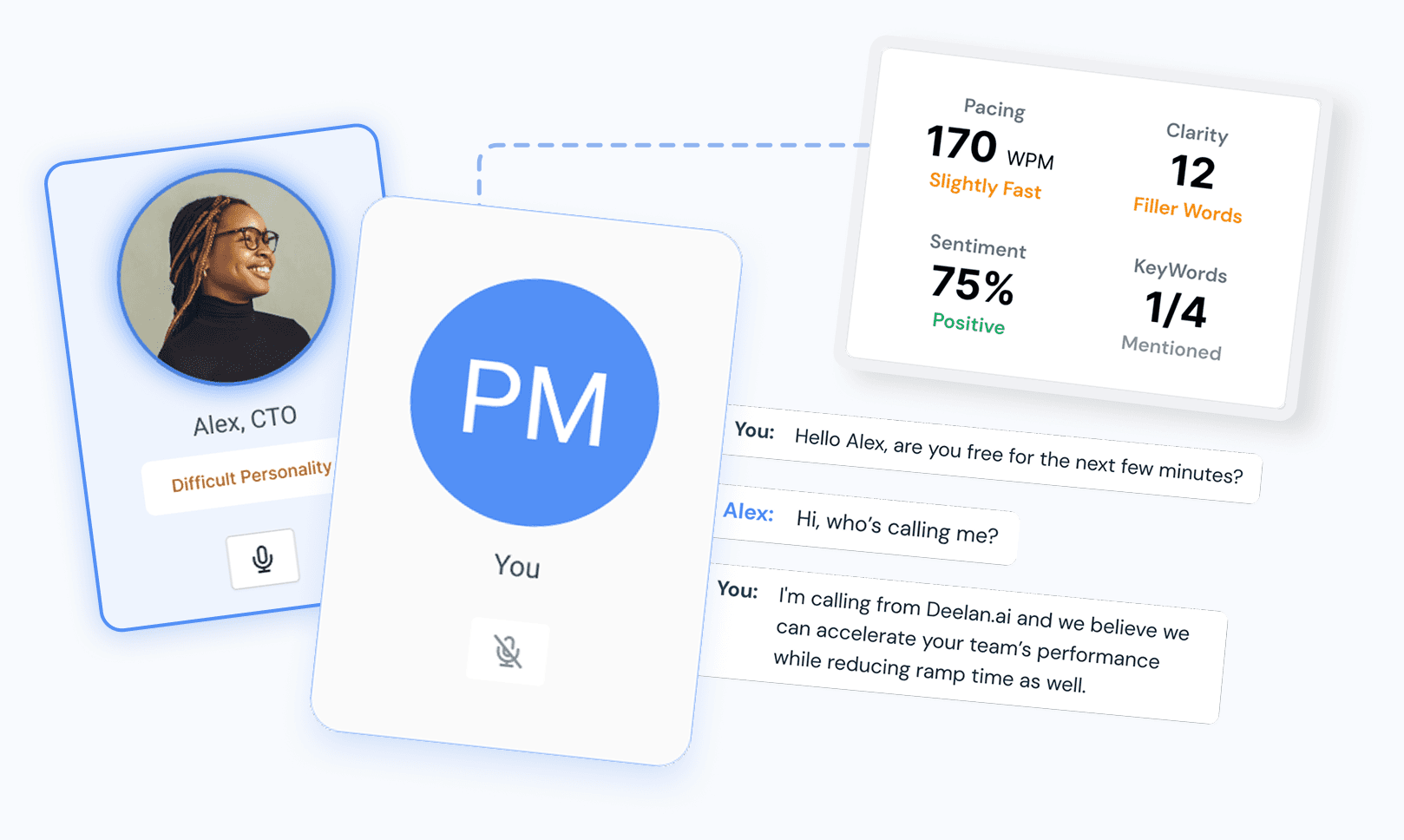
Exercise 2 – Objection Handling Role Play
A structured objection handling role play is one of the most effective training techniques.
In this scenario:
one person acts as the prospect
the other acts as the sales rep
The prospect raises realistic objections during the conversation.
Examples include:
“I’m not sure this is a priority for us right now.”
“We’re already working with another provider.”
“I don’t see the value yet.”
The rep must respond using discovery questions, value explanations, and active listening.
After the roleplay, the team discusses:
what worked well
where the rep could improve
how the response could be stronger
Roleplays allow reps to practice real conversations in a safe environment, which dramatically improves performance during actual sales calls.
Exercise 3 – The “Why Behind the Objection” Exercise
Many objections are not the real problem. Often, prospects raise surface-level concerns while hiding the real issue.
For example:
Prospect:
“It’s too expensive.”
Instead of immediately defending the price, the rep practices asking clarifying questions.
Example response:
“I understand. Can you tell me what makes the price a concern right now?”
Other follow-up questions might include:
“Is budget the main concern, or are you evaluating the value?”
“What would need to change for this to make sense financially?”
This exercise teaches reps to explore the root cause of objections instead of reacting immediately. Asking better questions often turns objections into deeper conversations.
Exercise 4 – Competitor Objection Practice
Competition is one of the most common objections in B2B sales.
Prospects frequently say:
“We’re already using [competitor].”
In this sales objection training exercise, reps practice how to handle competitor objections effectively.
The rep should focus on three key actions: Ask discovery questions
Example:
“How has your experience been with that solution so far?”
Highlight differences
Explain how your product or service addresses challenges differently.
Focus on value
Shift the conversation toward outcomes and benefits.
Example response:
“Many of our clients previously used that platform. They switched because they wanted deeper analytics and faster onboarding.”
Practicing competitor scenarios helps reps stay confident instead of defensive.
Exercise 5 – Call Review Training
Another powerful training method involves reviewing real sales calls.
In this exercise, teams listen to recorded conversations and analyze them together.
During the review, the team identifies:
what objection appeared
how the rep responded
what could have been improved
Managers can pause the recording and ask the team:
“How would you respond here?”
“What question would you ask next?”
Call reviews allow teams to learn directly from real situations and refine their objection handling techniques.
How to Run an Effective Objection Handling Training Session
A structured objection handling workshop ensures training is consistent and effective.
Here is a simple framework sales managers can follow.
Identify Common Objections: Audit your call intelligence software and ask your reps to identify the top 5-10 objections currently stalling deals in your market.
Create Roleplay Scenarios: Build realistic buyer personas and scenarios around these specific objections.
Practice Responses: Use the exercises outlined above to drill the responses until they become second nature.
Give Feedback: Provide immediate, constructive feedback focusing on tone, active listening, and framework adherence.
Repeat Regularly: Make objection training a recurring part of your weekly sales cadence. Consistent training is the only key to long-term behavioral change.
AI Tools and Software for Better Objection Handling Training
Traditional training methods are helpful, but modern tools are making objection handling training even more effective.
Many sales teams now use AI-powered training platforms to simulate real conversations.
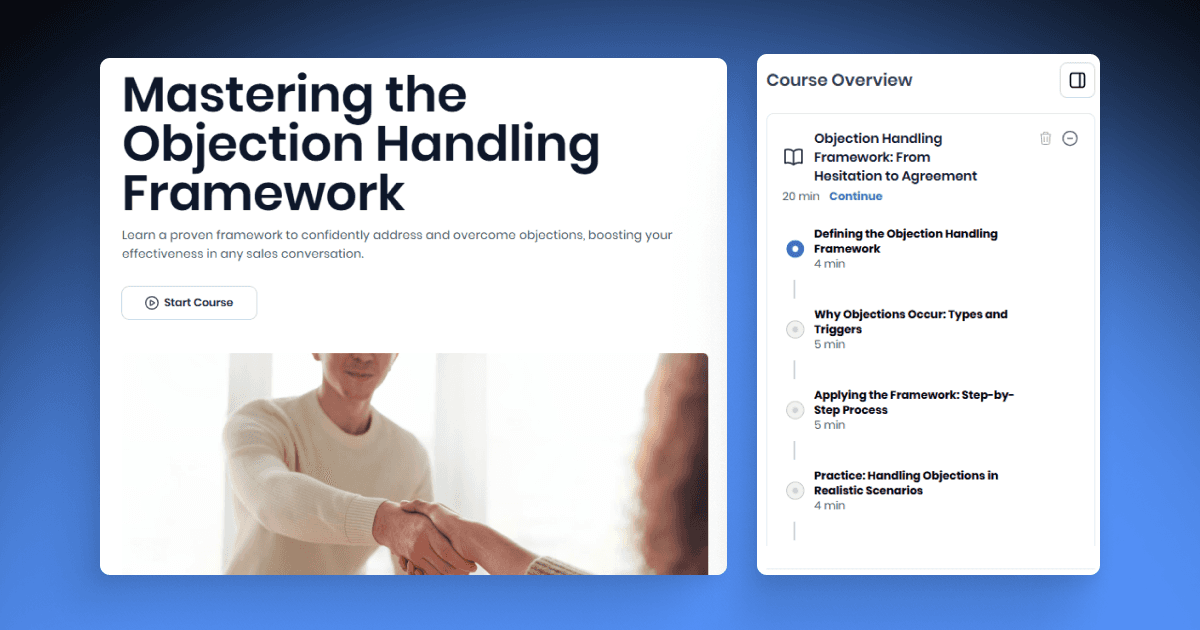
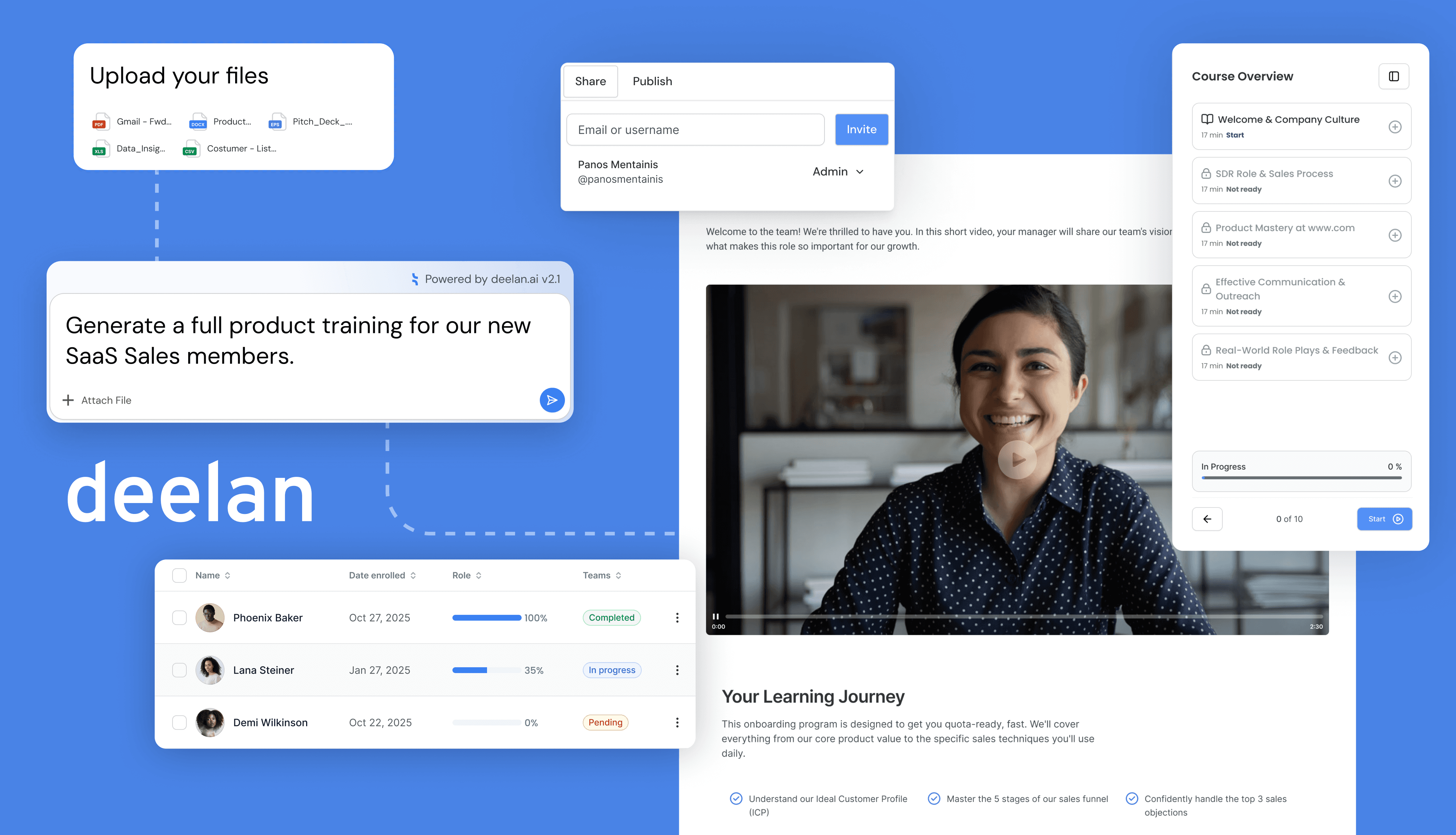
Platforms like Deelan help teams scale their training by turning existing materials into structured learning experiences.
With Deelan, sales teams can:
turn playbooks into structured training programs
generate objection pathways automatically
practice conversations through AI-powered roleplays
simulate cold calls and product demos
receive feedback and coaching after practice sessions
Ready to scale your training?
Objections are a natural part of every sales conversation. The most successful teams don’t try to avoid them — they prepare for them. Through structured objection handling training, sales reps can develop the confidence and skills needed to navigate difficult conversations.
Exercises such as roleplays, rapid-response drills, competitor scenarios, and call reviews help reps improve their ability to handle objections in real time.
Modern tools are making this process even more powerful. With Deelan, you can turn your playbooks, scripts, and recordings into interactive sales training in minutes. Your team can practice objections, demos, and customer conversations through AI-powered roleplays — helping reps ramp faster, improve their confidence, and increase win rates.
If you're looking to scale objection handling training across your revenue team, explore Deelan and see how AI-powered roleplay training can transform your sales performance. Book a demo.