Only 21% of employees strongly agree that they received meaningful feedback from their manager in the past week (Gallup, Post-Pandemic Workplace Research 2025).
The coaching gap is especially costly in sales: 67% of representatives did not expect to meet quota, while sellers reported spending 70% of their time on activities other than selling (Salesforce, State of Sales 2024).
AI is beginning to change how that coaching is delivered. Sellers who effectively work with AI are 3.7 times more likely to meet quota, while Visa reported a 78% increase in seller confidence after introducing AI-powered pitch training and coaching (Gartner, Seller Skills Survey 2024; LinkedIn Learning, Workplace Learning Report 2025).
We aggregated data from Salesforce, Gartner, Gallup, LinkedIn Learning, Microsoft, McKinsey, and dozens of other primary and methodology-backed sources to compile this report.
The numbers show why sales coaching is moving away from occasional call reviews and toward continuous, skills-based practice supported by conversation data, simulations, and AI-generated feedback.
Key Takeaways
Only 21% of employees strongly agree that they received meaningful feedback from their manager in the previous week (Gallup, Post-Pandemic Workplace Research 2025).
47% say they received manager feedback only a few times or less during the previous year (Gallup, Manager Development Strategy 2026).
Employees receiving weekly meaningful feedback are 3.5 times more likely to be engaged (Gallup, High-Quality Conversations Research 2022, most recent available).
Managers trained in coaching and people development can lead teams with up to 18% higher engagement (Gallup, Manager Development Strategy 2026).
57% of chief sales officers place manager coaching, improved tools, or upskilling among their three main productivity measures (Gartner, Sales Transformation Survey 2024).
84% of sales leaders say their sales analytics do not meet expectations for influencing performance (Gartner, Seller Productivity Research 2024).
Sellers who effectively partner with AI are 3.7 times more likely to meet quota (Gartner, Seller Skills Survey 2024).
49% of organizations planned to purchase games or simulations, while 28% planned coaching or mentoring purchases (Training magazine, Training Industry Report 2025).
72% of B2B sellers feel overwhelmed by the number of skills their roles require (Gartner, Seller Skills Survey 2024).
41% of leaders expect employees to train AI agents within five years (Microsoft, Work Trend Index 2025).
1. The Current Sales Coaching and Performance Baseline
Sales coaching is being introduced into an environment where missed targets, administrative work, and skill overload are already common. Managers therefore need to distinguish between a coachable execution problem and a structural issue involving territory, pipeline, pricing, product fit, or capacity.
The number of sellers missing quota does not mean that coaching is ineffective. It means coaching should begin with diagnosis rather than assuming that every performance gap can be solved with more motivation or another generic training module.
Quota attainment and seller productivity
84% of representatives said they had missed quota during the previous year. A coaching program that focuses only on the lowest performers may therefore overlook widespread execution and productivity problems across the wider team.
Metric | Value | Source |
|---|---|---|
Sales representatives who did not expect to meet quota | 67% | Salesforce, State of Sales 2024 |
Representatives who said they missed quota the previous year | 84% | Salesforce, State of Sales 2024 |
Representative time spent on non-selling activities | 70% | Salesforce, State of Sales 2024 |
Sales teams experimenting with or implementing AI | 81% | Salesforce, State of Sales 2024 |
AI-using sales teams reporting revenue growth | 83% | Salesforce, State of Sales 2024 |
Non-AI sales teams reporting revenue growth | 66% | Salesforce, State of Sales 2024 |
Salesforce surveyed 5,500 sales professionals across 27 countries. The revenue-growth comparison is observational and should not be interpreted as proof that AI adoption alone caused the difference.
See the Salesforce State of Sales findings.
Complexity and seller overload
More coaching content is not necessarily better coaching. 72% of B2B sellers feel overwhelmed by the number of skills required for their role, suggesting that managers need to prioritize one or two behaviors at a time.
Metric | Value | Source |
|---|---|---|
Sellers overwhelmed by the number of technologies required | 70% | Gartner, Seller Skills Survey 2024 |
Sellers overwhelmed by the number of skills required | 72% | Gartner, Seller Skills Survey 2024 |
CSOs using coaching, tools, or training among their top productivity measures | 57% | Gartner, Sales Transformation Survey 2024 |
Sales organizations achieving commercial success while executing transformation | 11% | Gartner, Sales Transformation Survey 2024 |
Sellers who effectively partner with AI and meet quota | 3.7 times more likely | Gartner, Seller Skills Survey 2024 |
Sellers demonstrating tactical flexibility and meeting quota | 3.4 times more likely | Gartner, Seller Skills Survey 2024 |
Sellers demonstrating mentalizing ability and meeting quota | 2.9 times more likely | Gartner, Seller Skills Survey 2024 |
Gartner’s seller-skills findings were based on a survey of 1,026 B2B sellers conducted between January and March 2024.
See the Gartner Seller Skills Survey.
2. Manager Feedback and Coaching Frequency
The largest coaching problem is not necessarily feedback quality alone. Many employees do not receive feedback frequently enough for it to influence the next call, meeting, or deal.
Annual performance reviews occur too late to correct a discovery habit or objection-handling weakness. Weekly coaching creates a shorter feedback loop between behavior, practice, and the next customer interaction.
How often employees receive useful feedback
47% of employees receive manager feedback only a few times or less over an entire year. At that frequency, feedback becomes retrospective evaluation rather than active coaching.
Metric | Value | Source |
|---|---|---|
Employees receiving meaningful manager feedback in the previous week | 21% | Gallup, Post-Pandemic Workplace Research 2025 |
Employees receiving manager feedback a few times or less in the previous year | 47% | Gallup, Manager Development Strategy 2026 |
Employees strongly agreeing that their manager understands their projects and tasks | 34% | Gallup, Manager Development Strategy 2026 |
Employees strongly agreeing that feedback helps them perform better | 26% | Gallup, Manager Development Strategy 2026 |
Employees who would like manager feedback at least weekly | 27% | Gallup and Workhuman, Feedback and Recognition Research 2024 |
The 27% figure does not imply that the remaining employees want no feedback. Some may prefer feedback at different intervals or through less formal conversations.
See Gallup’s manager-development research.
What consistent feedback changes
Frequent coaching is associated with motivation and engagement, but frequency alone is insufficient. Repetitive pipeline interrogation is not the same as a useful coaching conversation.
Employees receiving meaningful weekly feedback are 3.5 times more likely to be engaged. The word “meaningful” matters: the conversation must clarify expectations, recognize progress, or help the employee improve.
Suggested visual: Weekly meaningful feedback connected to motivation, engagement, and performance.
Metric | Value | Source |
|---|---|---|
Likelihood of being motivated to do outstanding work after weekly meaningful feedback | 3.2 times higher | Gallup, High-Quality Conversations Research 2022, most recent available |
Likelihood of being engaged after weekly meaningful feedback | 3.5 times higher | Gallup, High-Quality Conversations Research 2022, most recent available |
Team-engagement improvement linked with manager coaching training | Up to 18% | Gallup, Manager Development Strategy 2026 |
Employees formally able to provide upward feedback to managers | 42% | Gallup, Manager Blind Spots Research 2024 |
Employees who have formally rated their manager’s performance | 24% | Gallup, Manager Blind Spots Research 2024 |
These are workplace-wide findings rather than sales-only benchmarks. Their relevance to sales coaching is the dependence of rep development on frequent, credible manager conversations.
For a practical structure, Deelan’s 12 sales coaching techniques cover call review, self-evaluation, one-skill coaching, action planning, and progress measurement.
3. Sales Manager Capacity and Coaching Quality
Managers are usually expected to coach while forecasting, hiring, reviewing deals, reporting performance, and handling escalations. Coaching therefore competes with urgent operational work even when leaders consider it important.
The issue is less about convincing managers that coaching matters and more about providing enough time, reliable evidence, and a process they can repeat consistently.
Manager support and capability
50% of L&D professionals say managers lack sufficient support for career development. This indicates that weak coaching may be a systems problem rather than simply a manager-attitude problem.
Metric | Value | Source |
|---|---|---|
Respondents saying managers lack proper support for career development | 50% | LinkedIn Learning, Workplace Learning Report 2025 |
Respondents saying employees lack sufficient support | 45% | LinkedIn Learning, Workplace Learning Report 2025 |
Respondents saying talent teams lack sufficient support | 33% | LinkedIn Learning, Workplace Learning Report 2025 |
Respondents naming lack of leadership support as a major barrier | 11% | LinkedIn Learning, Workplace Learning Report 2025 |
Employees whose manager helped them create a career plan in the previous six months | 15% | LinkedIn Learning, Workplace Learning Report 2025 |
Year-over-year decline in employees receiving manager career-planning support | 5 percentage points | LinkedIn Learning, Workplace Learning Report 2025 |
Only 11% identified leadership indifference as a leading barrier. The more common problem was insufficient capacity and support at the manager, employee, and talent-team levels.
See the LinkedIn Workplace Learning Report 2025.
Coaching from performance data
A larger analytics stack does not automatically produce better coaching. Managers need to know which metrics represent symptoms, which reveal behaviors, and which should lead to a specific intervention.
84% of sales leaders say their analytics fail to meet expectations for influencing sales performance. That is a major warning for AI coaching systems that generate large quantities of scores without explaining what a manager or representative should do next.
Metric | Value | Source |
|---|---|---|
Sales leaders saying analytics do not meet expectations for influencing performance | 84% | Gartner, Seller Productivity Metrics Research 2024 |
Sales leaders saying actionable insights are difficult to identify | 60% | Gartner, Seller Productivity Metrics Research 2024 |
Respondents reporting that managers effectively coach and develop employees | Fewer than 30% | McKinsey, Harnessing the Power of Performance Management 2018, most recent available |
Respondents with effective coaching who consider their performance-management system effective | 74% | McKinsey, Harnessing the Power of Performance Management 2018, most recent available |
Respondents with effective coaching who report outperforming competitors | 62% | McKinsey, Harnessing the Power of Performance Management 2018, most recent available |
Participants with effective performance systems saying managers were trained in feedback and coaching | 71% | McKinsey, Effective Feedback Conversations 2020, most recent available |
The McKinsey figures are older than three years and are retained as the most recent available findings from those specific research series.
See McKinsey’s performance-management research.
4. AI Sales Coaching Adoption and Performance
AI sales coaching addresses two constraints simultaneously: managers cannot manually review every conversation, and representatives often need feedback before their next scheduled one-to-one.
The value is not simply automatic scoring. The stronger use case is connecting evidence from calls, roleplays, CRM activity, or assessments to a narrow recommendation the representative can practice immediately.
AI use and seller outcomes
Sellers who effectively partner with AI are 3.7 times more likely to meet quota. This does not prove that an AI tool independently creates high performers, but it suggests that the ability to work productively with AI is becoming part of sales competence.
Metric | Value | Source |
|---|---|---|
Sales teams experimenting with or implementing AI | 81% | Salesforce, State of Sales 2024 |
Increased quota likelihood for sellers effectively partnering with AI | 3.7 times | Gartner, Seller Skills Survey 2024 |
AI-using sales teams reporting revenue growth | 83% | Salesforce, State of Sales 2024 |
Non-AI sales teams reporting revenue growth | 66% | Salesforce, State of Sales 2024 |
L&D professionals exploring, experimenting with, or integrating AI | 71% | LinkedIn Learning, Workplace Learning Report 2025 |
Career-development leaders’ increased likelihood of deploying AI training | 32% higher | LinkedIn Learning, Workplace Learning Report 2025 |
The Salesforce comparison reflects correlation rather than an isolated causal effect. AI-adopting organizations may differ in resources, management quality, data maturity, and operating model.
Deelan’s AI sales coach guide explains how call evidence, roleplay performance, and company knowledge can be translated into personalized coaching rather than generic feedback.
AI-powered practice and seller confidence
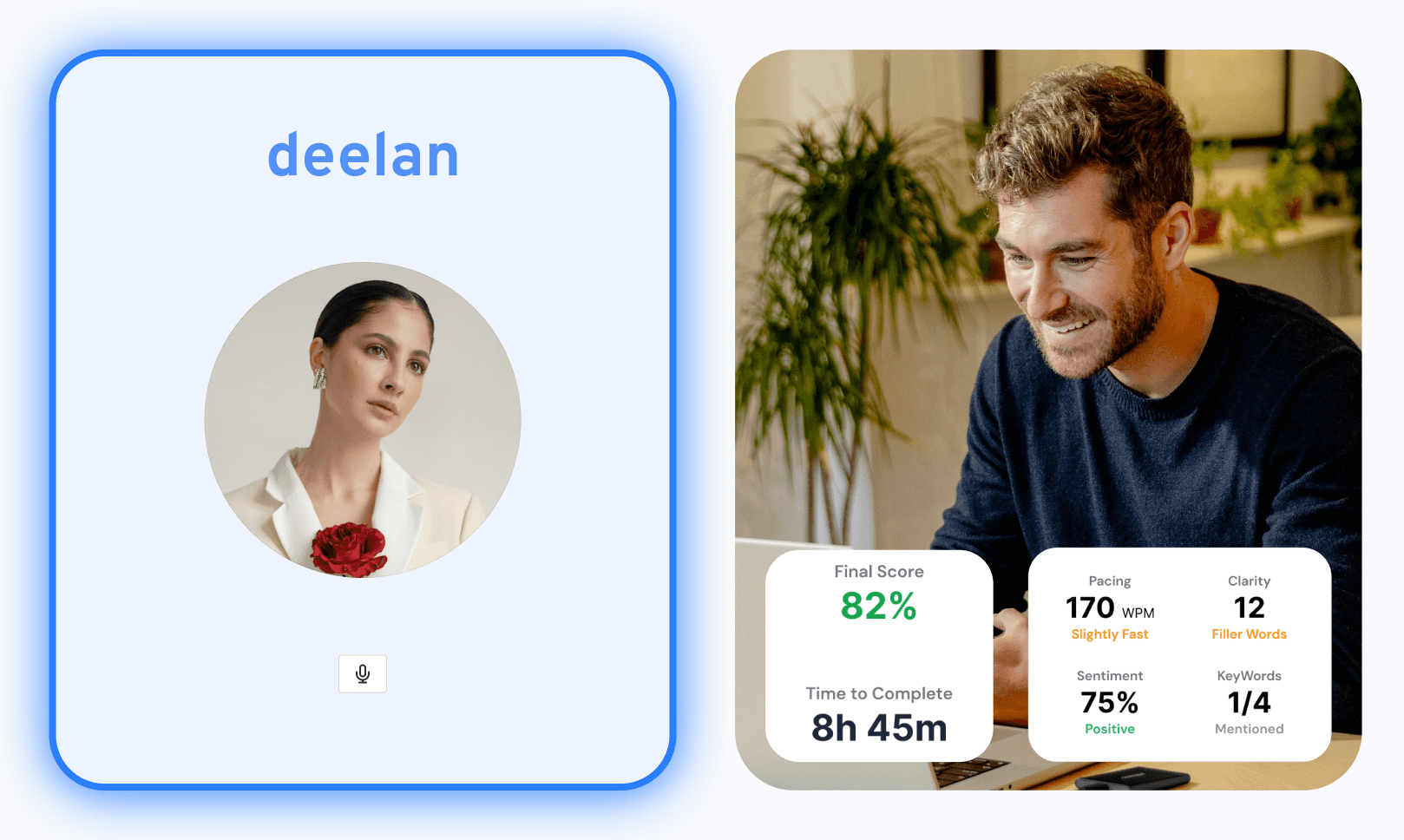
One of the clearest recent sales-coaching examples comes from Visa, where sellers use AI to practise more than 200 product and solution value propositions in a low-risk environment.
The reported improvement was in confidence, not independently measured revenue or win rate. That distinction matters: confidence is useful, but it should eventually be connected to observed behavior and commercial outcomes.
Metric | Value | Source |
|---|---|---|
Increase in Visa sellers’ confidence to pitch products | 78% | LinkedIn Learning, Workplace Learning Report 2025 |
Visa leaders seeing value in seller use of AI practice | 83% | LinkedIn Learning, Workplace Learning Report 2025 |
Product and solution value propositions Visa sellers may need to communicate | More than 200 | LinkedIn Learning, Workplace Learning Report 2025 |
Leaders expecting employees to train AI agents within five years | 41% | Microsoft, Work Trend Index 2025 |
Leaders expecting employees to manage AI agents within five years | 36% | Microsoft, Work Trend Index 2025 |
Leaders saying AI will let employees handle complex work earlier | 83% | Microsoft, Work Trend Index 2025 |
See the LinkedIn Workplace Learning Report’s Visa case study.
5. Roleplay, Simulations, and Coaching Practice
Feedback tells representatives what happened. Practice gives them a chance to respond differently before the behavior affects another real opportunity.
This explains why simulation purchasing is growing faster than interest in many passive formats. Roleplay can turn a coaching recommendation such as “improve discovery” into a repeatable scenario with evidence of whether the skill actually changed.
Investment in practice-based learning
49% of surveyed organizations expected to purchase games or simulations, making this the leading planned training-product category in Training magazine’s 2025 report.
Metric | Value | Source |
|---|---|---|
Organizations anticipating games or simulation purchases | 49% | Training magazine, Training Industry Report 2025 |
Organizations anticipating online-learning tools or systems | 45% | Training magazine, Training Industry Report 2025 |
Organizations anticipating business-skills products | 44% | Training magazine, Training Industry Report 2025 |
Organizations anticipating assessment or analysis testing | 30% | Training magazine, Training Industry Report 2025 |
Organizations anticipating coaching or mentoring purchases | 28% | Training magazine, Training Industry Report 2025 |
Organizations naming training-effectiveness improvement as a 2026 priority | 28% | Training magazine, Training Industry Report 2025 |
Organizations prioritizing increased learner use | 19% | Training magazine, Training Industry Report 2025 |
Organizations prioritizing lower costs or greater efficiency | 19% | Training magazine, Training Industry Report 2025 |
These figures cover organizational training generally, not sales departments exclusively. Their relevance is the broader movement toward active practice, measurement, and coaching support.
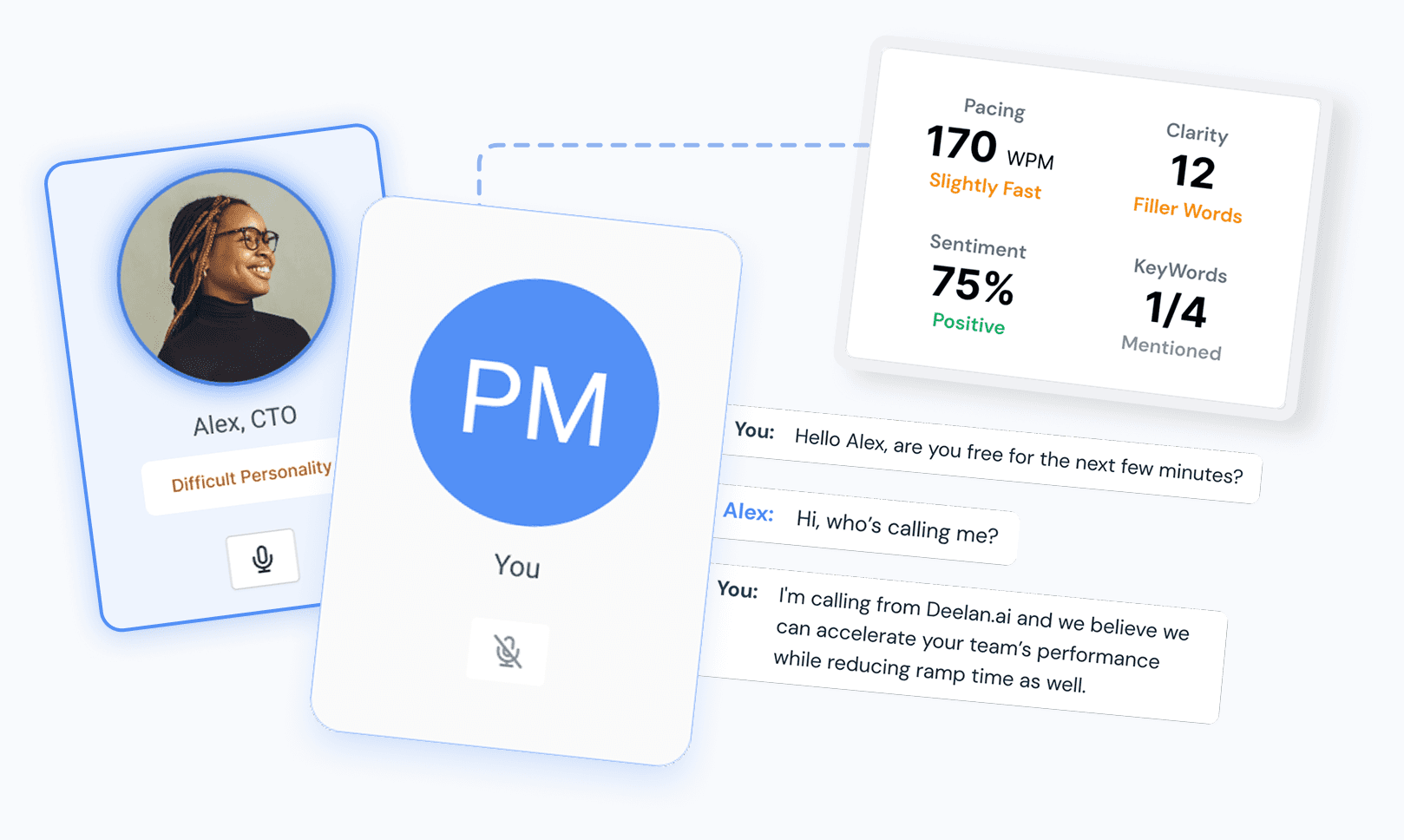
Deelan’s realistic AI roleplay guide shows how sellers can practise discovery, cold calls, objections, negotiation, and product demos with an AI buyer before speaking to a real prospect.
What scalable practice changes
AI simulations make repetition easier, but they do not remove the need for good scenario design. A representative will improve only if the roleplay reflects the real buyer, product, methodology, and level of difficulty.
A useful AI coaching simulation should therefore measure specific behaviors rather than award a single vague score.
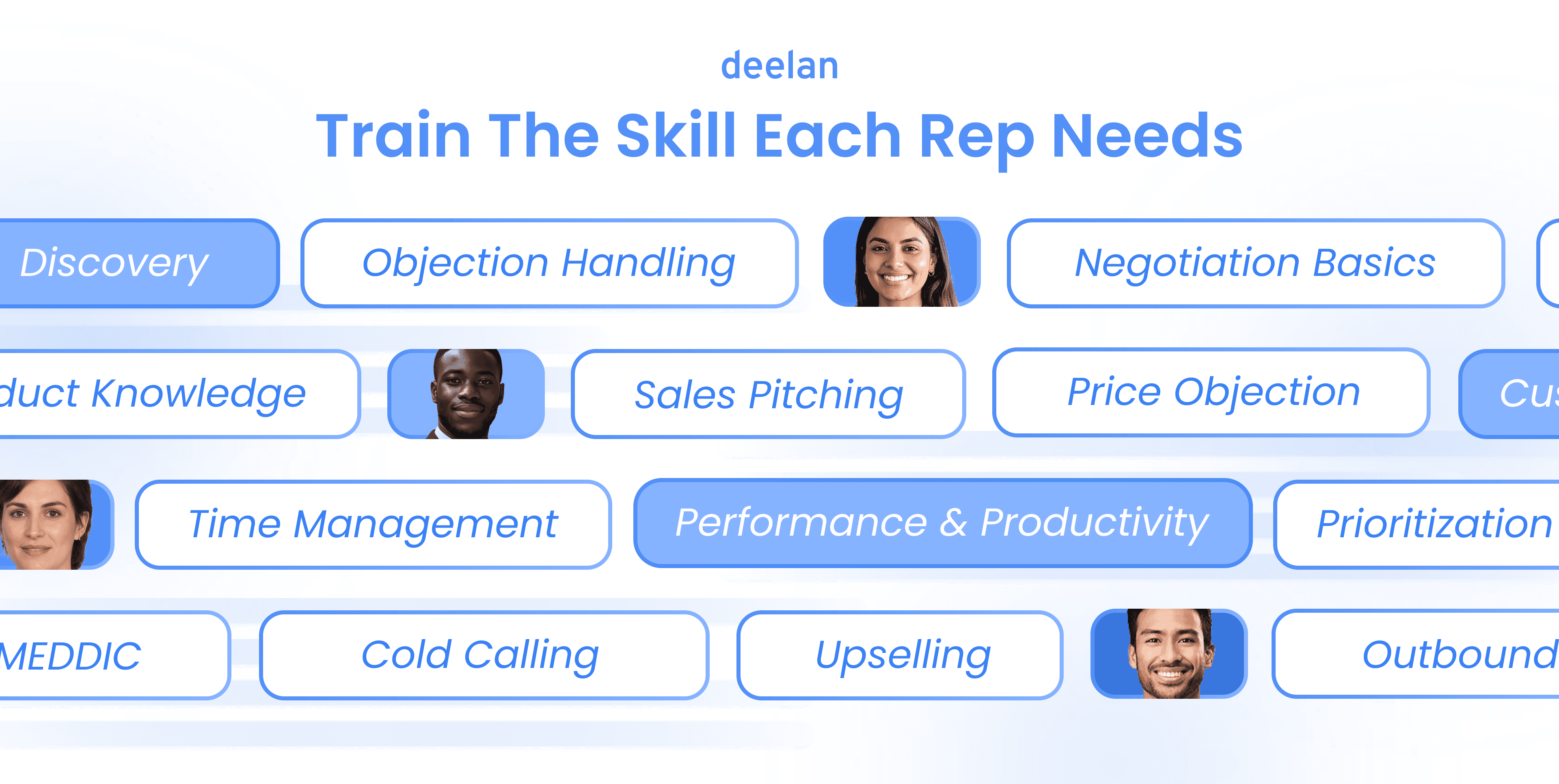
Coaching and practice dimension | What should be measured |
|---|---|
Discovery | Question relevance, depth, follow-up quality, and listening |
Diagnosis before response, clarity, and value connection | |
Product demos | Structure, relevance, engagement, and response to interruption |
Negotiation | Preparation, trade-offs, discount discipline, and next steps |
Communication | Talk-to-listen balance, clarity, confidence, and concision |
Methodology execution | Observable behaviors tied to the team’s chosen framework |
Improvement | Change between attempts and transfer to real conversations |
This measurement framework is editorial guidance rather than a third-party statistical finding.
6. Future Skills for Sales Coaches and Representatives
AI increases the importance of human coaching rather than removing it. Representatives still need judgment, adaptability, empathy, negotiation, and the ability to interpret what a buyer has not explicitly said.
Managers will also need to coach AI-supported work: whether representatives used reliable context, validated the output, protected sensitive information, and applied human judgment at the right point.
Skills disruption and reskilling
59% of the global workforce is expected to require training by 2030. Sales coaching will increasingly need to support both technical AI competence and human customer-facing skills.
Metric | Value | Source |
|---|---|---|
Global workforce expected to require training by 2030 | 59% | World Economic Forum, Future of Jobs Report 2025 |
Employers planning to prioritize workforce upskilling | 85% | World Economic Forum, Future of Jobs Report 2025 |
Employers identifying skills gaps as a major transformation barrier | 63% | World Economic Forum, Future of Jobs Report 2025 |
Existing skills expected to change or become outdated by 2030 | 39% | World Economic Forum, Future of Jobs Report 2025 |
Increase in employers identifying leadership and social influence as core skills | 22 percentage points | World Economic Forum, Future of Jobs Report 2025 |
Increase for resilience, flexibility, and agility | 17 percentage points | World Economic Forum, Future of Jobs Report 2025 |
Increase for AI and big-data skills | 17 percentage points | World Economic Forum, Future of Jobs Report 2025 |
The World Economic Forum surveyed more than 1,000 employers representing over 14 million workers across 55 economies. Its figures are employer expectations for 2030 rather than guaranteed outcomes.
See the World Economic Forum Future of Jobs Report 2025.
Workload and the future of AI-supported coaching
AI coaching adoption will be shaped partly by capacity. Managers and employees are already struggling to find time for deep work, feedback, and development.
80% of the global workforce reports lacking the time or energy required to complete its work. An AI coach is most useful where it reduces preparation and analysis rather than becoming another interface employees must manage.
Metric | Value | Source |
|---|---|---|
Workers lacking sufficient time or energy to complete their work | 80% | Microsoft, Work Trend Index 2025 |
Leaders saying productivity must increase | 53% | Microsoft, Work Trend Index 2025 |
Leaders expecting to use digital labor within 12–18 months | 82% | Microsoft, Work Trend Index 2025 |
Leaders reporting full automation of some workflows with agents | 46% | Microsoft, Work Trend Index 2025 |
Average interruption frequency from meetings, email, or messages | Once every two minutes | Microsoft, Work Trend Index 2025 |
Workers at “Frontier Firms” saying their company is thriving | 71% | Microsoft, Work Trend Index 2025 |
Workers globally saying their company is thriving | 37% | Microsoft, Work Trend Index 2025 |
Microsoft’s report combined a survey of 31,000 professionals across 31 countries with LinkedIn labor data and Microsoft 365 activity signals.
See the Microsoft Work Trend Index 2025.
7. Learning Culture, Career Development, and Retention
Sales coaching is often framed entirely as a quota intervention. However, representatives also interpret coaching as evidence of whether their manager and organization are invested in their development.
A coaching culture can therefore influence both execution and retention. This is particularly important where experienced sellers hold customer, market, and product knowledge that is difficult to replace.
Metric | Value | Source |
|---|---|---|
L&D professionals reporting executive concern about critical skill gaps | 49% | LinkedIn Learning, Workplace Learning Report 2025 |
L&D professionals agreeing continuous learning is more important than ever | 91% | LinkedIn Learning, Workplace Learning Report 2025 |
Organizations concerned about employee retention | 88% | LinkedIn Learning, Workplace Learning Report 2025 |
Organizations offering leadership training | 71% | LinkedIn Learning, Workplace Learning Report 2025 |
Organizations classified as career-development champions | 36% | LinkedIn Learning, Workplace Learning Report 2025 |
Organizations with limited career-program adoption | 31% | LinkedIn Learning, Workplace Learning Report 2025 |
Organizations with no initiatives or only beginning | 33% | LinkedIn Learning, Workplace Learning Report 2025 |
Learning opportunities were the most frequently cited retention strategy among respondents concerned about retention. That does not mean training alone prevents turnover, but weak development can increase the perceived cost of staying.
See the LinkedIn Workplace Learning Report 2025.
8. Measuring Sales Coaching Effectiveness and ROI
Completion rates say little about whether coaching improved a customer conversation. Strong measurement connects the coaching activity to demonstrated skill, behavior in real calls, pipeline movement, and commercial outcomes.
AI can make more behavior observable, but it can also create misleading precision. A score of 82 out of 100 is not useful unless managers understand the behaviors behind it, the evidence used, and the next action it recommends.
Coaching measurement maturity
Nearly one-quarter of employees said their manager or feedback provider lacked the skills needed to conduct an effective performance review. Measurement therefore depends on manager capability as much as dashboard quality.
Metric | Value | Source |
|---|---|---|
Respondents saying feedback providers lacked sufficient review skills | Nearly 25% | McKinsey, Employee Motivation and Performance Management 2024 |
Respondents reporting effective manager coaching and development | Fewer than 30% | McKinsey, Performance Management Research 2018, most recent available |
Effective-system participants saying managers had feedback and coaching training | 71% | McKinsey, Effective Feedback Conversations 2020, most recent available |
Close-rate improvement in a manager-coaching transformation case | 25% | McKinsey, Commercial Transformation Research 2018, single-company case |
Sales leaders dissatisfied with analytics’ ability to influence performance | 84% | Gartner, Seller Productivity Metrics Research 2024 |
Sales leaders struggling to identify actionable analytics insights | 60% | Gartner, Seller Productivity Metrics Research 2024 |
The 25% close-rate improvement is a single organizational case study and should not be treated as a universal return expected from sales coaching.
See McKinsey’s commercial-transformation case analysis.
What sales coaching teams should measure
A credible coaching system should separate activity, skill, behavior, and business impact.
Measurement level | Example metrics |
|---|---|
Coaching activity | Sessions held, calls reviewed, feedback delivered, practice attempts |
Coaching quality | Specificity, evidence used, action agreed, employee participation |
Skill demonstration | Discovery, listening, objection handling, demo, negotiation |
Behavior transfer | Improvement observed in real customer conversations |
Pipeline outcomes | Conversion by stage, opportunity progression, deal quality |
Commercial outcomes | Quota attainment, win rate, ramp time, discounting, retention |
Efficiency | Manager preparation time, cost per coached representative |
Durability | Whether improvement remains after several weeks or months |
Deelan’s sales coaching software guide explains how platforms can combine call analysis, skill assessment, roleplay, personalized recommendations, and progress tracking.
The supplied Deelan materials position the platform around adaptive training, AI roleplay, assessments, and scalable manager coaching rather than completion-only learning.
Sales Coaching by the Numbers: Summary Table
Metric | Value | Source |
|---|---|---|
Employees receiving meaningful feedback in the previous week | 21% | Gallup, Post-Pandemic Workplace Research 2025 |
Employees receiving feedback a few times or less in one year | 47% | Gallup, Manager Development Strategy 2026 |
Employees saying feedback helps them work better | 26% | Gallup, Manager Development Strategy 2026 |
Engagement likelihood with meaningful weekly feedback | 3.5 times higher | Gallup, High-Quality Conversations Research 2022, most recent available |
Motivation likelihood with meaningful weekly feedback | 3.2 times higher | Gallup, High-Quality Conversations Research 2022, most recent available |
Team-engagement improvement after manager coaching training | Up to 18% | Gallup, Manager Development Strategy 2026 |
Sales representatives not expecting to meet quota | 67% | Salesforce, State of Sales 2024 |
Representatives missing quota in the previous year | 84% | Salesforce, State of Sales 2024 |
Representative time spent on non-selling work | 70% | Salesforce, State of Sales 2024 |
Sellers overwhelmed by required skills | 72% | Gartner, Seller Skills Survey 2024 |
CSOs using coaching, tools, or training as productivity measures | 57% | Gartner, Sales Transformation Survey 2024 |
Sellers partnering effectively with AI | 3.7 times more likely to meet quota | Gartner, Seller Skills Survey 2024 |
Sales leaders dissatisfied with performance analytics | 84% | Gartner, Seller Productivity Metrics Research 2024 |
Sales leaders struggling to find actionable insights | 60% | Gartner, Seller Productivity Metrics Research 2024 |
Increase in Visa sellers’ pitching confidence | 78% | LinkedIn Learning, Workplace Learning Report 2025 |
Visa leaders seeing value in AI practice | 83% | LinkedIn Learning, Workplace Learning Report 2025 |
Organizations planning simulation purchases | 49% | Training magazine, Training Industry Report 2025 |
Organizations planning coaching or mentoring purchases | 28% | Training magazine, Training Industry Report 2025 |
Leaders expecting teams to train AI agents | 41% | Microsoft, Work Trend Index 2025 |
Global workforce expected to require training by 2030 | 59% | World Economic Forum, Future of Jobs Report 2025 |
Methodology and Sources
We prioritized original surveys, official reports, first-party datasets, and methodology-backed research. Statistics were checked for sample, population, date, and metric definition; figures older than three years are labeled “most recent available,” and single-company cases are identified rather than presented as universal benchmarks.
Sources cited:
Salesforce, State of Sales, sixth edition, 2024.
Gartner, Seller Skills Survey, 2024.
Gartner, Sales Transformation Survey, 2024.
Gartner, Identify Leading Indicators That Improve Seller Productivity, 2024.
Gallup, The Post-Pandemic Workplace: The Experiment Continues, 2025.
Gallup, Manager Development Strategy: A Practical Guide, 2026.
Gallup, High-Quality Conversations Are Banks’ Source for Growth, 2022, most recent available.
Gallup and Workhuman, Feedback and Recognition Research, 2024.
Gallup, The Strengths, Weaknesses and Blind Spots of Managers, 2024.
LinkedIn Learning, Workplace Learning Report, 2025.
Microsoft, Annual Work Trend Index, 2025.
World Economic Forum, Future of Jobs Report, 2025.
Training magazine, Training Industry Report, 2025.
McKinsey & Company, Harnessing the Power of Performance Management, 2018, most recent available.
McKinsey & Company, Unlocking the True Value of Effective Feedback Conversations, 2020, most recent available.
McKinsey & Company, What Employees Say Matters Most to Motivate Performance, 2024.
McKinsey & Company, The 90% Success Recipe, single-company coaching case.
Last updated: July 2026
We update this page quarterly with the latest data.