

Giving feedback to a sales rep is one of the hardest parts of the job. Not because managers don't care - most do - but because the line between honest coaching and accidental demotivation is thin. Say too little and nothing changes. Say too much at once and the rep shuts down. Say it wrong and you lose their trust.
Most advice on this topic is frustratingly vague. "Be specific." "Be timely." "Be constructive." What does specific actually sound like? What do you say to the rep who's been missing quota for two months without making them feel attacked?
80% of employees who receive meaningful feedback say they're fully engaged at work.
This guide gives you 15 real scripts — organized by situation — so you know exactly what to say. Along the way, you'll get the frameworks behind them, the mistakes to stop making, and a simple way to make feedback part of how your team actually works.
What you'll learn:
The three feedback frameworks top sales managers use
The golden rules that separate coaching from criticism
15 word-for-word scripts for positive, constructive, and review situations
Which feedback styles to avoid and why they backfire
How to build feedback into your weekly rhythm, not just your quarterly calendar
Want to build a more consistent coaching process?
Start a free 14-day trial and see how AI-powered roleplays, coaching feedback, and skills assessments help managers scale sales coaching across the entire team.
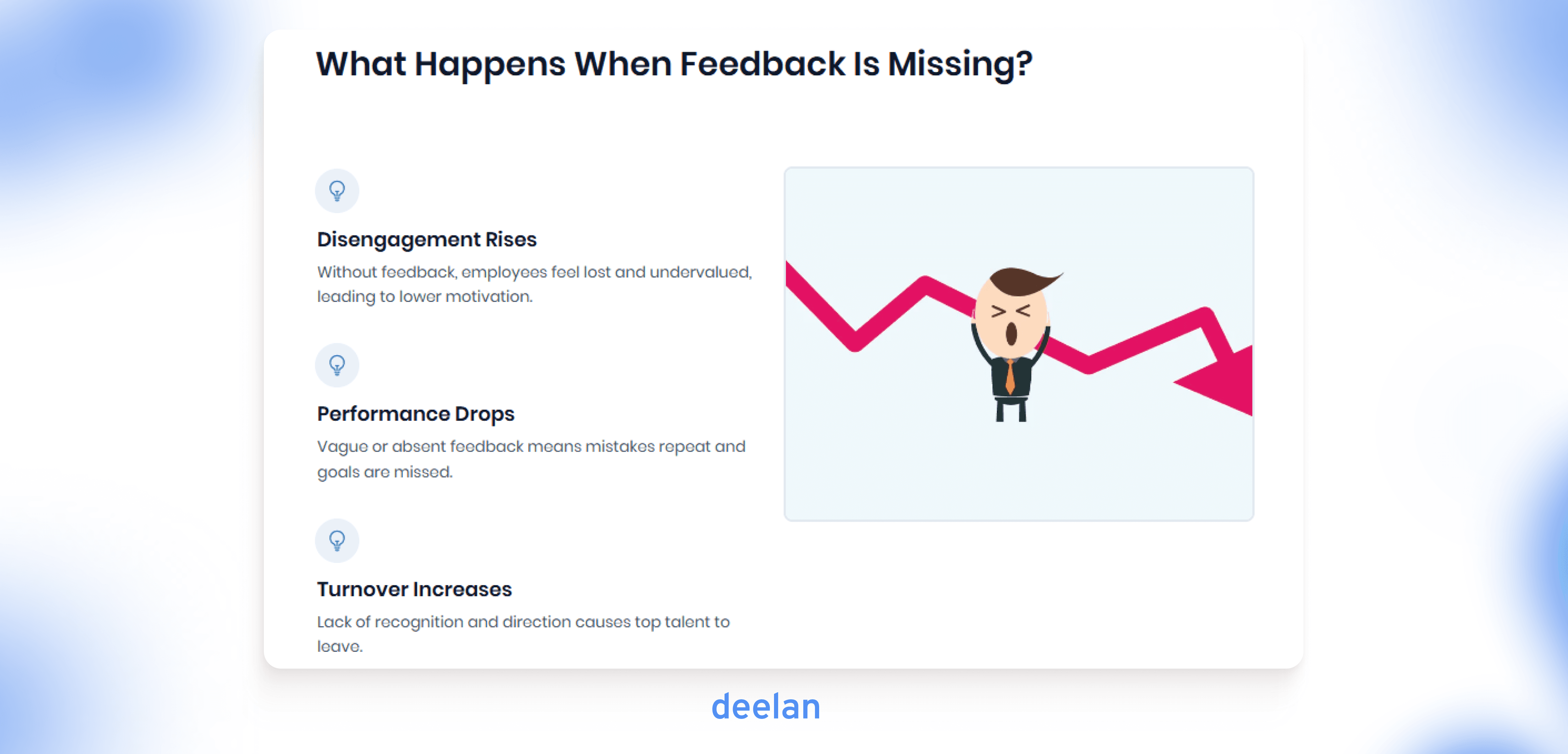
Why Feedback Is the #1 Lever for Sales Performance
A rep with a $1M quota who isn't coached properly costs the company around $20,000 a week in lost productivity. That's not a hypothetical — it's what happens when managers assume reps will figure it out on their own.
The problem isn't effort. Most sales reps want to improve. The problem is that 67% of them say sales leadership is disconnected from the realities of their day-to-day work. They're getting performance data but not guidance. Numbers but not direction.
Feedback, done right, closes that gap. It tells a rep not just where they are, but what to do next. It replaces "your close rate dropped" with "here's the specific moment in your discovery calls where deals start slipping — and here's what to try instead."
The reps who grow fastest aren't always the most talented. They're the ones getting the clearest coaching.
Looking for practical sales coaching resources?
Explore free courses, roleplays, and workshops designed for sales managers and enablement teams.
Explore Free Sales Training Resources
• How to Handle Any Objection
• Cold Outreach That Actually Works
• Run a Discovery Call Live
• Objection Drills: Handle It Live
The 3 Core Feedback Frameworks Every Sales Manager Should Know
Before the scripts, you need the structure. These three frameworks are what separate feedback that changes behavior from feedback that just fills a slot in the calendar.
The 5 R's of Feedback
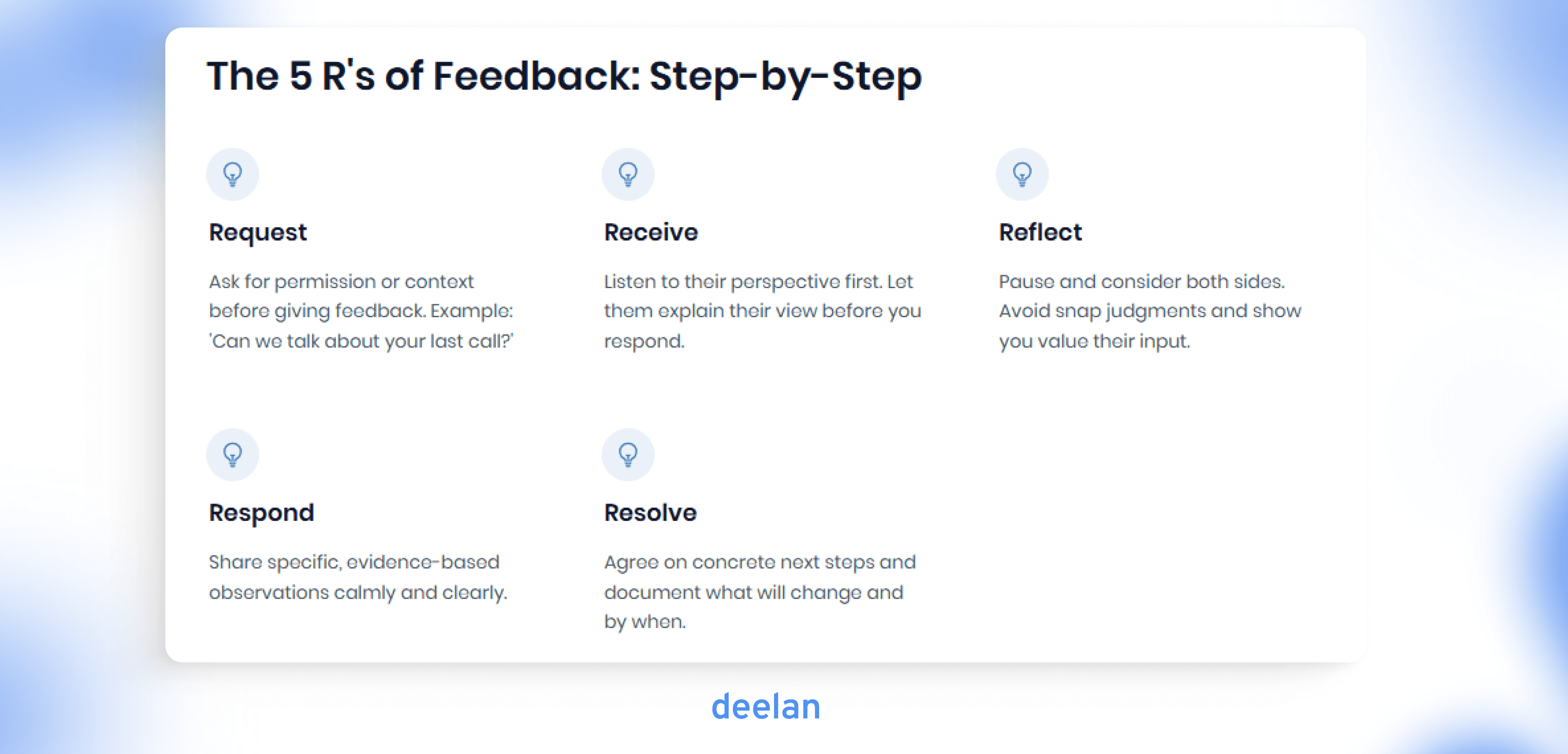
The 5 R's — Request, Receive, Reflect, Respond, Resolve — give every feedback conversation a shape.
Request means opening the conversation with context, not a verdict. "Can we talk about Thursday's call?" lands better than "I need to give you some feedback."
Receive is about listening first. Ask the rep what they thought before you share your view. You'll often find they already know what went wrong.
Reflect is the pause before you respond. What you observed and what actually happened may not be the same thing. Give yourself a moment to check.
Respond is where you deliver your specific, evidence-based observation. Not "you seemed distracted" — "you asked the same qualifying question twice, which made the prospect repeat themselves."
Resolve is the part most managers skip. Every feedback conversation should end with a clear agreement: what changes, what the rep will do differently, and when you'll follow up.
The 3 P's — Positive, on Point, Personal
Every piece of useful feedback is Positive in framing, on Point in specificity, and Personal to that individual rep.
Poor: "You're doing a great job."
Strong: "You've really improved your meeting hosting — the structured agenda you used on Thursday kept the prospect focused, and the way you handled the budget question directly instead of deflecting it was exactly what we've been working on."
The second version tells the rep what to repeat. The first one tells them nothing.
Feedforward, DESC, and the What/Why Technique
Feedforward shifts the focus from what went wrong in the past to what to do differently next time. Instead of "you talked over the prospect," try "next time there's a pause, let it sit for three seconds before you respond." Same message, completely different energy.
DESC is a four-part structure: Describe the situation, Express your concern, Specify what you need, explain the Consequence. "On Monday's call (D), you moved into the demo before asking about their current process (E). Going forward, run all five discovery questions first (S), because it directly affects whether we're showing relevant features (C)."
What/Why is the simplest. Name what happened, explain why it matters. "You interrupted the prospect twice. That signals impatience, and impatient reps lose trust fast."
The Three Golden Rules of Sales Feedback
Honest. Kind. Timely. All three have to be there.
Honest without kind is damage. The rep gets the information but loses confidence and often their trust in you. Kind without honest is just flattery — it feels good but changes nothing. And timely without both is noise. Feedback delivered three weeks after a call, with no real substance, teaches the rep that reviews are a formality.
Good feedback is also tied directly to observable behavior. Not attitude, not personality, not potential — behavior. What the rep said, when they said it, and what it led to. That's what's coachable.
Every conversation should end with a next step both of you have agreed on. Not a vague "work on your discovery." Something specific: which questions to ask, which call to review, what you'll both check in on next week.
How to Give Feedback to a Salesperson: 15 Real Examples
Here are 15 real scripts organized by situation. Each one is specific, behavioral, and forward-looking.
Situation | Main Feedback Point | What Manager Should Do |
|---|---|---|
Major win after objection handling | Reinforce the exact behavior that led to the win | Point out the specific move and tell the rep to repeat it |
Show progress from old habits to better ones | Highlight what changed and why it improved results | |
Extra effort on proposal | Connect extra work to the business outcome | Recognize the effort and tie it to the next meeting or deal progress |
Consistent performance | Praise the process, not only the number | Reinforce habits like follow-up and discipline |
First win from a new hire | Build confidence early | Show the rep which behavior led to the win |
Weak discovery | Rep rushed into demo too early | Tell them to stay longer in discovery and give exact questions to ask |
Talking too much on calls | Rep dominates the conversation | Use talk-ratio data and coach them to leave more space |
Missing follow-ups | Deals are stuck with no activity | Investigate the reason before judging and create a follow-up plan |
Weak pricing conversation | Rep sounds unsure when giving price | Give them stronger wording and practice it in role-play |
Rep upset after feedback | Rep becomes discouraged or defensive | Acknowledge the emotion and move quickly to a specific lesson |
Opening a quarterly review | Start with the rep’s own reflection | Ask what they are proud of and where they struggled |
Underperforming rep | Missed quota needs investigation, not blame | Explore blockers before deciding what needs to change |
Development plan | Turn feedback into a concrete action plan | Agree on 2–3 focus areas, role-plays, and check-ins |
Peer feedback | Use peer feedback as encouragement, not comparison | Frame it as a strength and an opportunity to contribute |
Closing with alignment | End with clear next steps | Confirm exactly what the rep will do and when you will review it |
Positive Feedback Examples for Sales Reps
1. Recognizing a major win Situation: Rep closed a deal after strong objection handling. What to say: "The way you handled the pricing pushback on that call was exactly right. You didn't apologize for the number — you went straight back to the ROI we'd already established. That's the move, and it worked. Keep doing that." Why it works: It names the exact behavior and tells them to repeat it.
2. Praising improved discovery Situation: Rep who used to pitch too early is now asking better questions. What to say: "I listened back to Thursday's call. You asked four open questions before you opened the deck. Six months ago you were pitching by minute three. That shift is real, and it's showing up in your pipeline quality." Why it works: It anchors the praise in progress, which is more motivating than baseline praise.
3. Acknowledging extra effort Situation: Rep stayed late to prep a complex proposal. What to say: "The Acme proposal was thorough. I know that took time outside normal hours. The level of detail on the ROI model specifically is what got us to a second meeting — that was your work." Why it works: It connects effort to a specific outcome, not just to working hard.
4. Recognizing consistent performance Situation: Rep has hit quota three months running. What to say: "Three months in a row, and more importantly you're doing it the right way — your follow-up cadence is the most consistent on the team. That discipline is harder to build than most people think." Why it works: It validates the process, not just the result. That sustains the behavior.
5. First win from a new hire Situation: New rep closes their first deal in week five. What to say: "Landing a deal in week five is genuinely fast. What I want you to notice is how you handled the second call — you asked a clarifying question instead of filling the silence with more pitch. That instinct will take you far." Why it works: It builds self-awareness from the start, which compounds over time.
Constructive Feedback Examples for Sales Reps
6. Low discovery quality Situation: Rep jumped to the demo before understanding the prospect's situation. What to say: "On today's call, you moved into the demo before asking anything about their current setup. We ended up showing features they don't need. Next time, stay in discovery mode for the first ten minutes — I'll send you the five questions I want you to run through first." What to avoid: "You need to do more discovery." — this tells them nothing actionable. Why it works: It gives a specific fix, not just a label for the problem.
7. Talking too much on calls Situation: Rep's talk ratio is consistently above 65%. What to say: "I pulled the recording from Tuesday. You had about 68% of the talk time. The prospect never got a chance to tell you what they actually care about. Let's work on making space after you pitch — I'll show you a clip of how [name] handles this." What to avoid: "You talk too much." — it's accurate but lands as a personality criticism. Why it works: Data removes the personal edge. A comparison to a technique (not a person) gives them something to copy.
8. Missing follow-ups Situation: Three pipeline deals have had no activity for two weeks. What to say: "Three deals haven't moved in two weeks. Before I draw any conclusions, walk me through what's happening with each of them. I want to understand if there's a capacity issue, a tool issue, or something specific about those accounts." What to avoid: "You're not following up properly." — this invites defensiveness before you have the full picture. Why it works: Investigating before judging often reveals a problem you're actually able to fix.
9. Weak pricing conversation Situation: Rep apologized before giving the price on a call. What to say: "When the price came up, I heard you say 'I know it's a lot, but...' before you gave the number. That signals uncertainty before the buyer has even reacted. Try this instead: 'Based on what we've mapped out, the investment is X.' Then stop. Let them respond. We'll role-play it before your next demo." What to avoid: "You need more confidence with pricing." — confidence isn't coachable without a specific behavior to change. Why it works: It gives the rep the exact words and a way to practice them.
10. Handling a rep who's upset after feedback Situation: Rep gets visibly discouraged during a difficult conversation. What to say: "I can see this is hard to hear. I want to be clear about why I'm raising it — it's because I think you can fix this quickly, and I want to help you get there. Can we look at the recording together and find the exact moment where it shifted?" What to avoid: "I'm frustrated because you keep making this mistake." — the rep focuses on your emotion, not the lesson. Why it works: It leads with intent and immediately turns the conversation toward action.
Performance Review & Career Growth Feedback Scripts
11. Opening a quarterly review Situation: Start of a formal review conversation. What to say: "Before I share anything, I want to hear from you. Looking at this quarter — what are you most proud of? What felt hardest? I want to make sure my read matches yours before we build a plan." Why it works: Self-reflection first. Reps who articulate their own performance engage more seriously with the plan that follows.
12. Addressing an underperforming rep Situation: Rep has missed quota two months running. What to say: "The numbers are below where we need them to be, and I want to understand why before we react. Walk me through a normal week for you right now. Where do you feel stuck? What would actually make the biggest difference?" What to avoid: "Your results aren't good enough." — accurate, but useless. It confirms what they already know and gives them nothing. Why it works: You might discover a blocker you can actually remove — bad lead quality, a tool issue, unclear messaging. Don't close that door before you've opened it.
13. Building a development plan together Situation: End of a review, moving toward next steps. What to say: "Based on what we've both said, I think the three things to focus on this quarter are discovery depth, pricing confidence, and follow-up cadence. Let's build a concrete plan around each — I'll set up two role-plays this month, and we'll check in together in four weeks. Does that feel right?" Why it works: Shared ownership of the plan. The rep agreed to it, so they're more likely to follow through.
14. Giving feedback in a peer context Situation: Peer review or team debrief where one rep can offer another useful observation. What to say: "Something I've noticed that you might not see from the inside — when you present in team calls, you have the room. Your framing is clean and your energy is real. I think you should be one of the people helping onboard the new hires." Why it works: Peer feedback framed as an opportunity, not a comparison. Never position one rep as a role model for another — they hear favoritism.
15. Closing with alignment Situation: Wrapping up any coaching or review conversation. What to say: "So to make sure we're aligned — you're going to focus on running full discovery before every demo, review two call recordings yourself each week, and we'll reconnect in three weeks to see how it's tracking. I'm genuinely looking forward to seeing this shift." Why it works: It closes the loop. Both parties leave knowing what was agreed, which is the only version of feedback that actually changes anything.
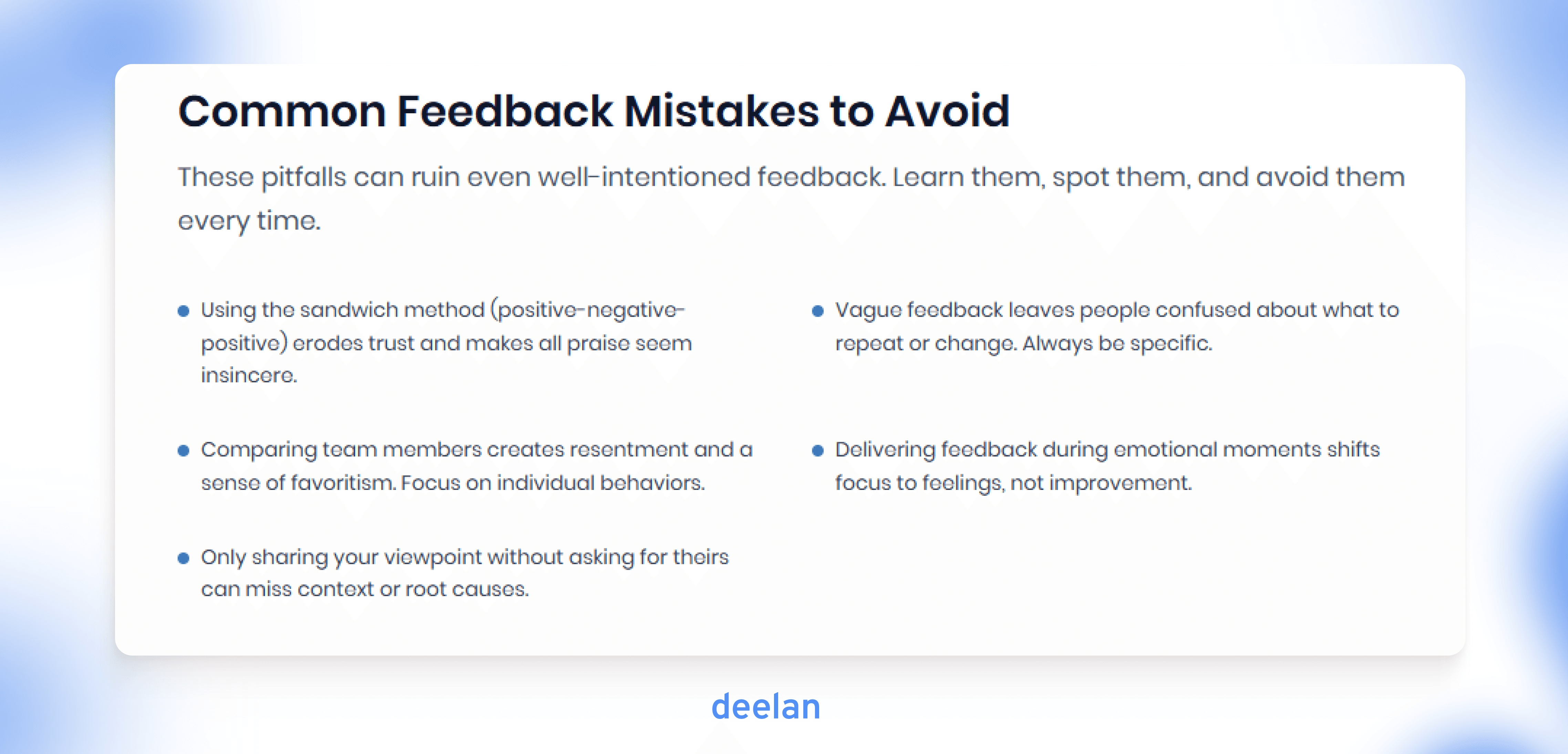
Two Types of Feedback to Always Avoid
The sandwich method. Positive — negative — positive sounds balanced in theory. In practice, reps learn to wait out the first positive because they know the real message is coming. Over time, they start doubting your compliments entirely, because every "great job" starts to feel like setup. Get to the point. Be kind about it, but get there.
Comparing reps to each other. "Look at how Jack handles objections" is intended as instruction. What the rep hears is that you value Jack more. Even when you mean it neutrally, it creates a perception of favoritism that's very hard to walk back. Use external examples — calls from other companies, frameworks, industry benchmarks — not your own team members.
Two others worth mentioning: sugar-coating, which buries the actual message in so many softeners that the rep leaves confused about what you were asking; and "what I would have done," which, however well-meant, almost always lands as condescending before you've actually heard the rep's perspective.
What Is the 3-3-3 Rule in Sales?
The 3-3-3 rule comes from marketing — focus on three core messages, reach three audience segments, prioritize three channels. Applied to sales coaching, it translates to this: limit each feedback session to three specific behaviors. Not six, not ten. Three.
More than three and the rep can't hold it all. They leave the conversation feeling overwhelmed rather than directed. Pick the three behaviors that will move the needle most, address those, and revisit the rest next time.
How to Make Sales Feedback Stick
Feedback delivered once, in isolation, rarely changes anything lasting. What changes behavior is repetition — specific observations, week after week, connected to real situations.
Weekly or bi-weekly 1:1s beat quarterly reviews for actual behavior change. The quarterly review is a summary. The 1:1 is where the work happens.
Praise in public, coach in private. Public recognition builds team culture. Private coaching protects dignity and makes reps more open to what you're saying.
Focus on behavior, not personality. "You talked over the prospect" is coachable. "You're impatient" is not. One of those sentences leads somewhere, the other just makes someone feel bad.
Write down what you agree on. What the rep will do differently, by when, and what you'll check in on next. Without documentation, even the best feedback conversation evaporates by the following Monday.
How AI Can Help You Give Better, More Consistent Feedback
The hardest part of feedback isn't knowing what to say. It's having the time and information to say it well for every rep, every week, not just the two or three you have bandwidth to focus on.
Traditional coaching is slow and often biased. Managers rely on the calls they happened to hear, the reps they interact with most, the moments they remember. That's not a system — it's a sample.
AI changes this by analyzing every call. Talk ratio, engagement score, how the rep handled specific objections, where in the conversation deals typically stall. Instead of gut-feel impressions, managers get specific, data-backed observations. "Your rep talked 71% of the time on their last four calls" is a different conversation than "I think you might be talking too much."
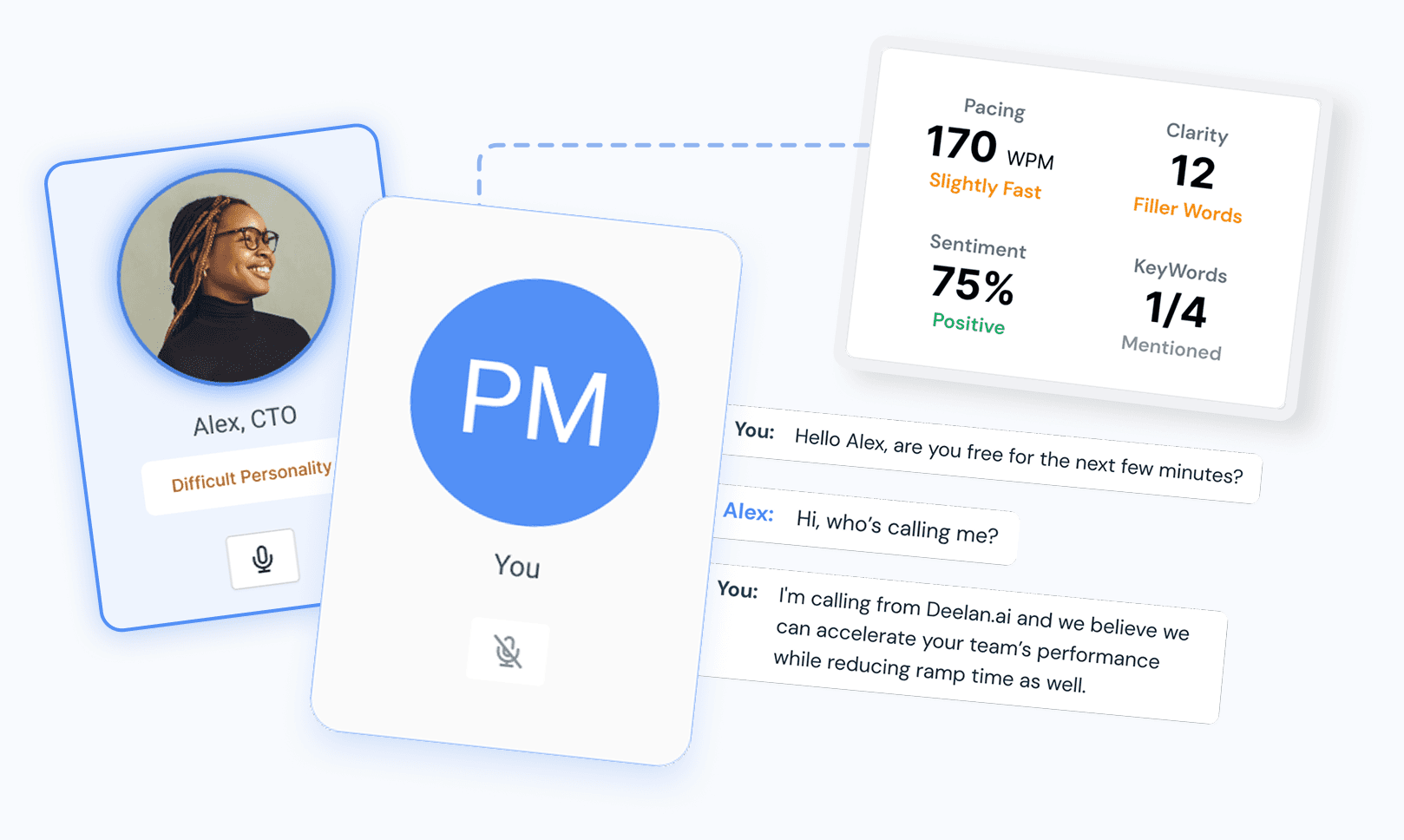
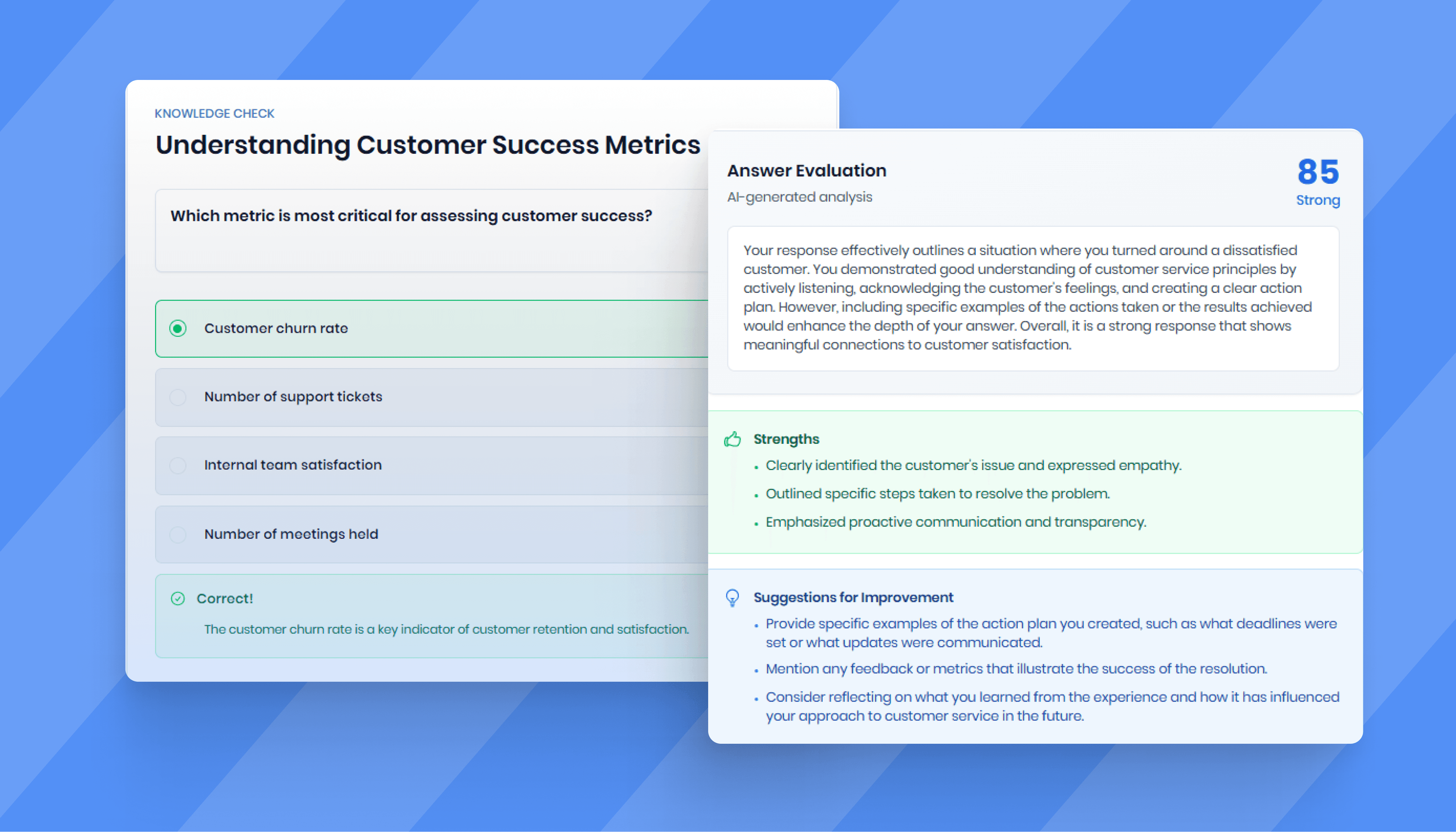
After a roleplay or training session, reps can see a skills radar across competencies — discovery, objection handling, communication, persuasion — showing what went well and what to improve next.
The most useful part is what happens between sessions. When the system detects a recurring skill gap — say, five reps all struggling with pricing conversations — it assigns the right training automatically. Managers stop explaining the same thing to different people every week.
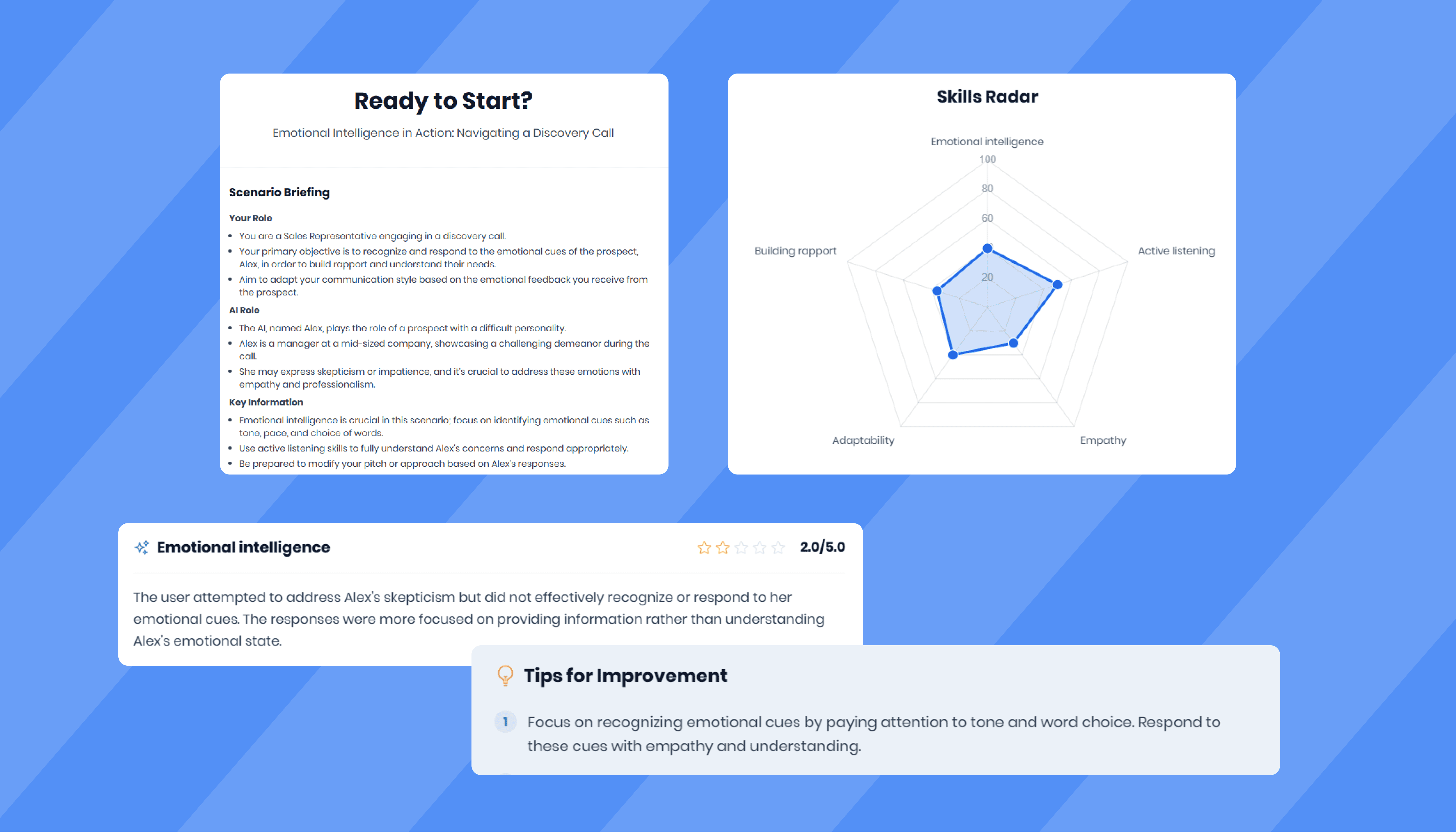
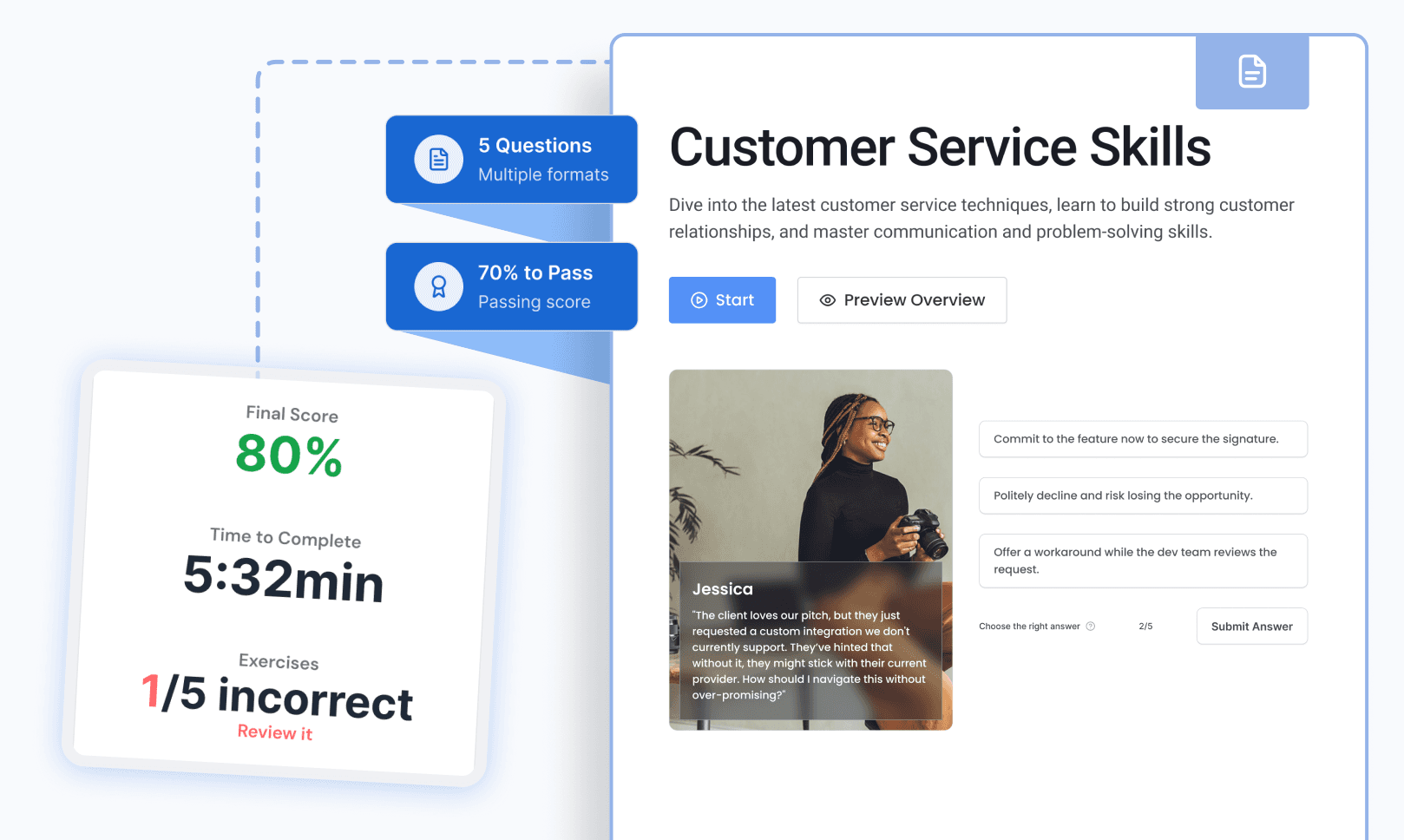
Deelan is built around adaptive coaching. After every session, reps get detailed feedback by skill area and the platform assigns targeted training based on what it found.
Managers spend their time on the conversations that actually require a human — the career discussions, the difficult situations, the judgment calls — instead of repeating the same objection-handling correction for the fourth time that month.
→ See how Deelan helps managers scale coaching without scaling headcount.
FAQ: Sales Feedback Questions Managers Ask Most
What is a positive feedback example for a sales rep?
"You've really improved your meeting hosting. The structured agenda on Thursday kept the prospect engaged the whole way through, and the way you handled the budget question directly instead of deflecting was exactly what we've been working on." Specific, behavioral, and tells them what to repeat.
What are the three golden rules of feedback?
Honest, kind, and timely. Remove any one of them and the feedback either misleads, damages, or arrives too late to be useful.
What are two types of feedback to avoid?
The sandwich method (positive-negative-positive) erodes trust over time. And comparing one rep to another creates perceived favoritism, even when the intent is purely instructional.
What are the three feedback techniques?
Feedforward (focus on future behavior), DESC (Describe, Express, Specify, Consequence), and the What/Why technique (name the behavior, explain its impact). All three are more effective than open-ended criticism because they give the rep something specific to act on.
How often should you give feedback to your sales team?
Real-time or same-day for call-specific coaching. Structured weekly or bi-weekly 1:1s for broader performance and development. Quarterly reviews should summarize what's already been discussed — they shouldn't be the first time a rep hears about a problem.
Feedback isn't a quarterly event. It's the work. The managers who build the best sales teams aren't always the best strategists — they're the ones who show up every week with something specific to say, and a genuine interest in helping their reps get better. The 15 scripts in this guide are a starting point. The real skill is developing the habit of using them.