
Most sales reps practice their pitch exactly twice — once in their head, once on a real prospect. That's not practice. That's gambling.
Sales pitch practice is what separates reps who close consistently from those who blame the lead. Without it, you forget key points under pressure, stumble when a prospect pushes back on price, and walk out of calls kicking yourself for what you didn't say.
Sructured repetition — starting with the basics, moving into mock sales pitch sessions, and eventually using AI-powered roleplay will get you genuinely ready before the call happens.
What Is Sales Pitch Practice (And Why Most Reps Skip It)?
Sales pitch practice is deliberate, repeated rehearsal of your pitch in conditions close enough to real calls that your brain actually learns from it. Not reading notes. Not thinking through what you'd say. Saying it out loud, on demand, against resistance.
The gap between knowing your pitch and being able to deliver it under pressure is wider than most reps admit. You can know every feature, every differentiator, every objection response — and still go blank when a skeptical CFO says "we're already talking to your competitor." That's not a knowledge problem. It's a practice problem.
According to Salesforce's State of the Connected Customer Report, 84% of B2B buyers expect sales reps to act as trusted advisors. Yet 59% say most reps never bother to learn their actual challenges. That gap doesn't close by reading more. It closes by practicing until the right questions and responses come out naturally, not from memory.
When reps skip practice, the reasons are predictable: no time, no partner, manager too busy, "I know my pitch." The result is equally predictable — inconsistent messaging, weak objection handling, and deals that stall because the rep couldn't hold the room.
If you want to practice your sales pitch seriously, you need a method. Here's where to start.
The 6 Core Components of a Great Sales Pitch (Before You Practice Anything)
Before you run a single mock sales pitch, know what you're rehearsing. A pitch isn't a monologue — it's six specific things, each of which can be strong or weak independently.
1. The Hook (First 10 Seconds)
The hook earns you the next 30 seconds. It doesn't introduce your company. It creates a reason for the prospect to keep listening.
A strong hook is either a sharp observation about their situation or a question that makes them think. Example: "We noticed your team tripled in size last year — most companies at that stage hit a wall with onboarding consistency around month four."
2. The Problem Statement
You're describing their pain, in their language. Not your category's problems in general — their specific situation.
The mistake most reps make is using marketing language here. Prospects don't say "lack of pipeline visibility." They say "we have no idea what's actually going to close this quarter." Use their words.
3. The Value Proposition
This is the outcome, not the feature list. What does life look like after they buy from you?
Skip "our platform helps you manage X." Say instead: "Our clients typically cut new rep ramp time by 30% in the first quarter." Tangible, not conceptual.
4. The Solution
This is where you explain what you actually do — but briefly. Save the technical details for the demo. The goal is clarity, not completeness.
Can someone who doesn't know your product understand what you do in 30 seconds? If not, it's too complicated.
5. Social Proof
One real case beats ten stat lines. Name a client in their industry and give a concrete result. "A company like yours, same size, same sales team structure, went from 45% to 67% quota attainment in two quarters."
If you can't share names, describe the scenario. Just make it specific.
6. The Call to Action
Vague closes lose deals. "Let's stay in touch" is not a next step. "Are you free Thursday at 2pm for a 30-minute discovery call?" is.
The CTA is the only moment in the pitch where you explicitly ask for something. Make it count.
5 Ways to Practice Your Sales Pitch (From Basic to Best)
Not all practice is equal. Here's an honest ranking, from least to most effective.
1. Solo Rehearsal (Mirror or Video Recording)
Good for memorization. You get familiar with the words, the flow, the rhythm. Recording yourself on video is genuinely useful — most reps are surprised by how many filler words they use, how fast they talk, how little eye contact they make.
The ceiling here is low, though. There's no pressure, no objections, no one pushing back. You can rehearse a perfect pitch in an empty room and still freeze when a prospect asks a hard question.
2. Peer Role-Play With a Colleague
A step up, because now you have social pressure. Your colleague might catch things you miss. They can simulate basic objections.
The problem is everyone's too nice. Peers rarely push back hard enough or ask the uncomfortable questions real prospects ask. And scheduling it depends on two people's calendars aligning.
3. Manager-Led Mock Sales Pitch Sessions
Traditionally the best option — an experienced manager who knows your ICP, plays the prospect well, and gives structured feedback. When it works, it works.
When it works. Managers are stretched thin. Practice happens on their schedule, not yours. Many reps, especially at smaller companies, describe feeling completely on their own when it comes to pitch development. The manager bottleneck is real and it doesn't get better as teams scale.
4. Live Calls
You learn fast. You also burn prospects. Every mistake has a real cost — lost credibility, a stalled deal, a prospect who moves on. It's not repeatable and it's not scalable. The only reason reps do this is because they haven't set up a better alternative.
5. AI-Powered Sales Pitch Practice
This is where the gap closes. AI practice combines the realism of a manager-led session with the availability of solo rehearsal. It's available at 11pm before a big call. It pushes back with industry-specific objections. It doesn't go easy on you.
Sales teams using AI coaching tools report up to 76% higher win rates. The reps who use it consistently aren't just more prepared — they're visibly more confident on live calls because they've already had the hard conversation five times.
How to Run a Mock Sales Pitch (Step-by-Step)
A mock sales pitch is only useful if it's set up properly. Here's how to run one that actually improves your performance.
Choose a specific scenario. Cold call opener, discovery call, price objection, closing conversation. One at a time. Don't try to practice everything at once.
Define the buyer persona. Industry, role, company size, pain points, likely objections, level of skepticism. The more specific, the more useful the practice.
Set your success criteria before you start. What does "good" look like for this scenario? What do you want to be able to do by the end?
Run the roleplay and record it. Audio minimum. Video if possible.
Review against objective criteria — not just "did it feel good."
Repeat. The goal is for the pitch to feel natural, not scripted. That takes more repetitions than most reps expect.
What to evaluate in every mock sales pitch:
Hook strength — did you earn attention in the first 10 seconds?
Problem framing — did you use the prospect's language, or yours?
Objection handling — did you stay composed and redirect to value?
Filler words — um, uh, like, you know, so...
Talk-to-listen ratio — are you talking too much?
CTA — was the next step specific and concrete?
Practice Sales Pitch With AI — What It Actually Looks Like
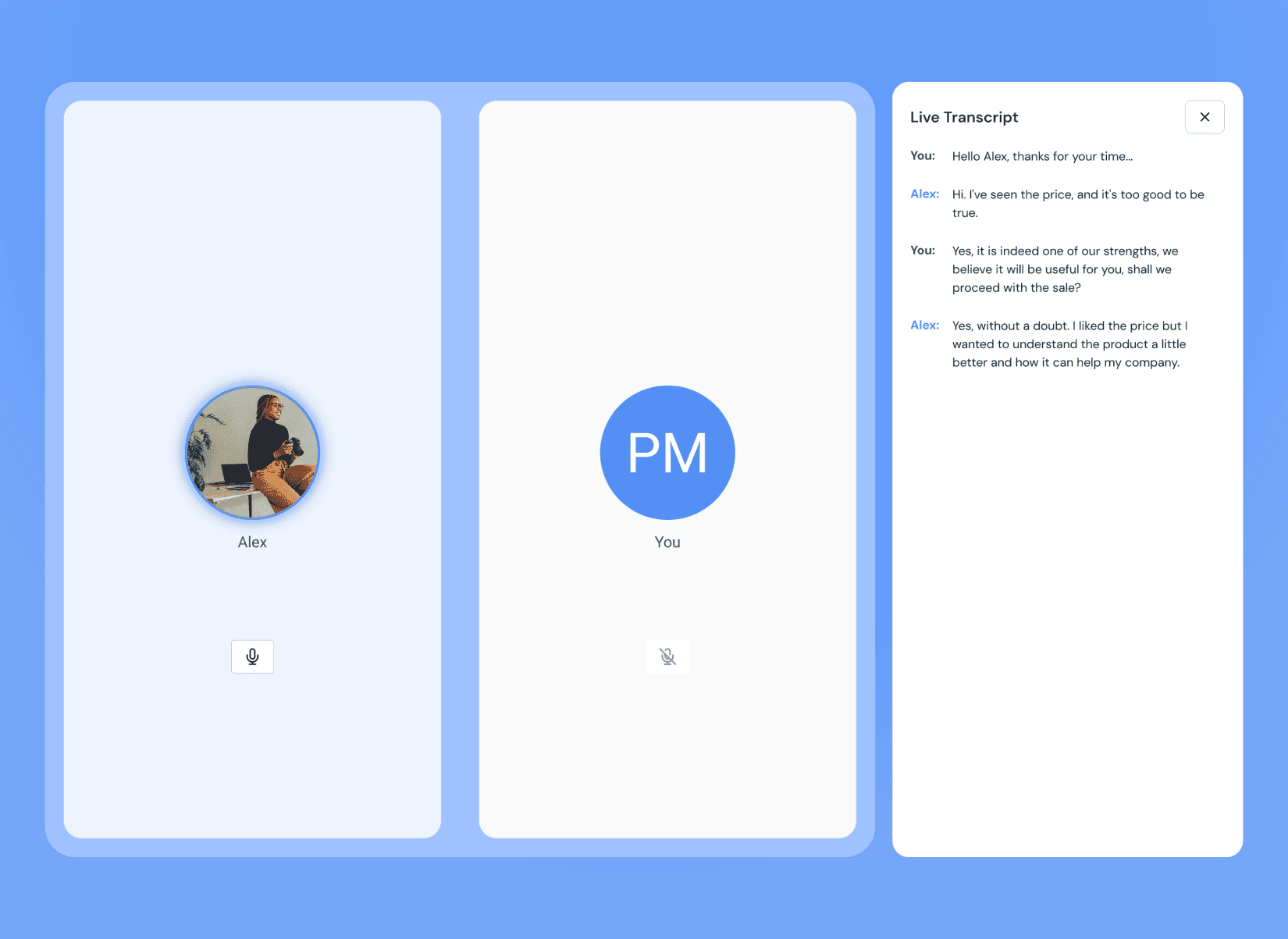
When you practice sales pitch with AI, the experience is different from anything you get from solo rehearsal or peer roleplay.
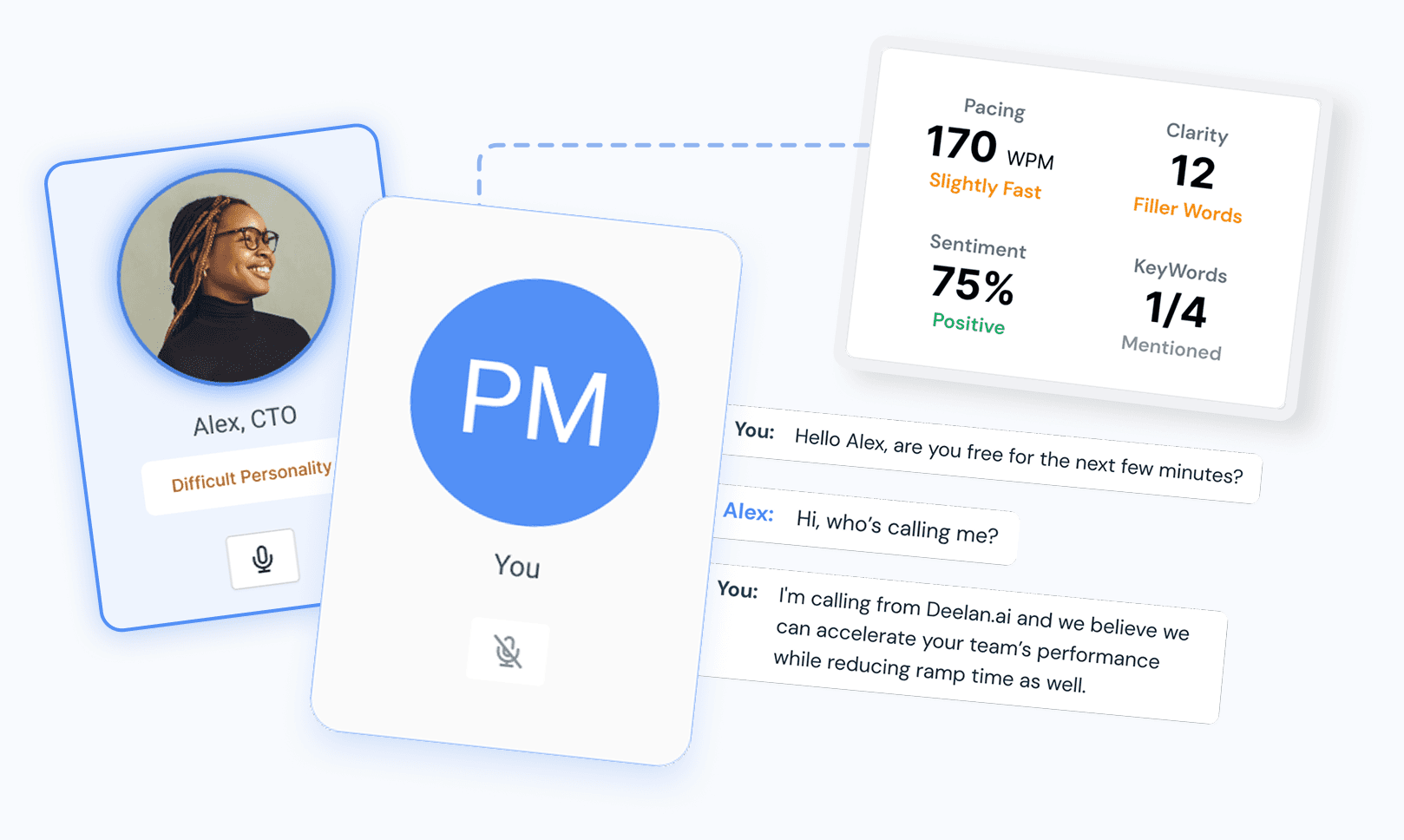
You speak. The AI persona responds in context — not with a generic "interesting, tell me more," but with actual pushback. "Your competitor quoted us 40% less." "We already have a vendor." "Send me an email." The objections are realistic because they're built from real sales conversations.
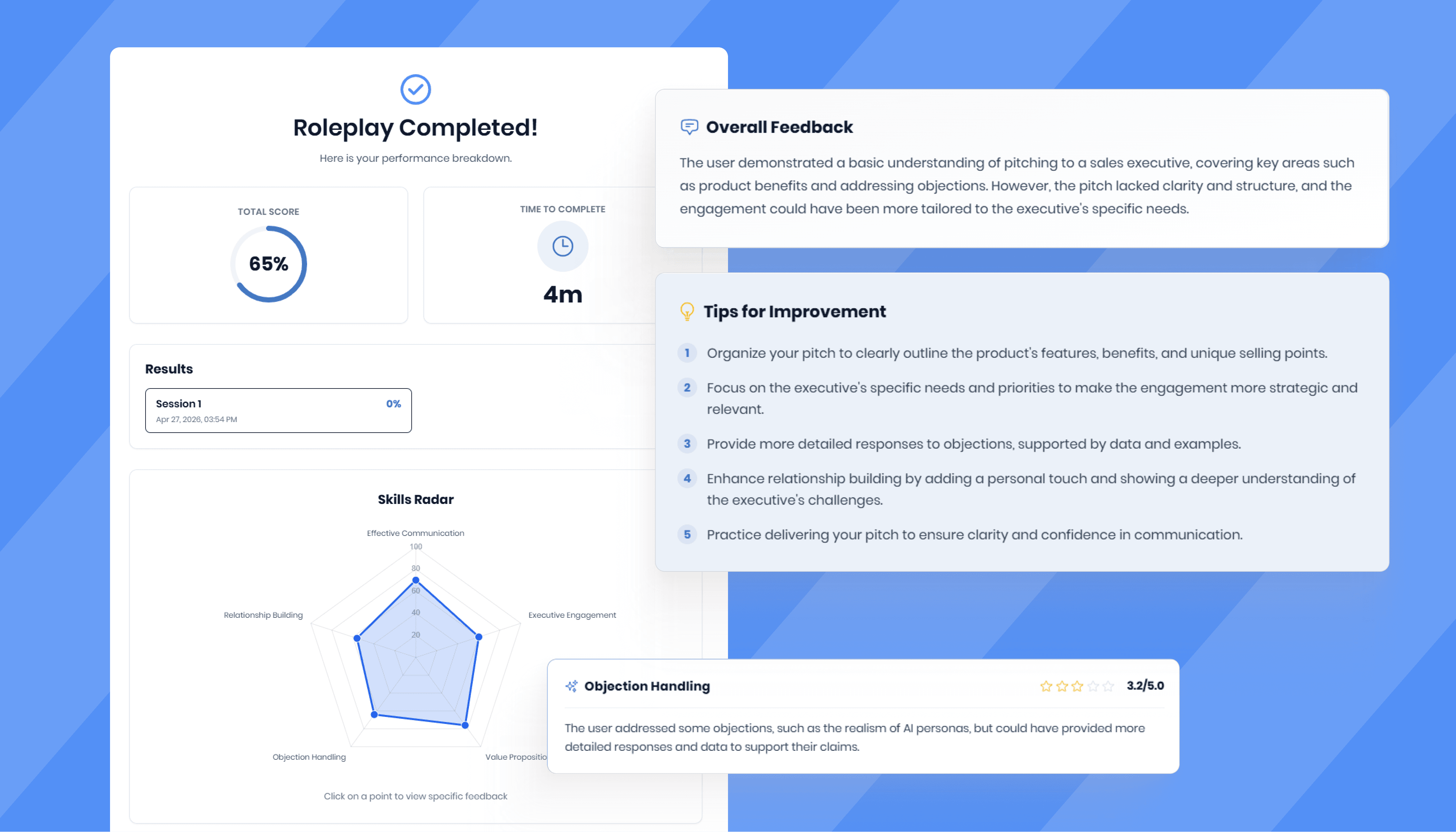
After the session, you get a coaching report that analyzes what was actually said. Talk-to-listen ratio. Tone and confidence levels. Points where you hesitated. Objections you handled well vs. ones where you lost momentum. Specific quotes from your conversation with commentary on what to change.
That's the difference from traditional feedback. Manager feedback is subjective and delayed — you get it days later, filtered through memory and relationship dynamics. AI feedback is objective, immediate, and consistent. Every rep is evaluated on the same criteria, every time.
Deelan's AI Sales Roleplay — Practice That Mirrors Real Calls
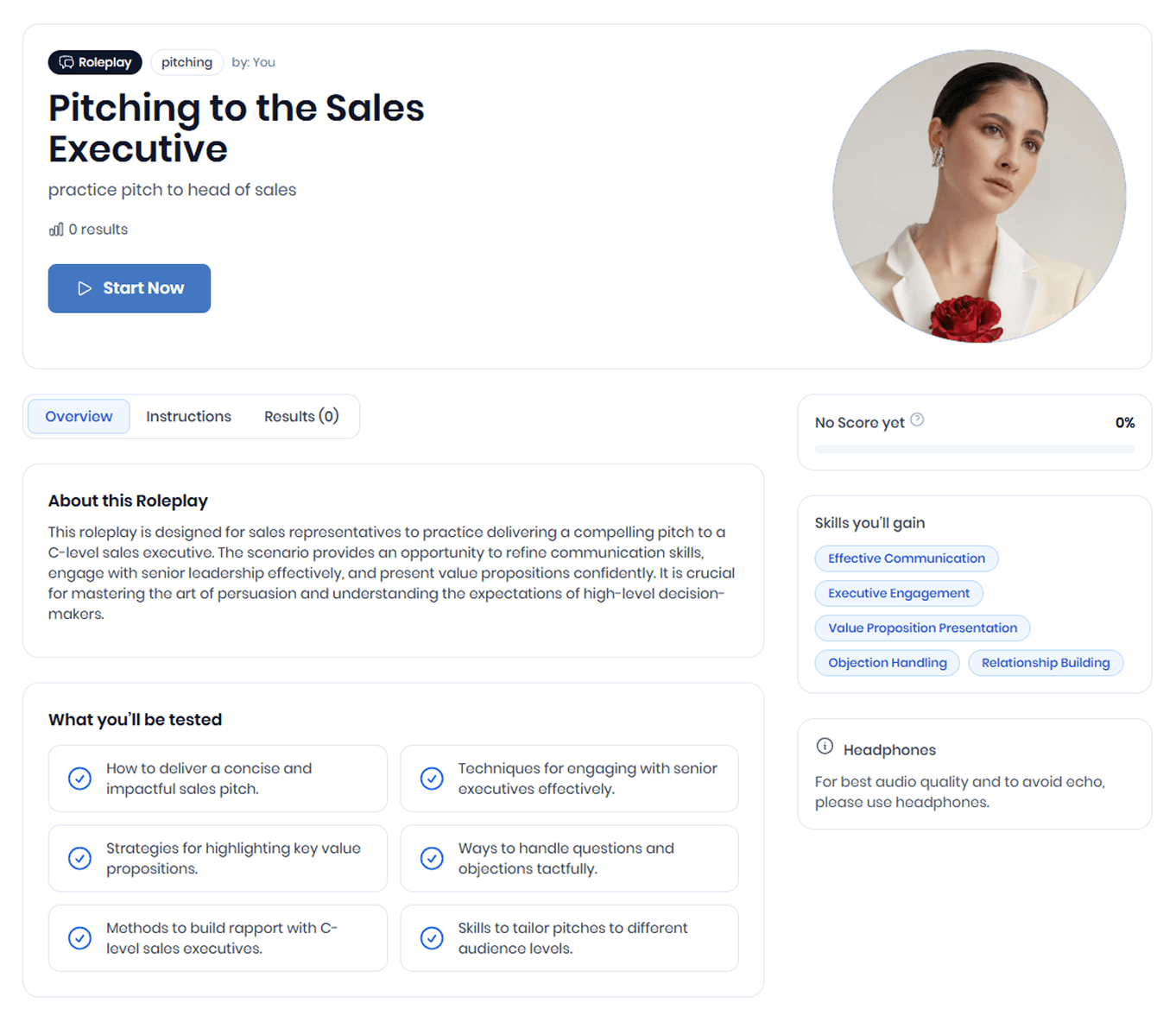
Deelan's AI Sales Roleplay was built for exactly this. Not a generic simulation. A practice environment configured to your ICP, your scenarios, your team's specific skill gaps.
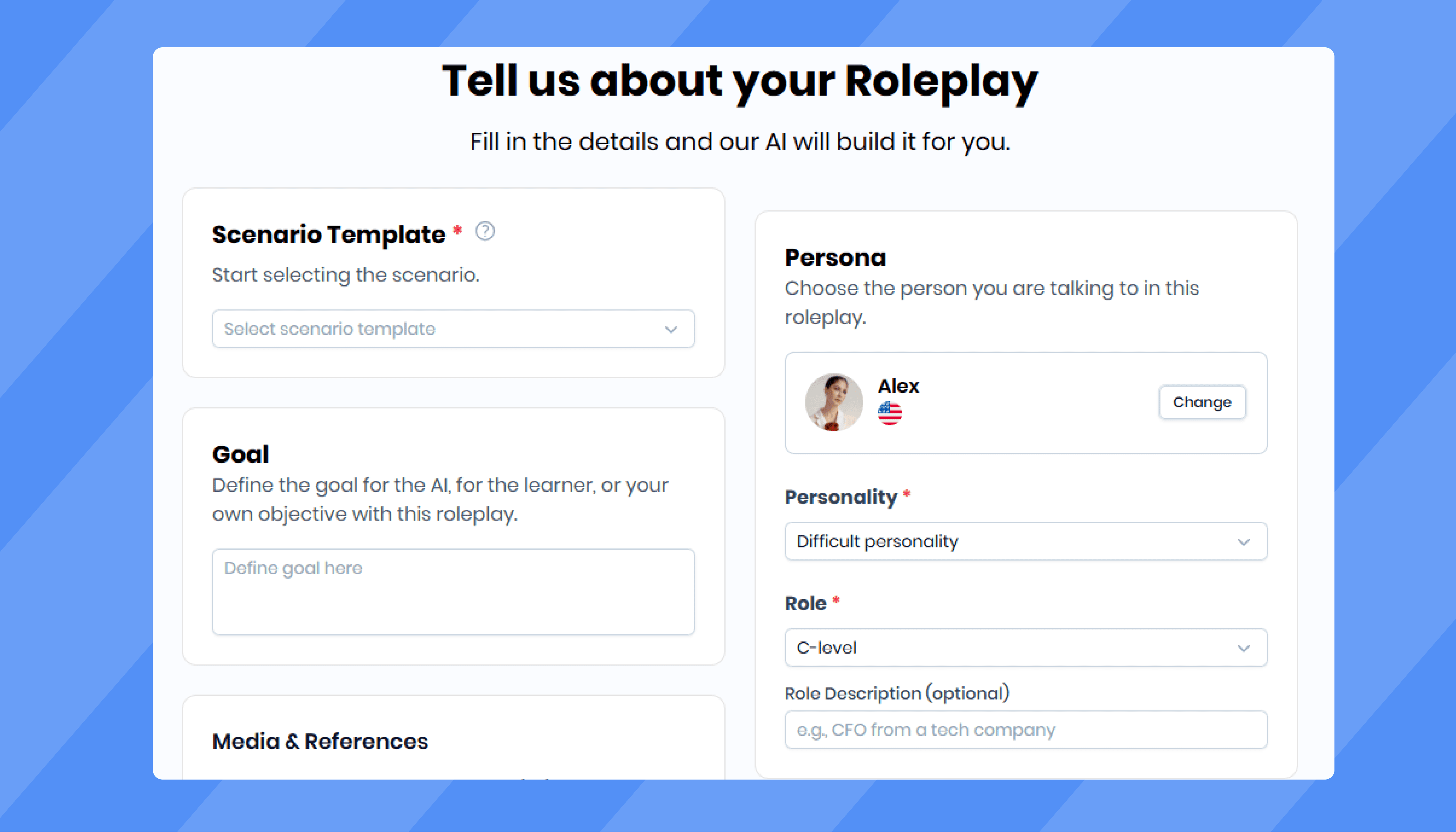
Realistic AI personas. Deelan's AI doesn't just simulate a friendly buyer. You can configure personality, patience level, objection intensity, industry knowledge. The AI interrupts mid-sentence. It says "hum." It mimics the rudeness and distraction of a real senior buyer who's been pitched a hundred times. Because that's what your reps are actually walking into.
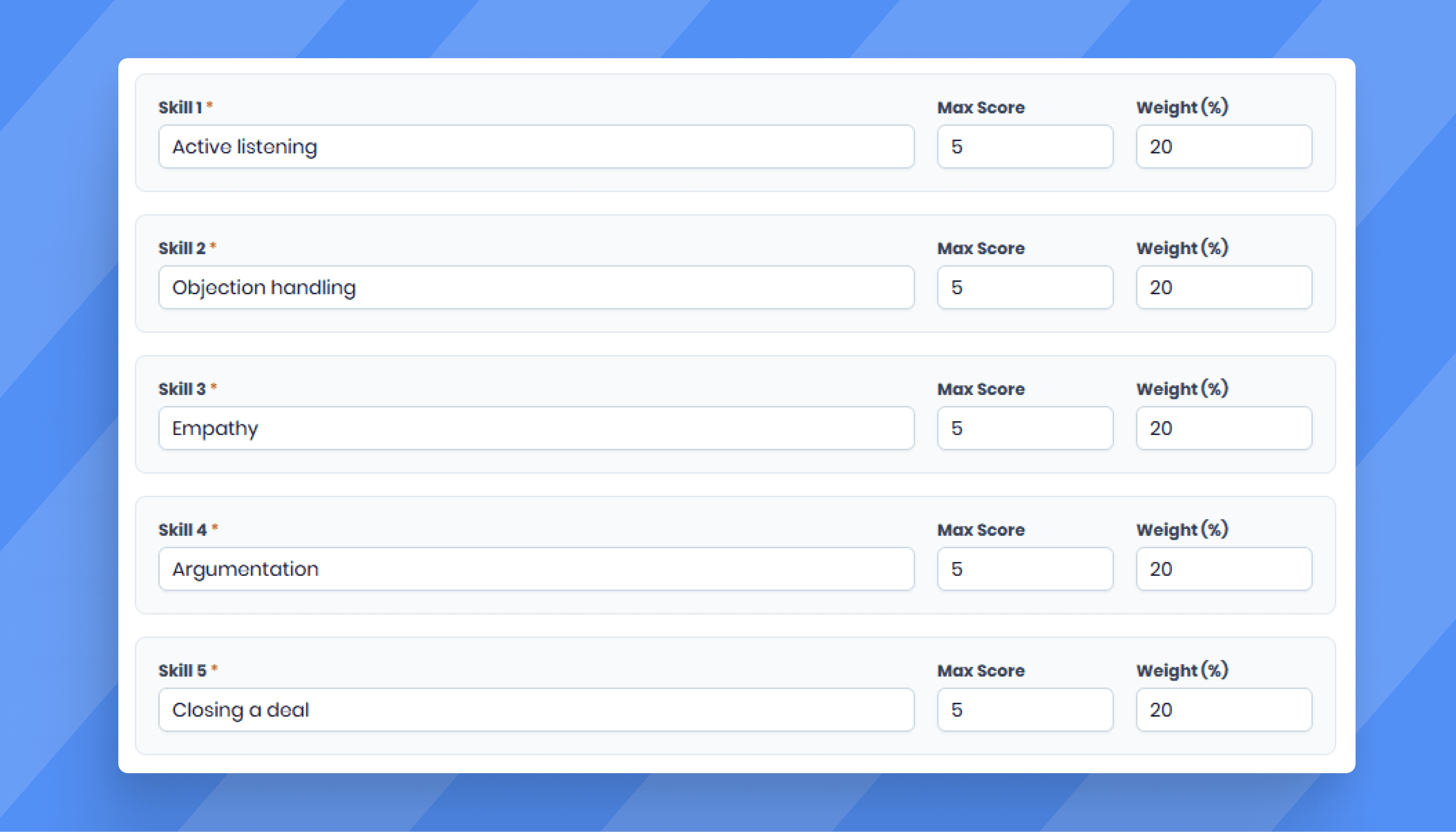
Objective scoring — same criteria, every rep, every time. No more subjective manager feedback. You define the rubric. Deelan scores every rep against it consistently. You finally know what "good" looks like across the whole team.
Data-driven insights, not completion metrics. Deelan analyzes talk-to-listen ratio, tone, confidence, silence, objection handling quality, question depth, and eloquence. You see real skill gaps — not whether someone finished the module.
Certification. Every rep meets the same quality bar before they go live on prospects. And when you launch a new product, enter a new vertical, or expand to a new region, you can re-certify the whole team in days, not weeks.
Personalized coaching per rep. Feedback is tailored to each person's conversation, not a generic rubric printout. Reps see specific quotes from their session alongside improvement suggestions. They can compare to previous sessions and see actual progress.
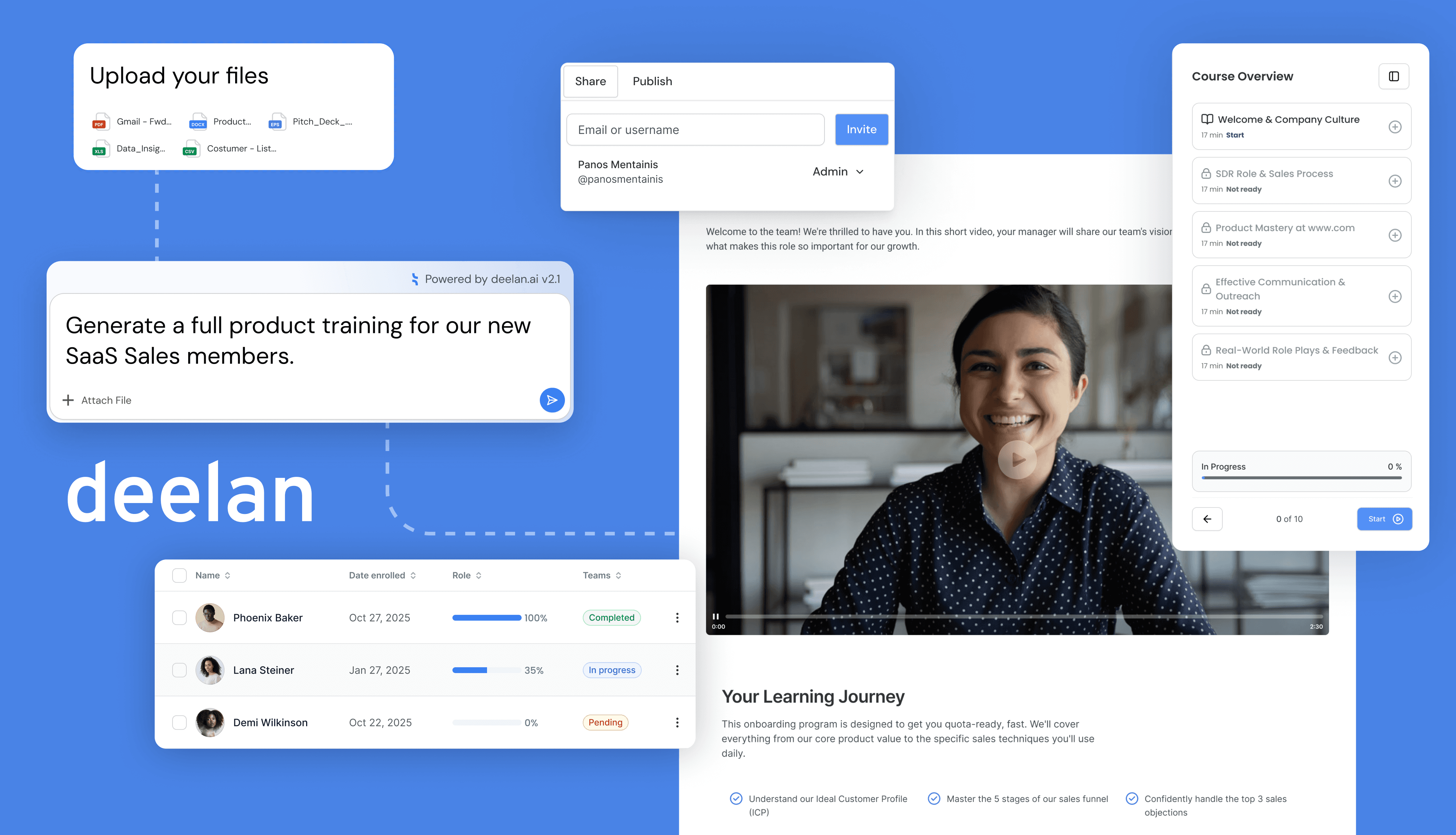
Build roleplays in minutes. Chat with the AI from a single prompt and get a complete roleplay. Fill out a form and let Deelan generate it. Or start from 30+ proven templates and customize to your team. No weeks of setup. No training department required.
Jonathan Kindermans, founder of Kidola, put it plainly: "We reduced ramp time by over 30% and saved countless hours of manual coaching."
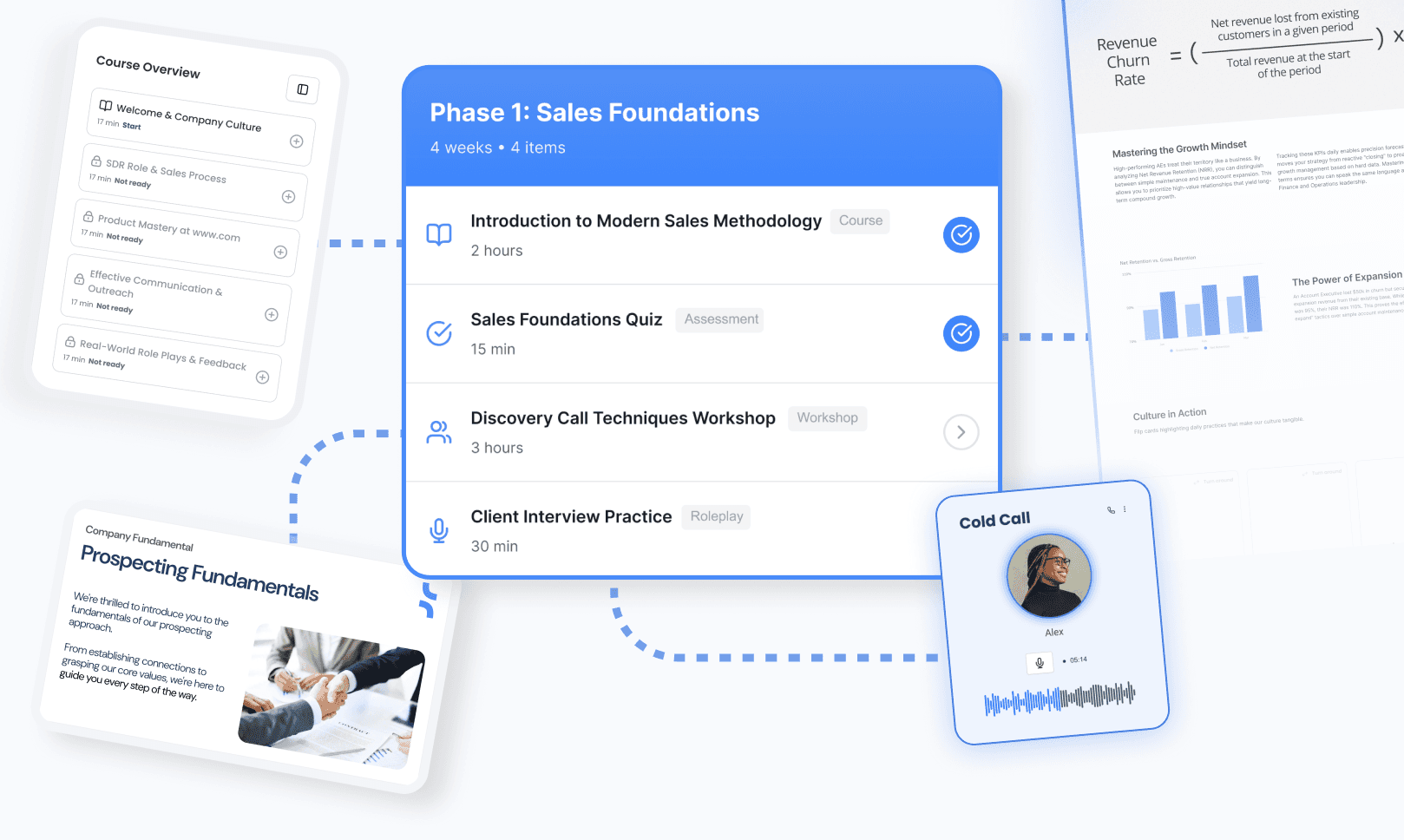
Skill drills in Deelan cover the scenarios that matter most: cold call openers, discovery calls with skeptical senior buyers, price objection negotiation, technical demos, customer renewals, and difficult management conversations.
Common Mistakes Reps Make During Sales Pitch Practice
Most practice fails not because reps don't try, but because they practice the wrong things the wrong way.
They rehearse the pitch they're already comfortable with, not the one they keep stumbling on. They over-rehearse until it sounds robotic and loses all human texture. They practice alone, with no pressure and no objections, and wonder why they still freeze on real calls.
Practice gets treated as a one-time event — something you do before a big pitch, then forget about. But the research is clear: short, frequent sessions beat long, infrequent ones every time. Fifteen minutes, three times a week, produces more consistent improvement than one two-hour session per month.
And too many reps never watch or listen to their own recordings. That discomfort is the fastest feedback loop available to you.
How to Build a Sales Pitch Practice Habit
Four weeks plan:
Week 1: Hook and problem statement. Nothing else. Get those two pieces sharp enough to deliver in any context, to any buyer, without thinking.
Week 2: Objection handling. Pick the three objections you face most often. Practice until you stop getting rattled.
Week 3: Closing and CTA. Focus on asking for the next step cleanly, specifically, and without hedging.
Week 4: Full mock sales pitch — all six components, end to end, against a skeptical persona.
Deelan makes this easy to operationalize across a team.
Skill drills target individual components.
AI quizzes reinforce product and competitive knowledge between roleplay sessions.
You can track who's improving and who needs another pass before they go live.
Stop Practicing on Real Prospects
Great pitches aren't written. They're built through repetition, pressure, and honest feedback.
The reps who consistently outperform their peers don't have better scripts. They've practiced more, in more realistic conditions, and they've gotten specific feedback on exactly what to fix. That's it.
Deelan's AI Sales Roleplay gives your team the environment to do that — realistic simulations, instant coaching reports, and objective data on every conversation. No scheduling, no bottlenecks, no burned prospects.
Book a Free Demo and see what your team can improve before the next call.