

Every salesperson has different strengths and weaknesses.
Some reps still struggle with objections. Others ask the wrong discovery questions. And some deliver great presentations but never manage to close the deal.
Let's look at what the research says about sales skill gaps, how to identify them, and what actually helps reps improve.
Main Findings from Research around Sales Skill Gaps
According to Salesforce's State of Sales report:
52% of sales reps say traditional enablement doesn't provide the skills they need.
46% rarely receive feedback on sales conversations.
41% say they don't get enough opportunities to roleplay before customer calls.
75% believe coaching or mentoring makes them more likely to reach their targets.
There's another issue: reps and managers don't always agree on where improvement is needed.
Salesloft's 2025 Sales Skill Gap Survey found that 83% of sellers rated themselves strong at executive engagement, while 41% of managers reported that their reps struggled with it.
7 Sales Skill Gaps Worth Paying Attention To
There are dozens of competencies that contribute to sales performance. But these seven areas provide a practical starting point for understanding where reps may struggle.
Sales skill gap | What it looks like in real conversations |
|---|---|
1. Discovery | Asking surface-level questions without uncovering the customer's real problems |
2. Qualification | Failing to identify decision-makers, budgets, or buying processes |
3. Value Communication | Explaining features instead of connecting them to business outcomes |
4. Influence | Using the same pitch for every prospect instead of adapting to their situation |
5. Objection Handling | Jumping into defensive responses without understanding the real concern |
6. Deal Execution | Ending conversations without clear next steps or missing deal risks |
7. Conversation Skills | Talking too much, interrupting, or missing important customer signals |
Sometimes, the biggest problem isn't what a rep says, but how they communicate.
Gong analyzed 326,000 sales calls and found:
Average seller talk time: 60%
Closed-won deals: 57%
Lost deals: 62%
1. Discovery: Staying on the Surface
Asking questions doesn't necessarily mean running a good discovery call.
One of the most important distinctions is between collecting information and understanding a customer's real problem.
The second question opens a conversation about actual business challenges.
Skills to evaluate: Open Questioning, Active Listening, Root-Cause Probing, Implication Building.

2. Qualification: Talking to the Wrong People
A prospect can be enthusiastic without having the budget, authority, or ability to move a deal forward.
Qualification isn't just asking whether someone has the budget. It means understanding how purchasing decisions happen, who influences them, and whether there's a genuine business fit.
Skills to evaluate: Economic-Buyer Identification, Multithreading, Decision-Process Mapping, Fit Assessment.

3. Value Communication: Selling Features Instead of Outcomes
"We have AI-powered coaching and realistic roleplays."
That's a product description, not a business case.
A stronger conversation connects those capabilities with something the buyer actually wants to improve: faster onboarding, reduced manager workload, or better sales performance.
Reps need to understand not only what their product does, but why it matters to each buyer.
Skills to evaluate: ROI / Impact Quantification, Differentiation, Business-Case Construction.

4. Influence: Using the Same Pitch for Everyone
A sales manager, a CFO, and an enablement leader can look at the same product and care about completely different things.
Yet a standard pitch often stays exactly the same.
Good influence means adapting the message, challenging assumptions when appropriate, and connecting insights to the buyer's situation.
Skills to evaluate: Message Tailoring, Commercial Insight, Reframing.
5. Objection Handling: Answering Before Understanding
Prospect: "It's too expensive."
Rep: "We can offer a discount."
And just like that, a negotiation starts before the rep understands the objection.
Does the buyer lack budget? Do they doubt the ROI? Are they comparing alternatives?
Different concerns need different answers.
Skills to evaluate: Objection Isolation, Objection Resolution, Value Defense, Calibrated Questioning.

6. Deal Execution: Losing Momentum After a Good Call
Sometimes a sales conversation goes well, but nothing happens afterward.
No confirmed next step. No clear timeline. No understanding of the approval process.
A rep can be great at communicating and still struggle to move opportunities forward.
Skills to evaluate: Next-Step Discipline, Mutual Action Planning, Deal-Risk Sensing.
7. Conversation Skills: Talking More Than Listening
This one is particularly interesting because it's measurable.
Gong's analysis of 326,000 sales calls found that reps spoke for an average of 60% of the conversation. In won deals, that figure was 57%, compared with 62% in lost deals.
That doesn't prove talking less causes more sales. But it's a useful reminder to examine how reps communicate.
Are they interrupting? Asking multiple questions at once? Giving customers enough space to explain their challenges?
Skills to evaluate: Talk-Time Balance, Question Craft, Letting Them Finish, Pace & Clarity.
How to Identify Your Team's Actual Skill Gaps
These seven categories aren't a universal ranking. Your team's weakest skills could be completely different.
And that's precisely why we believe sales training should start with evaluating real performance.
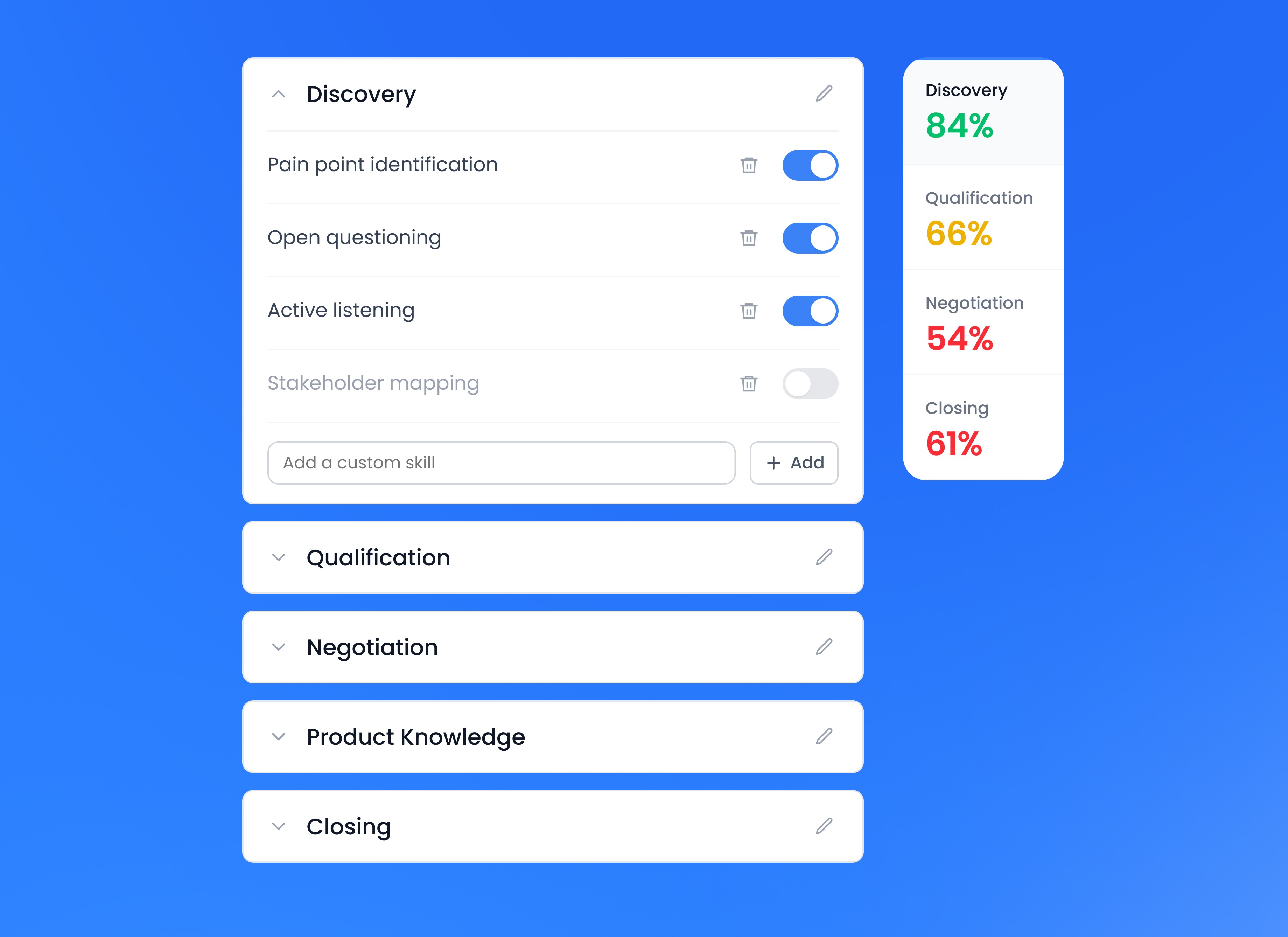
Start With Your Own Skills Framework
A team selling enterprise software won't need exactly the same skills as a team selling transactional products.
Define what good performance looks like for your team, using your methodology, sales process, and customer expectations.
At deelan, teams can start with predefined competencies or create custom skills and evaluation criteria.
Use Real Sales Conversations
Call recordings and transcripts offer something traditional training surveys can't: evidence of how reps actually behave with customers.
Conversation analytics can reveal missed follow-up questions, weak value statements, unresolved objections, excessive talk time, and unclear next steps.
Rather than relying on a manager's impression of one meeting, look for recurring behaviors across relevant calls.

How to Actually Fix Sales Skill Gaps
Once you know where someone struggles, the next question is what kind of training will help.
Our approach is simple: match the learning experience to the skill, then measure whether performance improves.
Identified skill gap | Training approach |
|---|---|
Weak product knowledge | Short courses and quizzes |
Poor objection handling | AI roleplays with challenging buyer personas |
Discovery weaknesses | Simulated discovery calls and feedback |
Weak value communication | Business-case exercises and coaching |
Negotiation challenges | Scenario-based roleplays |
Poor listening | Call review and personalized coaching |
Inconsistent deal execution | Coaching and practical assessments |
At deelan, we connect these steps in one training system.
Analyze real calls. Identify performance gaps using call analytics and your team's skill framework.
Build personalized training. Turn company knowledge, playbooks, and identified gaps into courses, roleplays, assessments, and coaching.

Adapt as reps improve. Assign follow-up training based on performance, rather than putting everyone through the same fixed learning path.
Coach and reassess. Give reps personalized feedback, opportunities to practice, and a way to track development over time.
Instead of spending more time creating generic training, managers can focus on helping reps improve where it matters.