

Key Takeaways
Only 8% of B2B companies achieve strong sales and marketing alignment — despite near-universal agreement that it drives revenue.
Aligned organizations achieve 2.4x higher revenue growth and 32% year-over-year revenue gains compared to misaligned peers.
Misalignment costs up to 36% more in customer acquisition and leaves 73% of marketing-generated leads untouched by sales.
The fix is shared goals, shared data, a defined lead-qualification framework, and ongoing training that keeps both sides moving in the same direction.
What Is Sales and Marketing Alignment?
Sales and marketing alignment is a shared operating model where both teams pursue the same revenue goals, use the same data, speak the same language, and create a seamless experience for the buyer at every stage of the journey.
In practice, alignment means:
Both teams agree on who the ideal customer is and what qualifies a lead as "sales-ready"
Marketing delivers context-rich leads rather than handing names over the fence
Sales closes the feedback loop — sharing what messaging lands, what objections come up, and what content actually moves deals
Every campaign, piece of content, and outreach sequence maps to a shared pipeline target
Today's B2B buyer does the majority of their research before ever contacting a vendor. Depending on the study, buyers are between 57% and 80% through their purchasing decision before they engage with a sales rep. The average B2B buying group now includes 13 stakeholders. Buyers interact across 10 or more channels before a deal closes.
In this environment, a siloed approach - where marketing owns the top of funnel and hands off to sales at some arbitrary point - simply doesn't reflect how buying actually happens. The handoff doesn't disappear; it becomes invisible, and your competitors benefit from the confusion.
The business case is undeniable:
Forrester found that aligned organizations achieve 2.4x higher revenue growth and 2x higher profitability than misaligned peers
Aberdeen Group documented a 39-percentage-point difference in year-over-year revenue between highly aligned B2B organizations and laggards
Gartner found that sales leaders who prioritize alignment with marketing are nearly 3x more likely to exceed new customer acquisition targets
HubSpot's 2025 State of Sales Report found that sales reps in aligned organizations are 103% more likely to exceed their targets
Aligned organizations report 30% shorter sales cycles and 73% higher conversion rates when content maps to specific buyer journey stages
The Cost of Misalignment
Content waste: Between 60% and 70% of B2B marketing content goes unused by sales teams — often because the topics don't reflect real buyer conversations. Meanwhile, 65% of sales reps report they cannot find relevant content to send prospects. Marketing produces; sales can't find it. That's not a content problem. That's an alignment problem.
Lead leakage: 79% of marketing-generated leads never convert, primarily due to poor nurturing and failed handoffs. And 73% of those leads are never contacted by sales at all.
Acquisition cost bloat: McKinsey found that customer acquisition cost increases by up to 36% when marketing and sales processes are not harmonized.
The perception gap: Forrester's 2024 research uncovered a damaging disconnect — 82% of C-level executives believe their sales and marketing teams are aligned, while 65% of the people actually doing the work say they are not. Leaders who believe alignment already exists have zero incentive to invest in fixing it. That is how the gap persists.
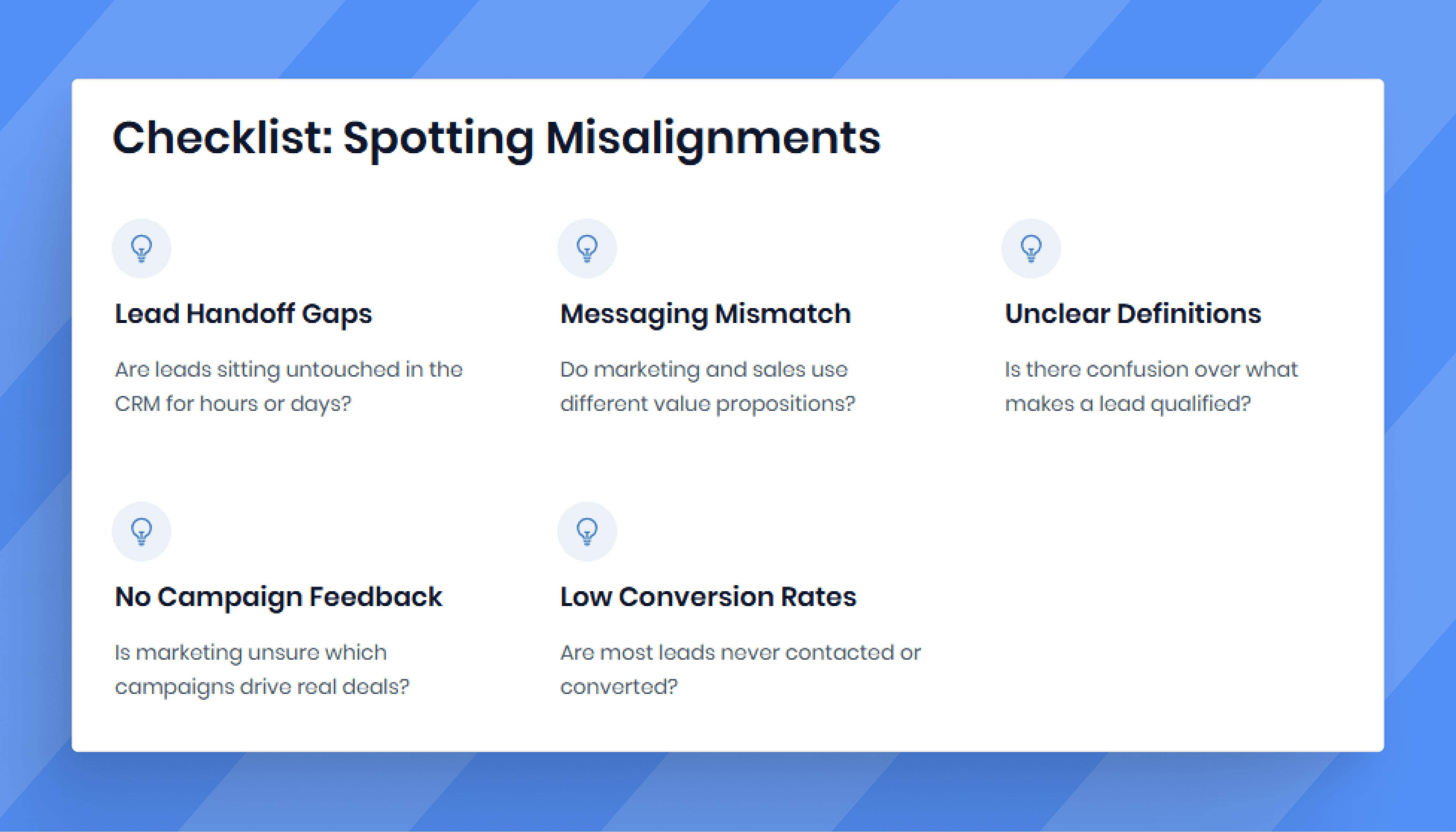
5 Root Causes of Misalignment (and How to Spot Them)
1. Different Goals, Different Time Horizons
Marketing is typically measured on lead volume and campaign engagement. Sales is measured on closed revenue and quota attainment. These different incentive structures create different "thought worlds" — marketing optimizes for the long game, sales optimizes for this quarter. When neither team is accountable for the same number, every downstream process breaks.
Warning sign: Marketing celebrates MQL records while sales ignores the leads as unqualified.
2. No Shared Definition of a Qualified Lead
Gartner found that 49% of Chief Sales Officers report their organization's definition of a marketing-qualified lead differs significantly from marketing's definition. This single disconnect cascades through everything. Leads that marketing considers qualified get discarded by sales. Both teams point fingers. The pipeline fills with noise.
Warning sign: Put your sales and marketing leaders in separate rooms. Ask them to write down what "MQL" and "SQL" mean. Compare the answers.
3. Data Silos and Disconnected Tools
When sales tracks conversations in one platform and marketing tracks engagement in another, neither team can act on the full picture. Sales reps don't know which content a prospect consumed. Marketers don't know which campaigns generated deals. Without unified data, both teams operate on assumption.
Warning sign: Sales reps don't reference marketing data when preparing for calls. Marketing has never listened to a recorded sales conversation.
4. Broken or Absent Lead Handoff Processes
When marketing passes a lead "over the fence" with no context — no engagement history, no trigger signals, no recommended next steps — sales reps have to start from scratch. The response is predictably slow or absent. Competitors engage first. Opportunities are lost.
Warning sign: Average lead response time exceeds 24 hours, or follow-up activity varies wildly between reps.
5. No Feedback Loop
Sales learns what messaging lands in real buyer conversations. Marketing learns what topics drive engagement and pipeline. When these insights aren't systematically shared, both teams iterate in the dark. Marketing creates content nobody uses. Sales reinvents materials ad hoc.
Warning sign: Sales reps build their own decks and one-pagers instead of using marketing assets.
How to Achieve Sales and Marketing Alignment: 8 Proven Steps
Step 1: Establish Shared Revenue Goals
The fastest way to align two teams is to give them one number to own together. Instead of measuring marketing on leads generated and sales on deals closed, create shared metrics anchored to pipeline value, opportunity conversion rates, and revenue attribution.
Gartner found that companies setting interdepartmental KPIs are nearly 3x as likely to exceed customer acquisition targets. Define success the same way for both teams, and the behavioral change follows.
Step 2: Build a Unified Buyer Persona Together
Effective buyer personas require input from both sides. Marketing brings market research, firmographic data, and campaign behavior. Sales brings real-world context — the objections they hear, the pain points that resonate, the deals that were "nightmares" to close versus the ones that closed fast.
Personas built without this collaboration reflect assumptions. Personas built with it reflect reality. The difference shows up in content relevance, campaign targeting, and win rates.
Step 3: Define Lead Qualification Criteria Jointly
Write down your MQL and SQL definitions together, in the same room, until both teams agree. Include:
Demographic and firmographic fit criteria
Behavioral signals (content consumed, events attended, intent data)
Engagement thresholds before handoff is triggered
What context must accompany a lead when it is passed to sales
This single exercise eliminates the most common source of inter-team friction.
Step 4: Create Service Level Agreements (SLAs)
An SLA makes expectations explicit and creates mutual accountability. A strong SLA specifies:
How many qualified leads marketing will deliver per period
How quickly sales will follow up (HubSpot data shows companies responding within 5 minutes achieve 34% higher ROI)
How both teams will report on adherence
Companies with active SLAs between sales and marketing are 34% more likely to experience greater year-over-year ROI. The SLA is not bureaucracy. It is the operating contract that keeps both teams honest.
Step 5: Map the Buyer's Journey Collaboratively
Document every touchpoint — from first marketing interaction to closed deal — and define ownership and success metrics at each stage. The modern B2B buying journey spans an average of 4.6 months across 10+ channels. No single team controls it.
Mapping it together reveals gaps, redundancies, and handoff failures that neither team could see on their own.
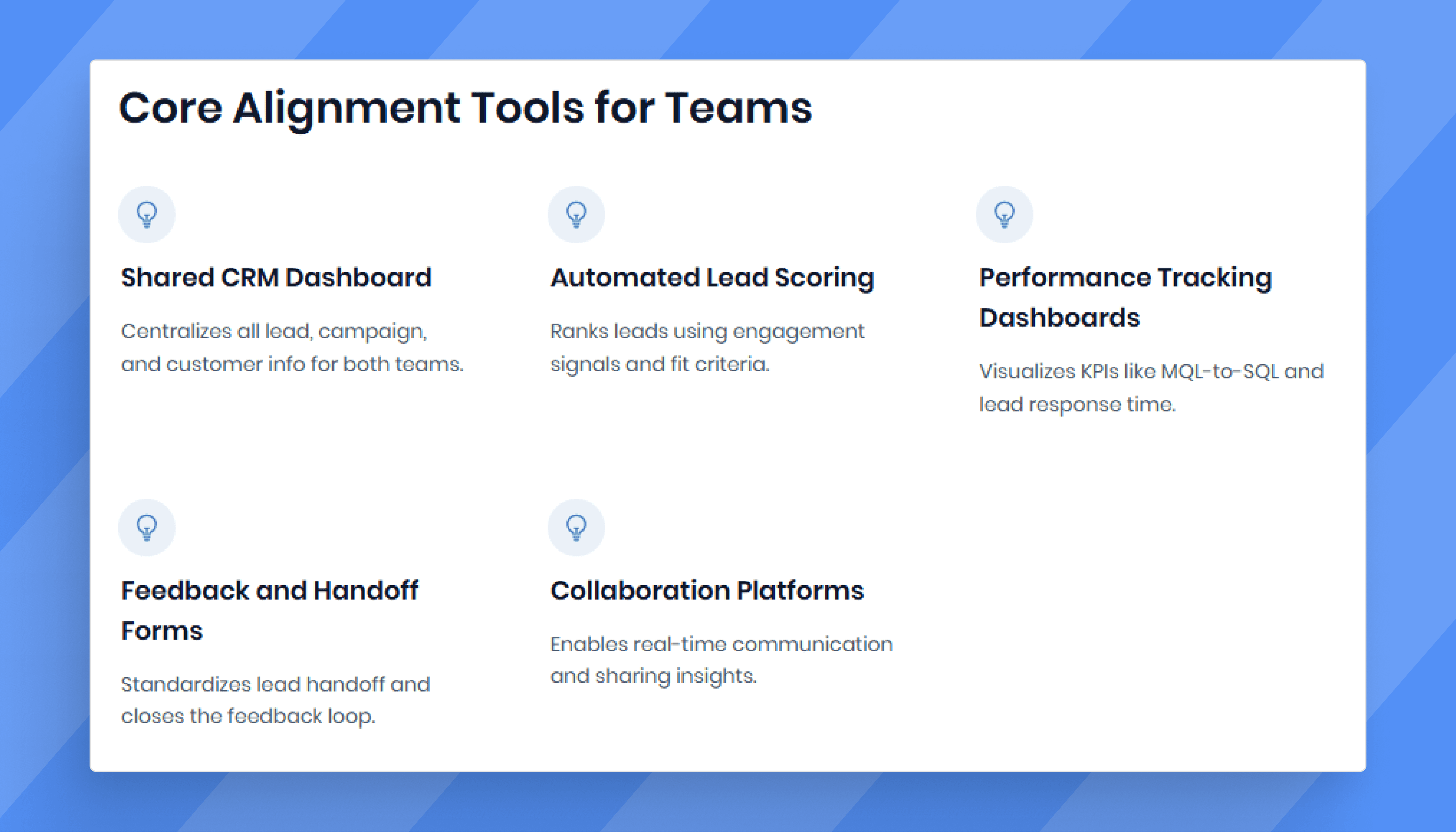
Step 6: Build a Shared Technology Stack
A reliable CRM is the single source of truth that makes everything else possible. Both sales and marketing must use it consistently. Layer in marketing automation that feeds into CRM records, so sales reps can see engagement history without switching tools.
When teams share the same data foundation, coordination happens naturally through shared visibility rather than manual processes that degrade under pressure.
Step 7: Establish Regular Communication Cadences
Alignment is not a meeting — it is a rhythm. An effective cadence includes:
Weekly: Pipeline review and lead quality calibration
Monthly: Messaging feedback and content performance review
Quarterly: Joint strategic planning
Annually: Buyer persona refresh and ICP validation
These meetings should focus on shared metrics, not departmental updates. When marketing explains how their activity helps sales hit quota — and vice versa — alignment stops being a project and starts being a habit.
Step 8: Close the Feedback Loop Systematically
Build a structured process for sales to share field insights with marketing — not ad hoc, not when asked, but as a routine operating activity. This includes:
Which content actually gets used in deals
Which objections come up most in discovery
Which competitor comparisons prospects raise
Which messaging resonates in later-stage conversations
Marketing can respond with updated assets, refined positioning, and better-targeted campaigns. This loop is how both teams improve continuously rather than drifting back into silos.
Aligning Sales and Marketing Through Enablement and Training
Train sales on marketing strategy. When sales reps understand the campaigns running, the messaging frameworks, and the personas being targeted, they can connect their outreach to the broader context. Buyers experience consistency instead of contradiction.
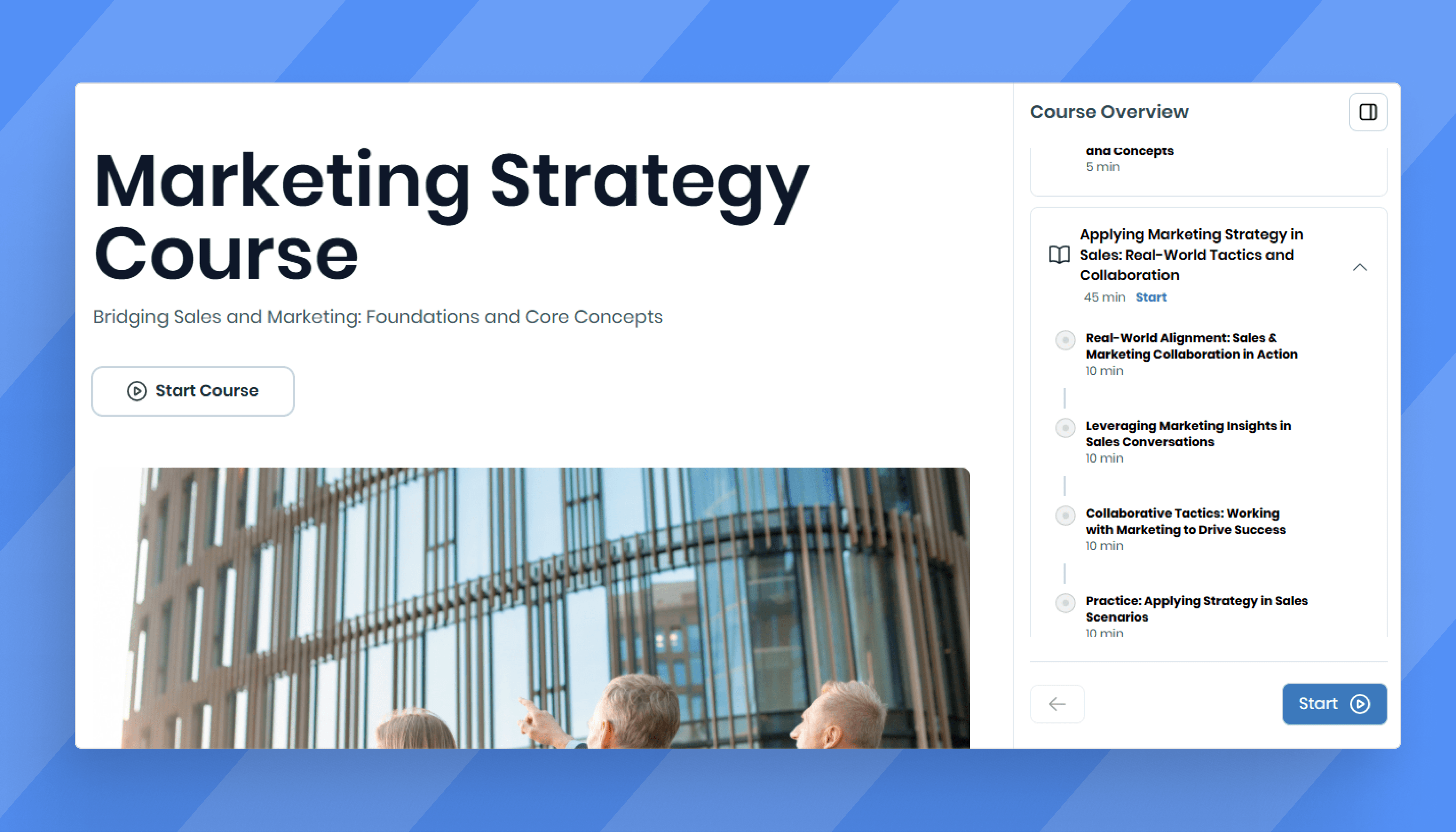
Train marketing on sales reality. When marketers listen to real discovery calls, understand common objections, and see which assets actually get used in deals, their content becomes more relevant and their campaigns become more targeted.
Align onboarding from day one. New hires in both functions should go through shared onboarding on brand positioning, buyer personas, and the customer journey. Alignment built into onboarding becomes cultural. Alignment bolted on later requires constant maintenance.
Use adaptive training that scales across roles. SDRs need different skills than Account Executives. Account Executives need different support than Customer Success managers. Training that adjusts to role, seniority, and skill gap — rather than delivering the same content to everyone — produces measurable performance improvements without the overhead of manual coaching at scale.

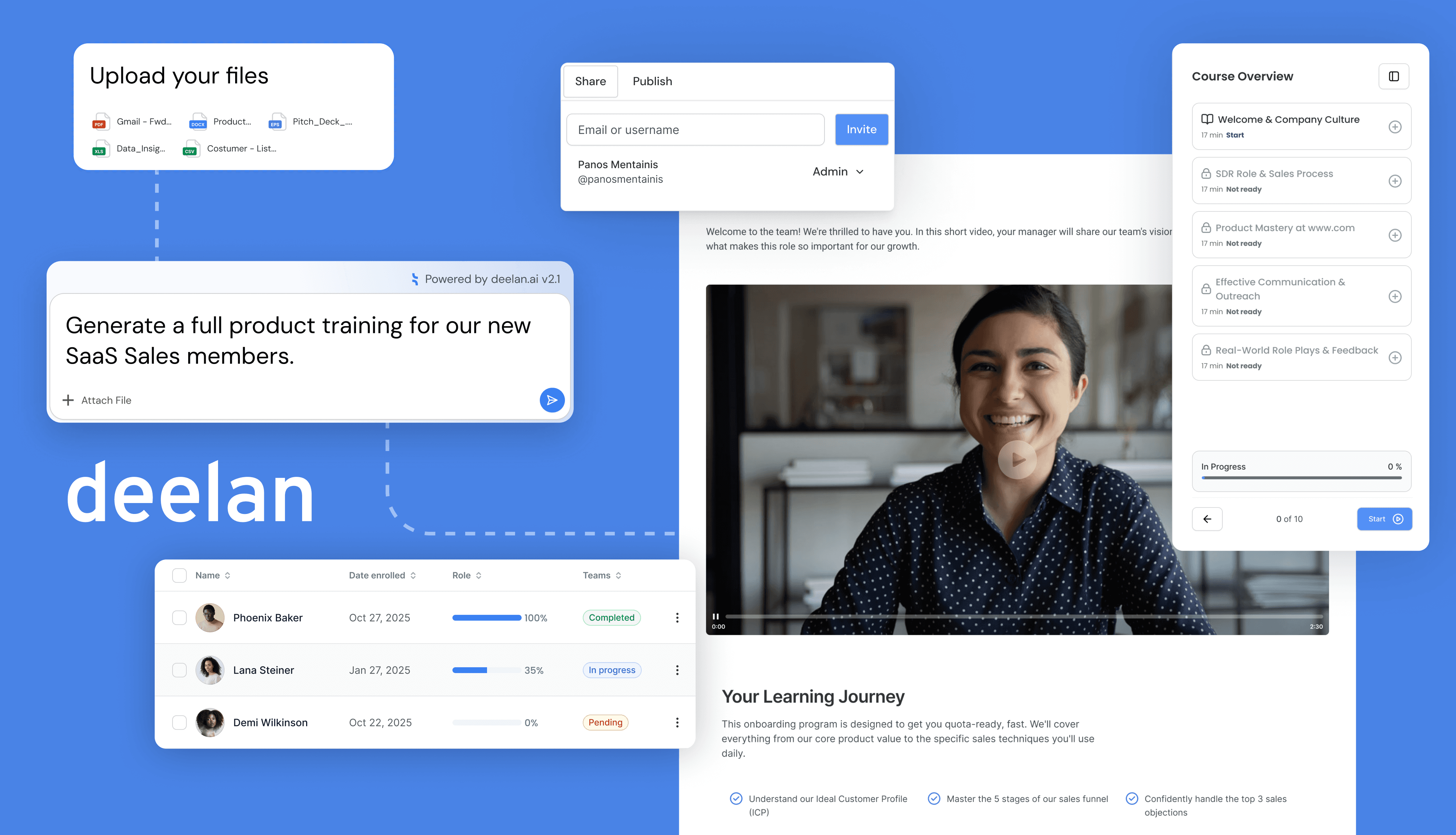
Deelan's adaptive AI training platform lets revenue teams build and deploy role-specific training from existing sales content, call recordings, playbooks, and product docs — in minutes rather than weeks.
Rather than treating enablement as a separate function that runs parallel to alignment efforts, Deelan embeds alignment directly into how reps are trained and coached. The result is faster ramp times, higher content adoption, and a feedback loop between field performance and training content that keeps both teams moving in the same direction.
Metrics That Prove Your Alignment Is Working
Revenue and Pipeline Metrics
Metric | What It Measures |
|---|---|
Pipeline value | Total qualified opportunities in the funnel |
Pipeline velocity | Speed at which leads move through stages |
Revenue attribution | Which marketing activities influenced closed deals |
MQL-to-SQL conversion rate | Whether marketing leads are actually sales-ready |
Win rate by lead source | Which channels generate the highest-quality pipeline |
Lead Quality and Conversion Metrics
Metric | What It Measures |
|---|---|
Lead response time | How quickly sales follows up on marketing leads |
MQL-to-opportunity rate | Handoff effectiveness |
Lead-to-close rate by channel | Full-funnel channel performance |
Content influence rate | Which assets appear in closed deals |
Team Efficiency Metrics
Metric | What It Measures |
|---|---|
Content utilization rate | Whether sales is using marketing-produced assets |
Time from lead creation to first contact | Handoff speed and SLA adherence |
Ramp time | How quickly new reps reach quota (a training alignment indicator) |
Repeat coaching ratio | Whether training is landing or requiring constant repetition |
FAQ: Sales and Marketing Alignment
What are the biggest signs of sales and marketing misalignment? Key indicators include: sales teams ignoring marketing-generated leads; marketing producing content that sales never uses; prospects receiving contradictory messaging from the two teams; long lead response times; and each team blaming the other when revenue targets are missed.
What is a marketing-qualified lead (MQL) vs. a sales-qualified lead (SQL)? An MQL is a prospect who has shown enough engagement with marketing content or campaigns to meet a jointly agreed threshold for outreach. An SQL is a prospect that sales has reviewed and confirmed matches the ideal customer profile and shows buying intent. The definitions must be agreed upon by both teams — not set unilaterally by marketing.
What is a service level agreement (SLA) between sales and marketing? An SLA is a formal agreement that specifies how many qualified leads marketing will deliver in a given period, how quickly sales will follow up, and how both teams will report on performance. Companies with active SLAs are 34% more likely to see greater year-over-year ROI.
How does sales and marketing alignment affect B2B revenue? The impact is significant and well-documented. Aligned organizations achieve 2.4x higher revenue growth, 32% year-over-year revenue gains, 30% shorter sales cycles, and 73% higher conversion rates compared to misaligned counterparts.
How does sales enablement support alignment? Sales enablement functions as a bridge between marketing and sales. It ensures content is delivered with context and training, so sales reps actually use it. It surfaces field insights back to marketing so assets stay relevant. And it measures content performance against deal outcomes — not just downloads or page views.
What is the fastest way to improve sales and marketing alignment? Start by auditing the current state: interview both teams separately, document where definitions diverge, and identify where handoffs break down. Then align on three things in the first 30 days: a shared revenue goal, a joint definition of a qualified lead, and a lead handoff SLA. Everything else builds on that foundation.
What does "smarketing" mean? Smarketing is a portmanteau of "sales" and "marketing" that describes organizations where the two functions operate as a single integrated unit — sharing goals, processes, communications, and accountability rather than managing separate playbooks that occasionally overlap.
Ready to Build Revenue Teams That Actually Work Together?
Alignment doesn't happen through better intentions. It happens through better systems — including the training systems that shape how your reps think, communicate, and execute.
Deelan is the AI training platform built for revenue teams. It helps marketing and sales teams to ramp faster, deliver consistent messaging, and improve performance continuously — with adaptive paths that adjust to each role's actual skill gaps.
If your sales and marketing teams are moving in different directions, the place to start is with how your people are trained.