Static slide decks. One-size-fits-all onboarding. A single training day that reps forget within a month. Sound familiar?
Here's the reality: organizations with continuous sales training programs see 12% higher win rates and 49% lower annual turnover. Yet only 9% of sales training programs actually exceed expectations.
This guide walks you through exactly how to build a sales training program that actually improve performance, with a framework you can start using today.
Why Most Sales Training Programs Fail
Before building something new, it's worth understanding why the old approach breaks down.
The typical sales training program looks like this: a few days of onboarding, a product knowledge deck, maybe a recorded demo walkthrough, and a quiz at the end. Reps get certified. Managers move on. And within 30 days, 87% of what was learned is forgotten.
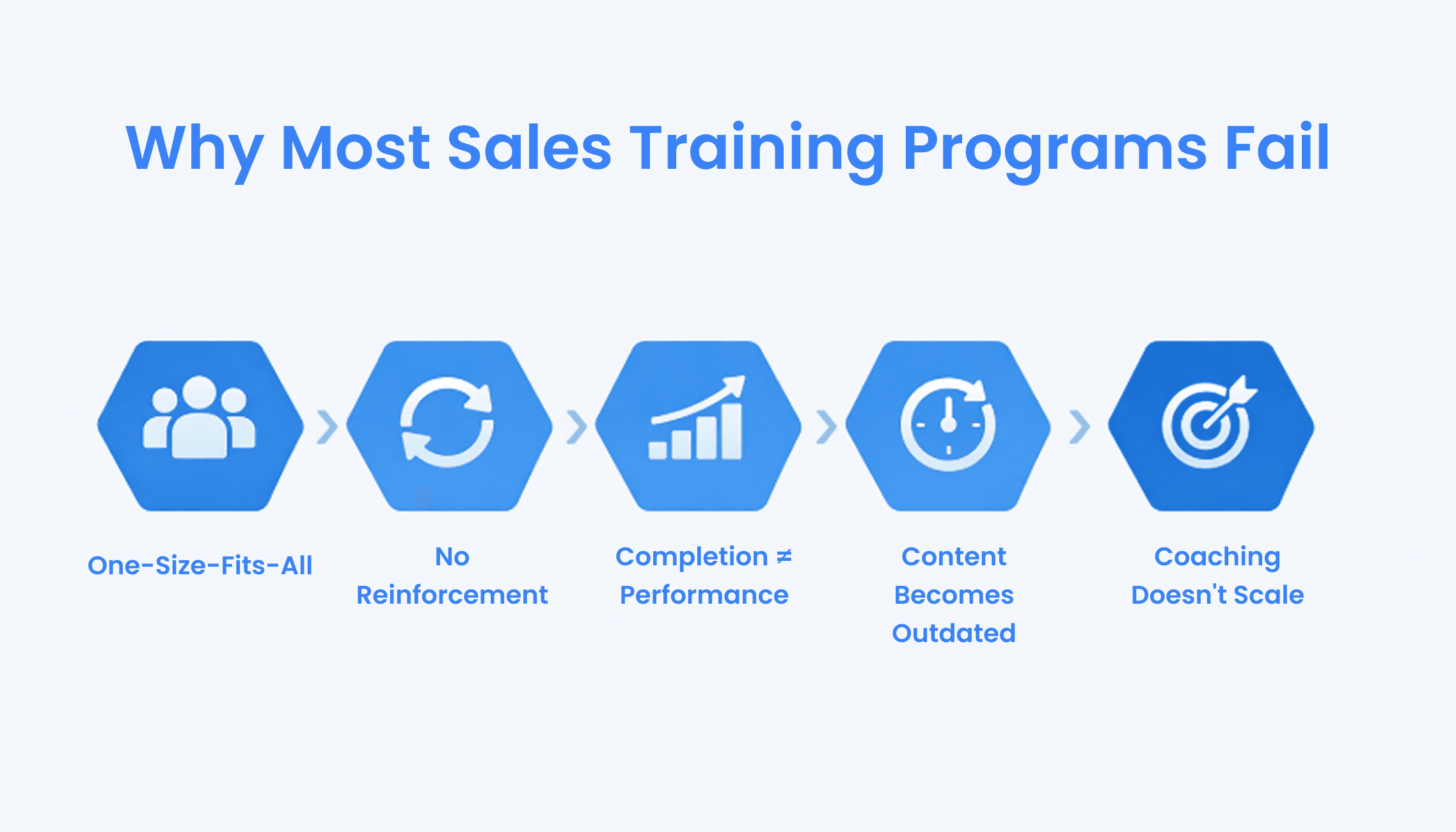
The core problems are predictable:
It's one-size-fits-all. An SDR and a senior AE have completely different skill gaps, yet they sit through the same training.
There's no reinforcement. Learning without repetition doesn't stick. One training event isn't a program — it's a presentation.
It measures completion, not performance. A 100% completion rate means nothing if win rates don't move.
It takes weeks to build and goes stale fast. Markets shift, products update, and training that took six weeks to produce is already outdated.
Coaching doesn't scale. Sales managers spend hours repeating the same feedback instead of developing their team strategically.
The fix isn't more training. It's smarter training — built around real skill gaps, delivered in the right formats, and continuously updated as your team and market evolve.
Step 1: Conduct a Sales Training Needs Assessment
The most common mistake in building a sales training program is skipping straight to content creation. Before you write a single module, you need to understand what your team actually needs.
Talk to the people closest to performance:
Interview sales managers and coaches. They see skill gaps daily. Ask them: What's the one thing that would make your team 20% better this quarter?
Listen to recorded calls. Tools like Gong or Chorus reveal patterns — the objections reps stumble on, the discovery questions they're skipping, the moments where deals go cold.
Review your pipeline data. Where are deals getting stuck? Which stages have the highest drop-off? That's where training needs to focus.
Survey reps directly. Ask them what they feel least confident about. You'll get surprisingly honest answers.
Reverse-engineer from business goals:
If you're doubling headcount, you need a scalable onboarding program. If win rates are down, you need sharper competitive positioning and objection handling. If churn is up, your CS team needs renewal and upsell skills. Start with the outcome, then build backwards.
This discovery phase is not optional. It's what separates training that gets used from training that gets ignored.
Step 2: Define Clear Goals and KPIs
A training program without measurable goals is just a content project. Before building anything, define what success looks like in numbers.
Common sales training KPIs:
Time to first deal closed (ramp time) for new hires
Win rate change at 30, 60, and 90 days post-training
Pipeline conversion rate by stage
Average deal size
Objection-handling score from call reviews
Training completion AND skill assessment scores (not just one)
Set specific, time-bound targets. "Improve win rates by 15% by end of Q2" is a goal. "Make the team better" is not.
Tie each training module to a business outcome. Objection handling training maps to win rate. Prospecting training maps to pipeline volume. Discovery training maps to deal quality. When leadership asks for ROI, you'll have the data to show it.
Step 3: Design Role-Specific Learning Paths
The biggest unlock in modern sales training is personalization by role and seniority. Not every rep needs the same content — and forcing them through it wastes time and kills engagement.
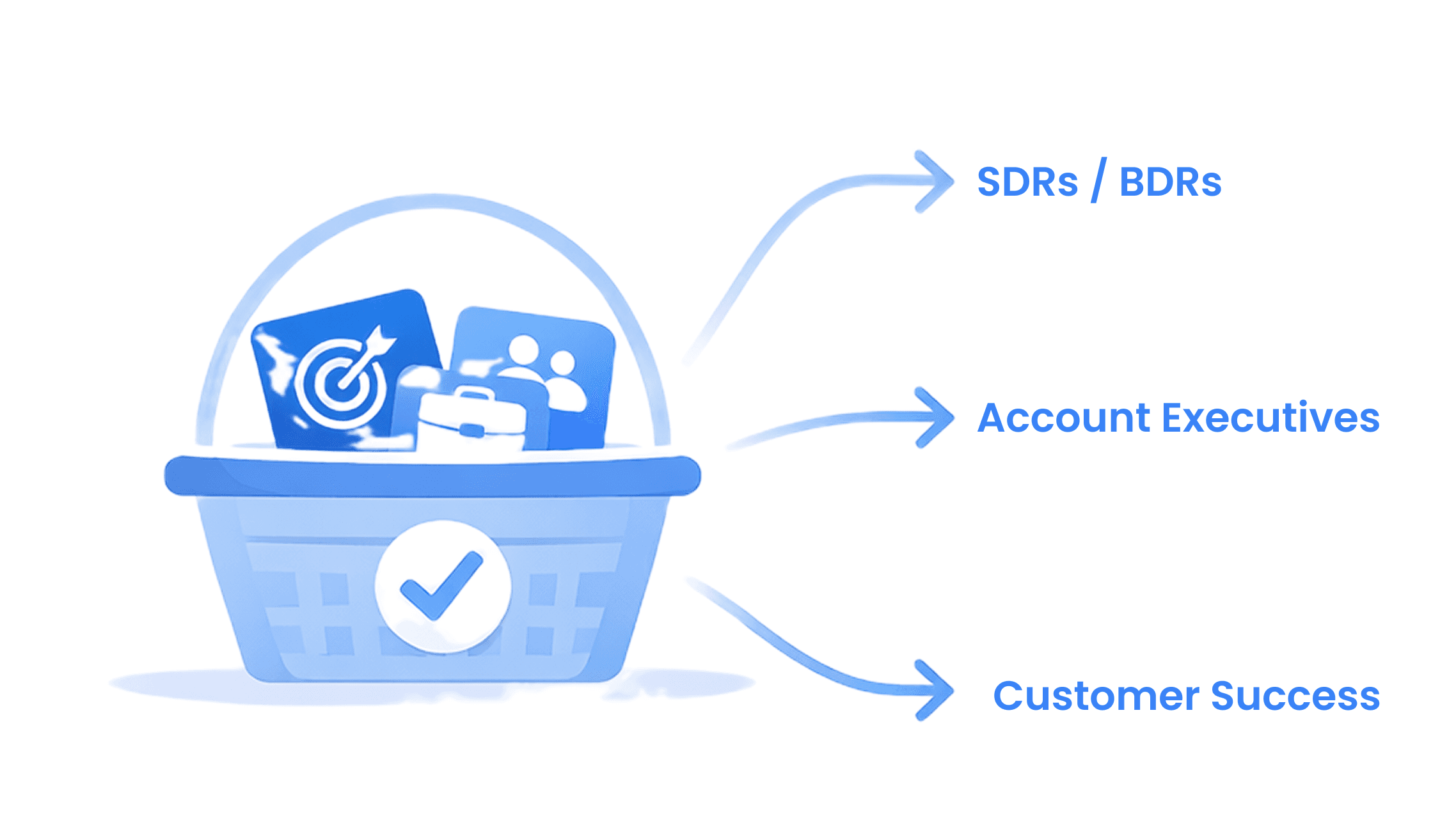
Here's how to think about role-based paths:
SDRs and BDRs need:
Cold outreach frameworks and messaging
Objection handling on the first call
Meeting-setting techniques
Product and ICP knowledge
Account Executives need:
Discovery and qualification frameworks
Demo and presentation skills
Technical validation and stakeholder management
Negotiation and closing techniques
Customer Success Managers need:
Renewal and expansion playbooks
EBR (Executive Business Review) facilitation
Escalation and churn prevention strategies
Upsell conversation frameworks
New hires need structured onboarding that covers company, product, process, and tools — in that order, over a defined ramp timeline.
Experienced reps need targeted skill development, not a repeat of onboarding. Identify their specific gap and build a focused path around it.
When training is built for the role and stage, completion rates go up, time-to-performance goes down, and reps actually engage because the content feels relevant to their day-to-day.
Step 4: Choose the Right Training Formats
Different skills require different formats. A rep can't learn objection handling by reading a PDF. A product overview doesn't need to be a live workshop. Match the format to what you're trying to build.
Courses and e-learning modules Best for: product knowledge, company processes, compliance, and foundational sales skills. Reps can access on demand, at their own pace, and revisit when needed.
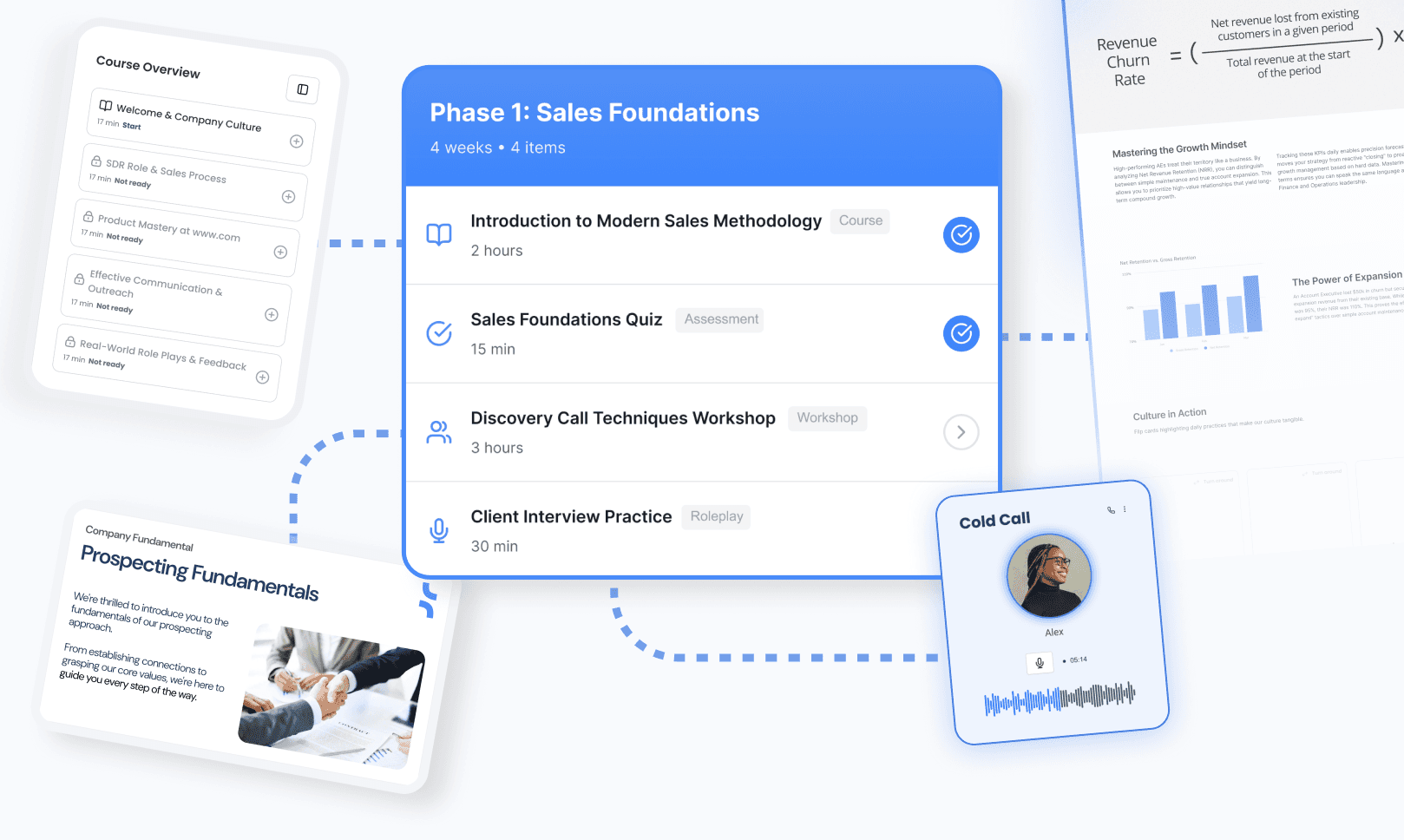
Role-play simulations Best for: cold calls, discovery conversations, objection handling, demos, and renewal negotiations. Practice in a safe environment before going live. AI-powered roleplay now allows reps to practice with a simulated buyer, receive real-time feedback on tone, clarity, and structure — and repeat as many times as needed without taking up manager time.
Live workshops Best for: strategy sessions, team alignment, and complex skill-building that benefits from real-time discussion and peer learning. Best when followed by structured practice and reinforcement.
Microlearning Best for: pre-call prep, quick refreshers, competitive intelligence, and point-of-need support. A 3-minute video before a key call is more valuable than a 2-hour course taken weeks earlier. Break complex topics into small, searchable pieces reps can pull when they need them most.
Assessments and certifications Best for: validating readiness before reps engage with real prospects. Quizzes and scenario-based exams reveal actual skill gaps, not just whether someone clicked through a module.
The strongest programs combine all of these into a structured learning path — not a random collection of content.
Step 5: Build the Curriculum
With your goals defined, roles mapped, and formats chosen, it's time to build.
Start with what you already have. Most companies are sitting on untapped training gold: top rep call recordings, winning email sequences, battle cards, product decks, customer case studies. These are your raw materials.
Structure content in logical progressions. Don't throw everything at a new hire in week one. Build a sequence: company and culture → product knowledge → ICP and buyer personas → sales process → core skills → advanced skills. Each stage should unlock the next.
Build for retrieval, not just delivery. The goal isn't to deliver information — it's to make sure reps can access and apply it when it counts. This means:
Short modules (10–15 minutes max) rather than hour-long courses
Quizzes and exercises after each module, not just at the end
A searchable knowledge base where reps can find specific answers fast
Spaced repetition — key concepts revisited over time, not just once
Update continuously. Assign content owners responsible for keeping modules current. Set a quarterly review cadence. Build with tools that make updates fast, not a two-week production cycle.
Step 6: Deliver, Reinforce, and Coach
Building the content is only half the work. The other half is making sure it actually changes how reps behave in the field.
Manager reinforcement is non-negotiable. Research consistently shows that training without manager follow-through has minimal lasting impact. Managers need to know what their reps are learning, ask about it in 1:1s, and reinforce it in deal reviews and call coaching.
Coaching should be data-driven, not opinion-based. Use call recordings, CRM data, and assessment scores to identify exactly where each rep needs support. Targeted coaching on a specific weakness is ten times more effective than generic feedback.
Create a culture where learning is tied to performance. When reps see a direct connection between training engagement and quota attainment, adoption takes care of itself. Track skill scores alongside pipeline metrics and share the correlation openly.
Step 7: Measure Impact and Iterate
Once your program is live, measurement is what keeps it improving.
Track leading and lagging indicators:
Leading: assessment scores, roleplay performance ratings, training completion, manager coaching frequency
Lagging: ramp time, win rates, average deal size, quota attainment, retention
Gather feedback regularly. Ask reps what was useful and what felt irrelevant. Ask managers whether they're seeing behavior change. Survey new hires at 30, 60, and 90 days.
Kill what isn't working. If a module has low completion and no measurable impact, cut it or rebuild it. The best programs get leaner over time, not longer.
Run quarterly reviews. Assess whether training objectives are being met, whether content is still current, and whether new skill gaps have emerged. Treat your training program the way your best reps treat their pipeline — always reviewing, always improving.
AI Tool for Building Efficient Sales Training
The biggest shift in sales training isn't a new methodology. It's the speed and personalization that AI now makes possible.
Traditionally, building a single training course took weeks: gathering SME input, writing scripts, designing slides, recording videos, building quizzes. Most teams were perpetually behind — training content was outdated before it launched.
However with the right AI-powered platform, you can:
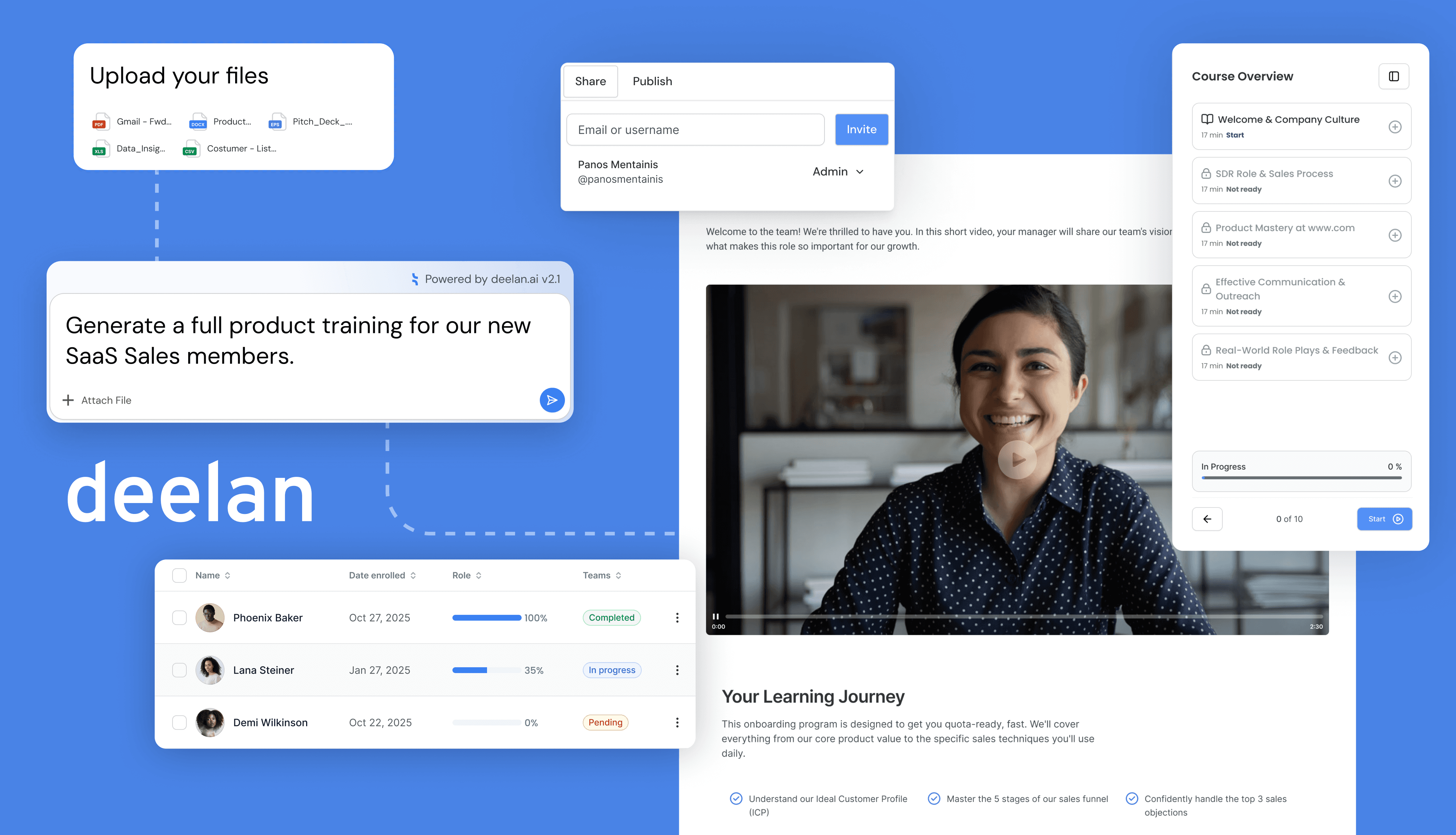
Generate a complete training module from a prompt, a call recording, or an existing document — in minutes
Create AI-powered roleplay simulations where reps practice objection handling against a realistic buyer persona, with instant feedback on their responses
Automatically adapt learning paths based on each rep's role, seniority, and assessed skill gaps
Update content in real-time as your product, pricing, or playbook changes
Scale coaching across the entire team without adding headcount
The Old Way vs. The New Way
Traditional Training | AI-Powered Training with Deelan | |
|---|---|---|
Build time | Weeks per course | Minutes per module |
Personalization | One-size-fits-all | Role and skill-gap adaptive |
Formats | Slides + quiz | Courses, roleplays, workshops, assessments |
Coaching | Manager-dependent | AI feedback + scaled coaching |
Updates | Quarterly at best | Real-time |
Measurement | Completion rate | Skill mastery + quota impact |
Onboarding | Inconsistent | Structured, trackable, repeatable |
Build Your Sales Training Program with Deelan
Building a high-performance sales training program used to require a dedicated enablement team, a suite of tools, and weeks of content production. That's no longer true.
Deelan is the AI training platform built specifically for revenue teams. Upload your scripts, call recordings, and playbooks — and Deelan converts them into adaptive training instantly. Generate courses, AI roleplays, workshops, and assessments from a single prompt. Deploy role-specific learning paths for SDRs, AEs, and CSMs. Track skill mastery in real-time.
Teams using Deelan ramp reps 55% faster, see 15–25% higher win rates, and build training 80% faster than with traditional tools.
Ready to see it in action?