
Sales territory design can determine whether your reps have a fair chance of hitting quota, or spend the year fighting against an impossible book of business.
A good territory gives each rep: enough opportunity, a manageable workload, clear account ownership, and the right type of customers for their skills.
A poor territory design creates the opposite:
Unequal opportunities
Overloaded or underused reps
Account ownership conflicts
Missed high-value prospects
Unreliable forecasts
Frustration and rep turnover
Before redesigning your territories, you can take a dedicated Territory and Quota Design training in Deelan. The training helps managers balance opportunity across reps, set ambitious but achievable quotas, scale the model as the team grows, and avoid decisions that damage morale.
What Should a Sales Territory Design Include?
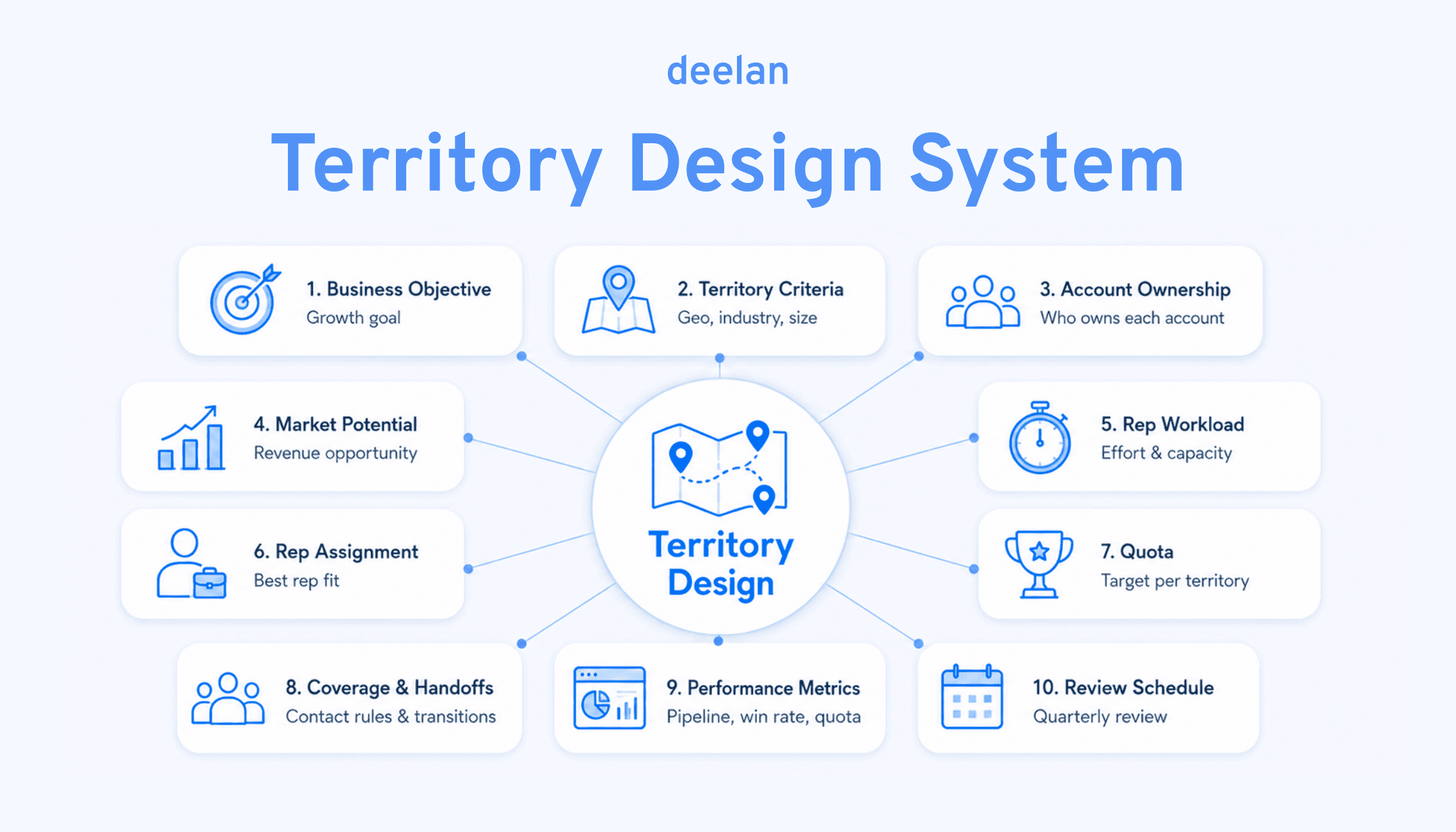
A complete territory plan should include these elements:
What it should define | Example | |
|---|---|---|
Business objective | What the territory model should help the company achieve | Grow enterprise revenue in France |
Territory criteria |
| Geography, industry, company size, account value |
Account ownership | Which rep or team owns each account | Ownership based on customer headquarters |
Market potential | The estimated revenue opportunity in each territory | Total addressable accounts and expected contract value |
Rep workload | The time and effort needed to manage the territory | Number of active opportunities and account complexity |
Rep assignment | Why a specific rep is matched with the territory | Industry expertise or enterprise-selling experience |
The revenue target connected to the territory’s potential | €800,000 annual quota | |
Coverage expectations | Which accounts should be contacted and how often | Tier 1 accounts contacted every month |
Handoff rules | How accounts move between reps or teams | SMB account moves to enterprise after reaching 500 employees |
Performance metrics | How managers will assess territory health | Pipeline coverage, win rate, quota attainment |
When the territory will be evaluated | Quarterly health review and annual redesign |
How to Design Sales Territories: 7-Step Guide
The following process can be used for a new territory model or a redesign of an existing one.
Step | What to do | Manager to-do list | Practical tip |
1. Set the objective | Decide what the territory structure should achieve | Choose one primary goal, such as market expansion, enterprise growth, or better coverage | Avoid trying to solve every sales problem with one territory redesign |
2. Collect the data | Gather information about customers, prospects, revenue, and rep capacity | Export CRM data, review historical results, identify missing information | Clean duplicate and outdated CRM records before making assignments |
3. Segment the market | Group accounts using criteria connected to how customers buy | Segment by geography, industry, company size, account value, or buying behavior | Start with the simplest segmentation that reflects your sales motion |
4. Estimate potential | Calculate the realistic opportunity available in each segment | Review account numbers, average deal size, win rates, growth potential, and whitespace | Do not use last year’s revenue as the only measure of future potential |
5. Balance workload | Compare the opportunity with the effort required to pursue it | Consider active deals, account complexity, travel, customer needs, and sales-cycle length | Equal account numbers rarely mean equal territories |
6. Assign reps and quotas | Match reps to suitable territories and set achievable targets | Review skills, experience, relationships, capacity, and development needs | Separate the territory score from the rep’s previous performance |
7. Test and communicate | Check the model, explain it to the team, and schedule reviews | Test ownership scenarios, collect rep feedback, document rules, and set a review date | Explain both what is changing and why it is changing |
7 Sales Territory Design Models and Examples
1. Geographic territories
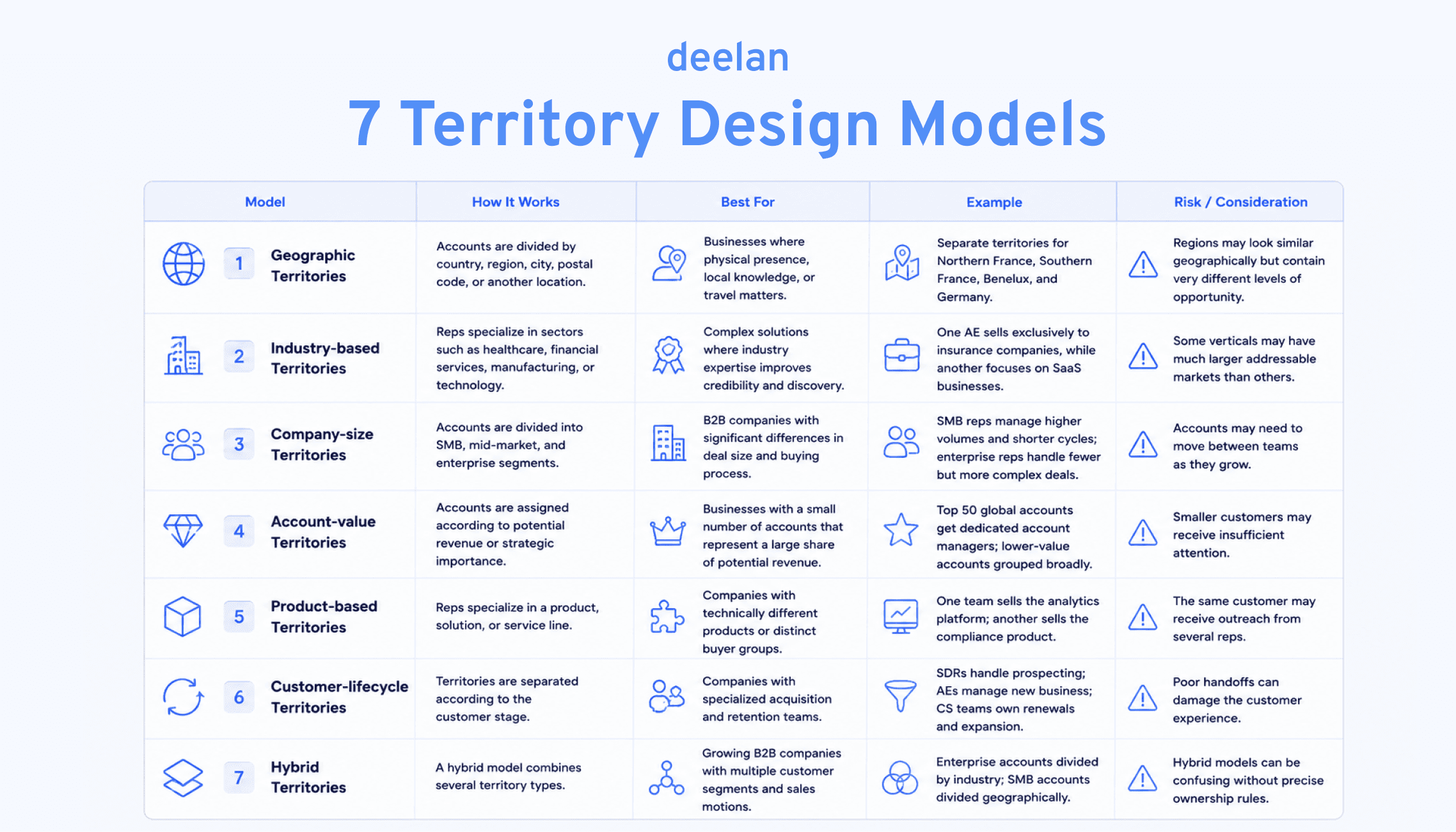
Accounts are divided by country, region, city, postal code, or another location.
Example: A field sales team has separate territories for Northern France, Southern France, Benelux, and Germany.
Best for: Businesses where physical presence, local knowledge, or travel matters.
Risk: Regions may look similar geographically but contain very different levels of opportunity.
2. Industry-based territories
Reps specialize in sectors such as healthcare, financial services, manufacturing, or technology.
Example: One account executive sells exclusively to insurance companies, while another focuses on SaaS businesses.
Best for: Complex solutions where industry expertise improves credibility and discovery.
Risk: Some verticals may have much larger addressable markets than others.
3. Company-size territories
Accounts are divided into SMB, mid-market, and enterprise segments.
Example: SMB reps manage higher volumes and shorter sales cycles, while enterprise reps handle fewer but more complex accounts.
Best for: B2B companies with significant differences in deal size and buying process.
Risk: Accounts may need to move between teams as they grow.
4. Account-value territories
Accounts are assigned according to potential revenue or strategic importance.
Example: The top 50 global accounts receive dedicated account managers, while lower-value accounts are grouped into broader territories.
Best for: Businesses with a small number of accounts that represent a large share of potential revenue.
Risk: Smaller customers may receive insufficient attention.
5. Product-based territories
Reps specialize in a product, solution, or service line.
Example: One team sells a company’s analytics platform, while another sells its compliance product.
Best for: Companies with technically different products or distinct buyer groups.
Risk: The same customer may receive outreach from several reps.
6. Customer-lifecycle territories
Territories are separated according to the customer stage.
Example: SDRs handle prospecting, account executives manage new business, and customer success teams own renewals and expansion.
Best for: Companies with specialized acquisition and retention teams.
Risk: Poor handoffs can damage the customer experience.
7. Hybrid territories
A hybrid model combines several territory types.
Example: Enterprise accounts are divided by industry, while SMB accounts are divided geographically.
Best for: Growing B2B companies with multiple customer segments and sales motions.
Risk: Hybrid models can become confusing without precise ownership rules.
For many B2B sales teams, the hybrid approach provides the best balance between specialization and market coverage.
How to Know Whether a Territory Is Fair
Territory fairness does not mean giving every rep the same number of accounts.
It means giving each rep a reasonably equal chance to succeed.
Track indicators such as:
Metric | What it reveals |
Pipeline-to-quota ratio | Whether the territory contains enough active opportunity |
Whether performance is consistently achievable | |
Win rate | Whether targeting and rep fit are effective |
Average deal size | The value of opportunities in the territory |
Sales cycle length | The time and effort required to close deals |
Account coverage | Whether valuable accounts are being contacted |
Rep capacity | Whether the workload is manageable |
Activity-to-opportunity conversion | Whether effort produces meaningful pipeline |
A rep with high activity but consistently low pipeline may not need more pressure. The territory, targeting criteria, or sales approach may need to change.

Train Reps for Their New Territories
A rep moving from SMB to enterprise, for example, may need training in:
Multi-threaded discovery
Longer sales cycles
Executive conversations
Account planning
Stakeholder management
Negotiation
Complex objections
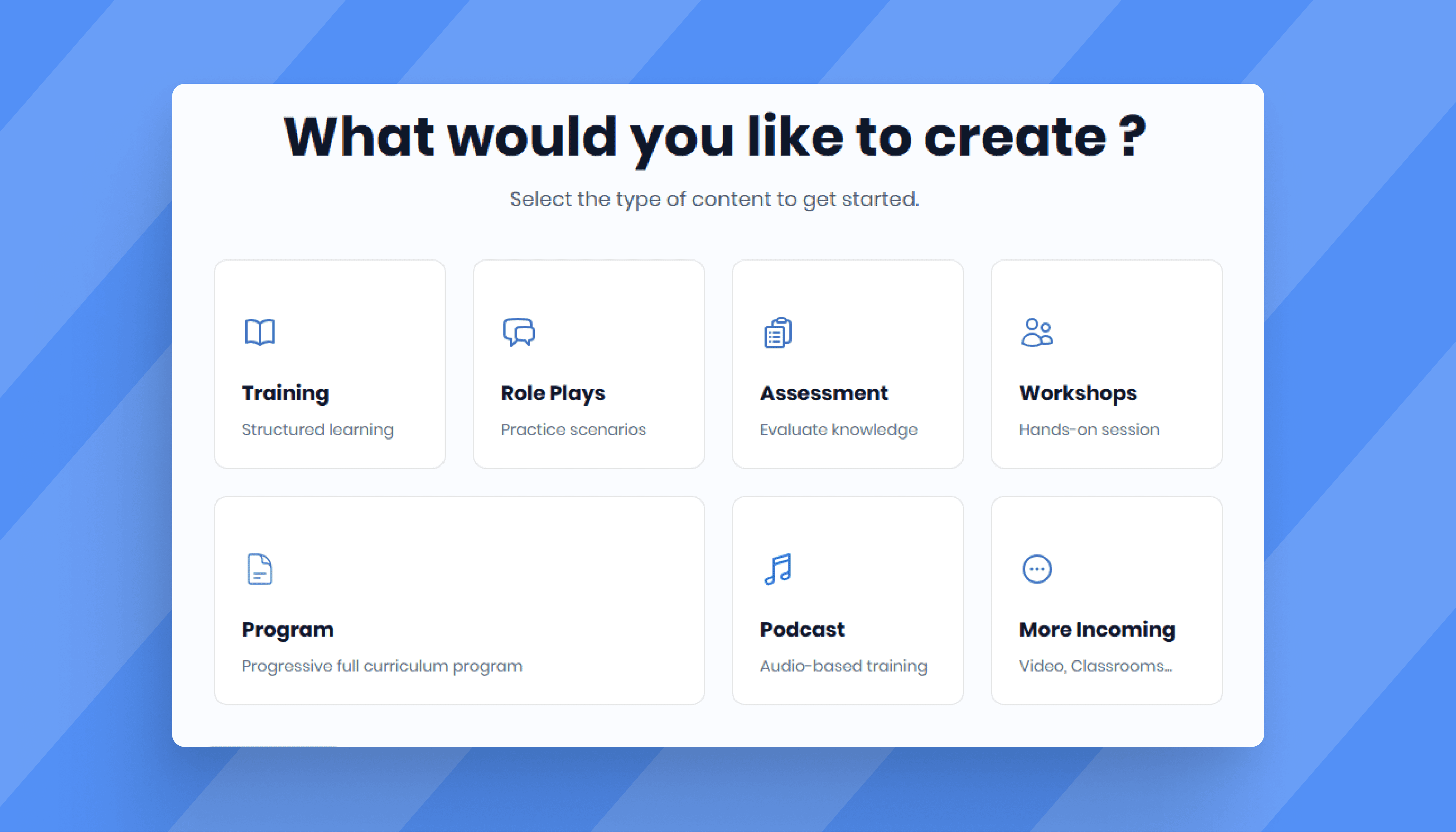
Deelan turns your playbooks, call recordings, product documentation, and sales materials into personalized training for each rep.

Managers can use Deelan to create:
Assessments
Microlearning
Complete training programs
Training can adapt to each rep’s role, seniority, performance, and skill gaps.
Reps can then practice realistic conversations and receive coaching before speaking to prospects.
Sales Territory Management Tips
After launching your new structure:
Review territory health during quarterly business reviews.
Avoid major changes in the middle of important deals.
Collect feedback from reps, but validate it with data.
Review account ownership after hires, departures, or promotions.
Update training when reps enter new markets or segments.
Compare territory performance using both activity and outcomes.
Reserve major redesigns for annual or semi-annual planning.
Territory management should be stable enough for reps to build relationships, but flexible enough to respond when opportunity shifts.

Good sales territory design creates clarity, fairness, and focus.
The best model is not necessarily the most complex one. It is the model that aligns market opportunity with rep capacity, supports your go-to-market strategy, and gives every seller a credible path to quota.
Start with reliable data, choose the territory model that reflects how your customers buy, communicate changes clearly, and review performance regularly.
Then make sure your reps are trained to succeed in the territories you give them.