

"It's too expensive." "We already have a solution." "Send me an email."
Every salesperson has heard these objections. And most know at least one textbook response.
Let's look at the objections worth preparing for, what makes them challenging, and how to train reps to handle them.
What Research Tells Us About Sales Objections
Gong analyzed more than 300 million cold calls and found that five objection categories accounted for 74% of cold-call objections.
That means, you don't need to prepare your reps for every imaginable objection. Start with the situations they're most likely to encounter.
In a separate analysis of 67,149 sales calls, Gong found that successful reps approached objections differently:
Top performers paused longer before responding.
Average performers tended to speed up and give long explanations.
Top performers were more likely to ask clarifying questions rather than immediately defend their position.
Takeaway: the most difficult part is staying curious when you feel pressure to defend your product.
7 Difficult Sales Objections and How to Handle Them
Not every objection means a prospect is uninterested. Sometimes it's a genuine concern about cost, timing, trust, or whether your product is right for them.
Here are seven objections worth practicing.
Sales objection | What might be behind it | Common mistake |
|---|---|---|
Budget limitations or unclear ROI | Discounting immediately | |
"We're already using a competitor." | Satisfaction with the current solution or switching costs | Criticizing the competitor |
"Send me an email." | Low interest, lack of time, or unclear value | Sending a generic pitch |
"We don't have budget." | No approved funding or low priority | Pushing for a purchase anyway |
"I need to think about it." | Unresolved concerns or uncertainty | Accepting a vague follow-up |
"Now isn't the right time." | Competing priorities or limited urgency | Creating artificial pressure |
"I need to discuss it internally." | Multiple decision-makers or approval requirements | Losing contact with the buying process |
1. "It's Too Expensive."

The instinctive response is to justify the price or offer a discount.
But price objections aren't always about affordability. Sometimes the buyer hasn't connected the solution with a valuable enough outcome.
Try asking:
"Can I ask what you're comparing the price against? Is it another solution, or the budget you've allocated?"
This helps distinguish a genuine budget constraint from a value communication problem.
2. "We're Already Using a Competitor."

A rep might immediately list every feature their product has that the competitor doesn't.
That's usually not the best starting point.
Try asking:
"That's good to know. What's working particularly well with your current solution? And is there anything you'd improve?"
The goal isn't to convince every prospect to switch. It's to understand whether there's a meaningful gap.
Skill to practice: Differentiation and Discovery.
3. "Just Send Me an Email."

This is a familiar objection during cold calling.
Sometimes the prospect genuinely wants information. Other times, it's a polite way to end the conversation.
Try asking:
"Absolutely. To make it relevant, what would be most useful for you to see?"
Their answer can reveal whether there's real interest and what matters to them.
Skill to practice: Open Questioning and Cold Call Engagement.
4. "We Don't Have Budget."

Not having budget is different from thinking something is too expensive.
The buyer might recognize the value but lack funding or approval.
Try asking:
"Understood. Is this something you've already considered budgeting for, or would it require a new business case?"
If the need is real, the next step might be helping the buyer establish priorities and build that case. If funding genuinely isn't available, respect the constraint.
Skill to practice: Qualification and Business-Case Construction.
5. "I Need to Think About It."

Probably one of the most frustrating objections because it tells you very little.
Don't rush to close or immediately assume the prospect is hiding something.
Try asking:
"Of course. What are the main things you'd like to think through before making a decision?"
This invites the buyer to share concerns that might not have surfaced earlier.
Skill to practice: Objection Isolation.
6. "Now Isn't the Right Time."

Timing objections can be genuine. A company might be going through a restructuring, budget freeze, or another urgent project.
Try asking:
"Makes sense. What's the main priority taking your attention right now, and when would it make sense to revisit this?"
Sometimes the right outcome is a future conversation, not an immediate sale.
Skill to practice: Why-Now Framing and Deal Execution.
7. "I Need to Discuss It With My Manager."

This isn't necessarily a negative signal. Many B2B decisions require multiple stakeholders.
The mistake is leaving the buyer to explain your solution internally without understanding what the other decision-makers care about.
Try asking:
"Absolutely. What do you think their biggest questions will be? Would it help if we prepared something specifically for them?"
Skill to practice: Champion Development and Decision-Process Mapping.
How to Train Sales Reps to Handle Difficult Objections
Objection handling is a practical skill. You improve it by handling objections, receiving feedback, and practicing again.
At deelan, we approach objection-handling training as a continuous process: identify the gaps, practice the skill, and measure improvement.
1. Find the Objections Your Reps Actually Struggle With
Start with real sales calls.
Which objections keep appearing? Where do reps become defensive, offer discounts too quickly, or fail to ask follow-up questions?
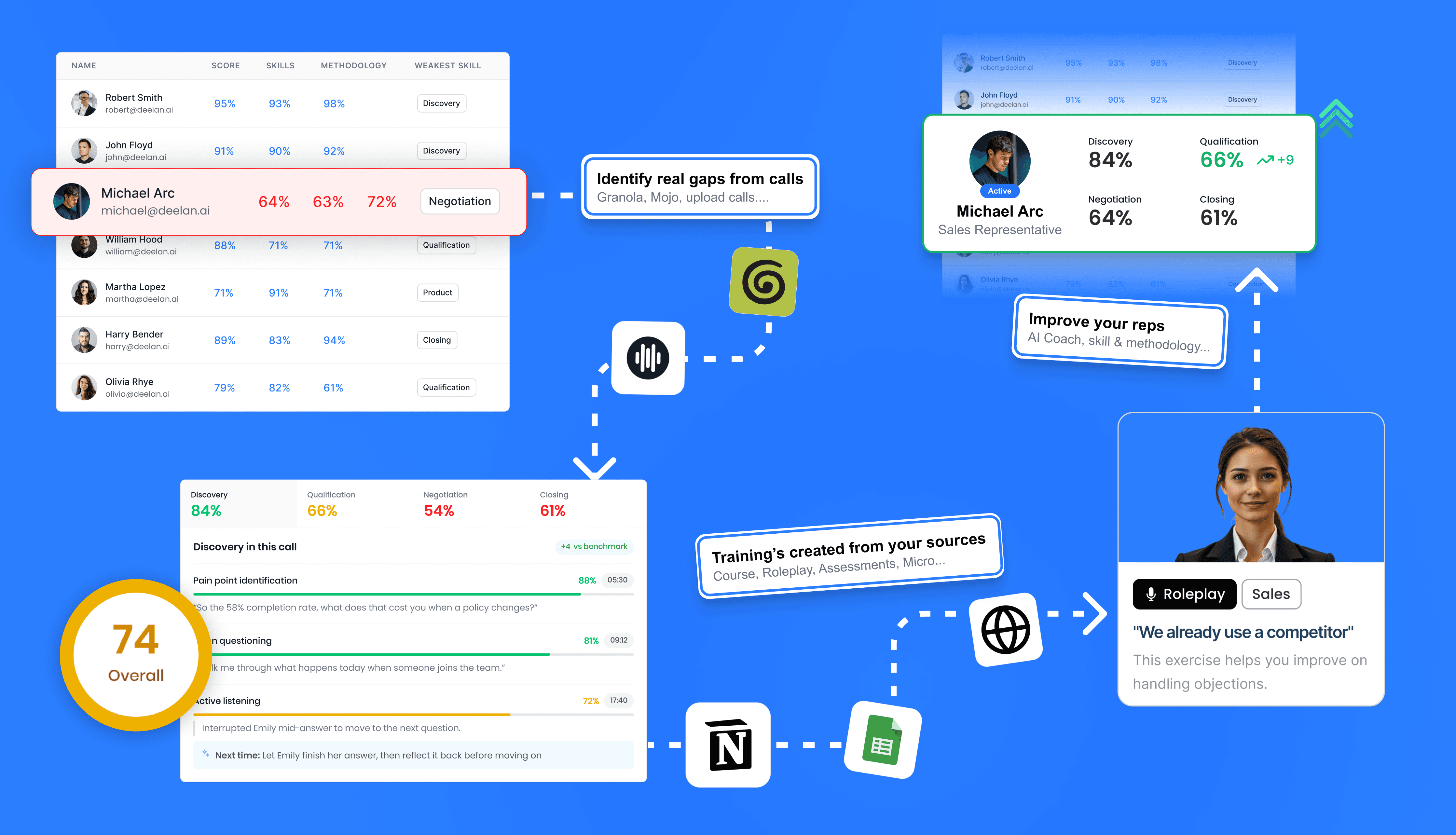
With deelan's call analytics, teams can analyze conversations to identify individual skill gaps.

2. Turn Your Sales Playbooks Into Training
Your best objection-handling knowledge probably already exists somewhere: sales playbooks, product documentation, competitive battlecards, or recordings of successful calls.

With deelan, you can upload existing sales materials and generate focused courses, assessments, and training programs.
3. Practice With Difficult AI Buyer Personas
With deelan, you can create realistic objection-handling simulations and configure the buyer's personality, industry, knowledge, difficulty, and objection intensity.
Want to challenge an experienced AE? Create a skeptical CFO who questions every ROI claim.

Training objective | |
|---|---|
Skeptical CFO challenging pricing | Defend value using relevant ROI |
Impatient prospect during cold calling | Stay composed and ask effective questions |
Buyer comparing three competitors | Communicate differentiation |
Procurement manager demanding discounts | Practice negotiation |
Existing customer questioning renewal | Reinforce value and uncover concerns |
4. Use AI Coaching to Understand What Went Wrong
After each session, deelan provides feedback on objection handling, question quality, confidence, tone, and other conversation skills.

Reps can also debrief with an AI coach, ask questions about their performance, explore better responses, and identify what to improve next.
5. Adapt Training to Each Rep's Progress
One rep might struggle with price objections. Another might handle pricing confidently but consistently lose momentum when a buyer mentions competitors.
They shouldn't receive identical training.

With deelan, each rep can follow a personalized learning path based on their skill gaps and performance.
The best time to discover that a rep struggles with a difficult objection isn't during a high-stakes customer conversation.
It's during practice.
Ready to turn your team's toughest objections into better sales skills?