Price objections are easy to misread. A buyer says, “It’s too expensive,” and the rep hears, “We’re about to lose this deal.”
The rep starts defending the price, adding more features, explaining the product again, or offering a discount before they even know what the buyer means.
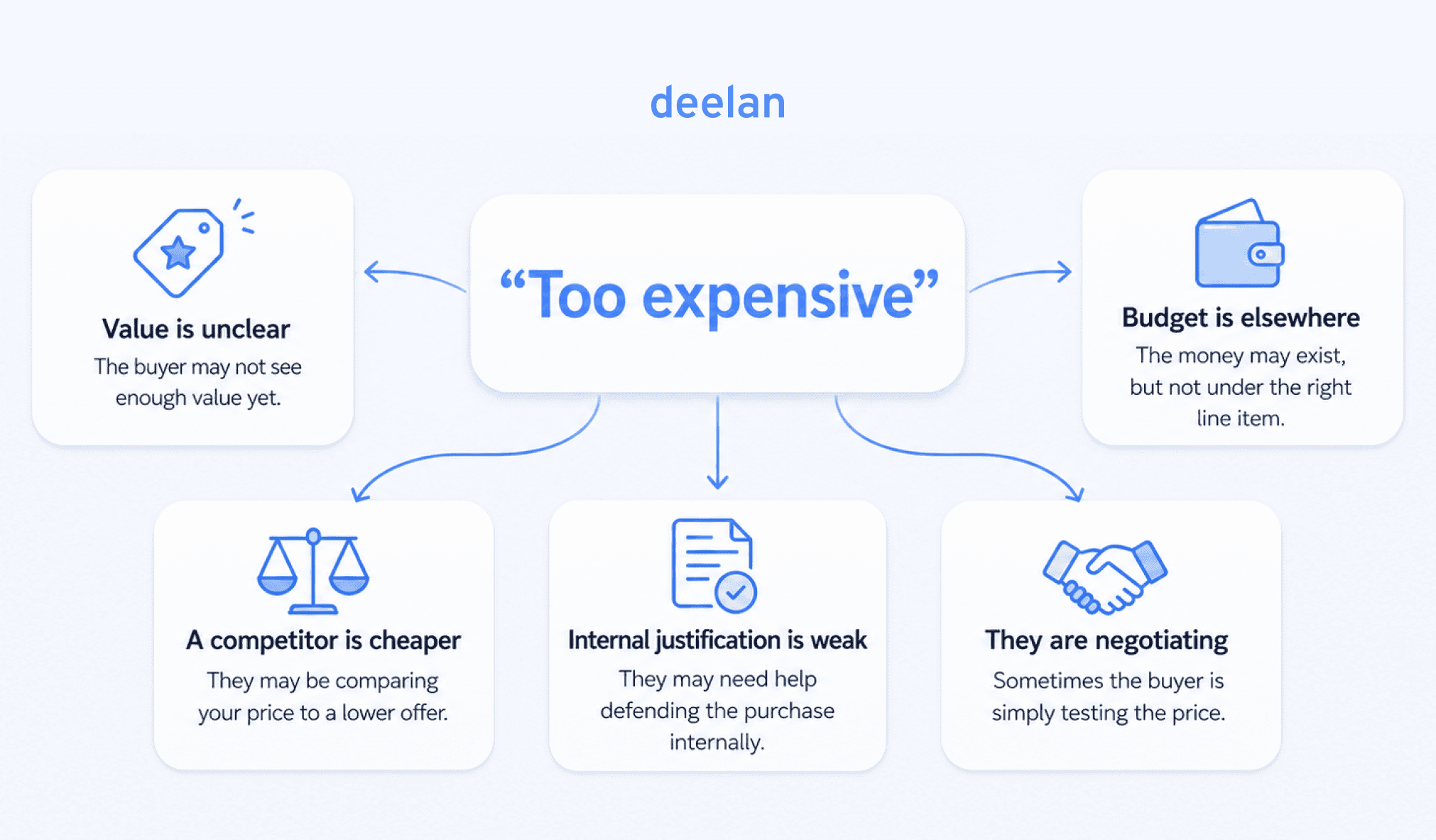
But “too expensive” can mean a lot of different things.
It can mean the buyer does not see enough value yet.
It can mean the budget exists, but not under the right line item.
It can mean a competitor gave them a lower number.
It can mean they need help justifying the purchase internally.
Sometimes it simply means they are negotiating.
Best sales reps do not rush to answer price objections, then they respond to the real concern.
This guide gives you 15 practical responses you can use in real sales conversations, plus the thinking behind each one.
Want to practice this before your next sales call?
Try Deelan’s free Academy roleplay: Objection Drills: Handle It Live.
You’ll face rapid-fire objections from an AI buyer and get scored on composure, reframe quality, and how well you keep the conversation moving.
Price objection types: what the buyer says vs. what it may mean
Buyer says | What it may really mean | Best response angle |
|---|---|---|
“It’s too expensive.” | Value is unclear, or the buyer is comparing you to something else. | Ask what they are comparing the price against. |
“We don’t have budget.” | No budget exists, or budget has not been allocated yet. | Clarify whether it is a hard limit or an approval issue. |
“Your competitor is cheaper.” | They may be comparing headline prices, not scope. | Compare what is included, what is missing, and what risk remains. |
“Can you discount?” | They are testing flexibility or trying to show they negotiated. | Check if price is the only blocker before changing anything. |
“Just send pricing.” | They want a shortcut before you understand scope. | Ask a few qualifying questions first. |
“I need to show this to my CFO.” | They need an internal business case. | Help them explain cost, impact, urgency, and risk. |
“I don’t see the ROI.” | The value is still too abstract. | Turn the value into one or two measurable outcomes. |
“Let’s revisit next quarter.” | The pain is not urgent enough yet. | Discuss the cost of waiting. |
“We could build this internally.” | They may be underestimating time, ownership, and maintenance. | Compare internal effort, timeline, and long-term responsibility. |
“This feels risky.” | The concern may be adoption, implementation, or trust. | Name the risk and address it directly. |
Before you respond, diagnose the objection
Before responding, try to understand which type of objection you are dealing with.
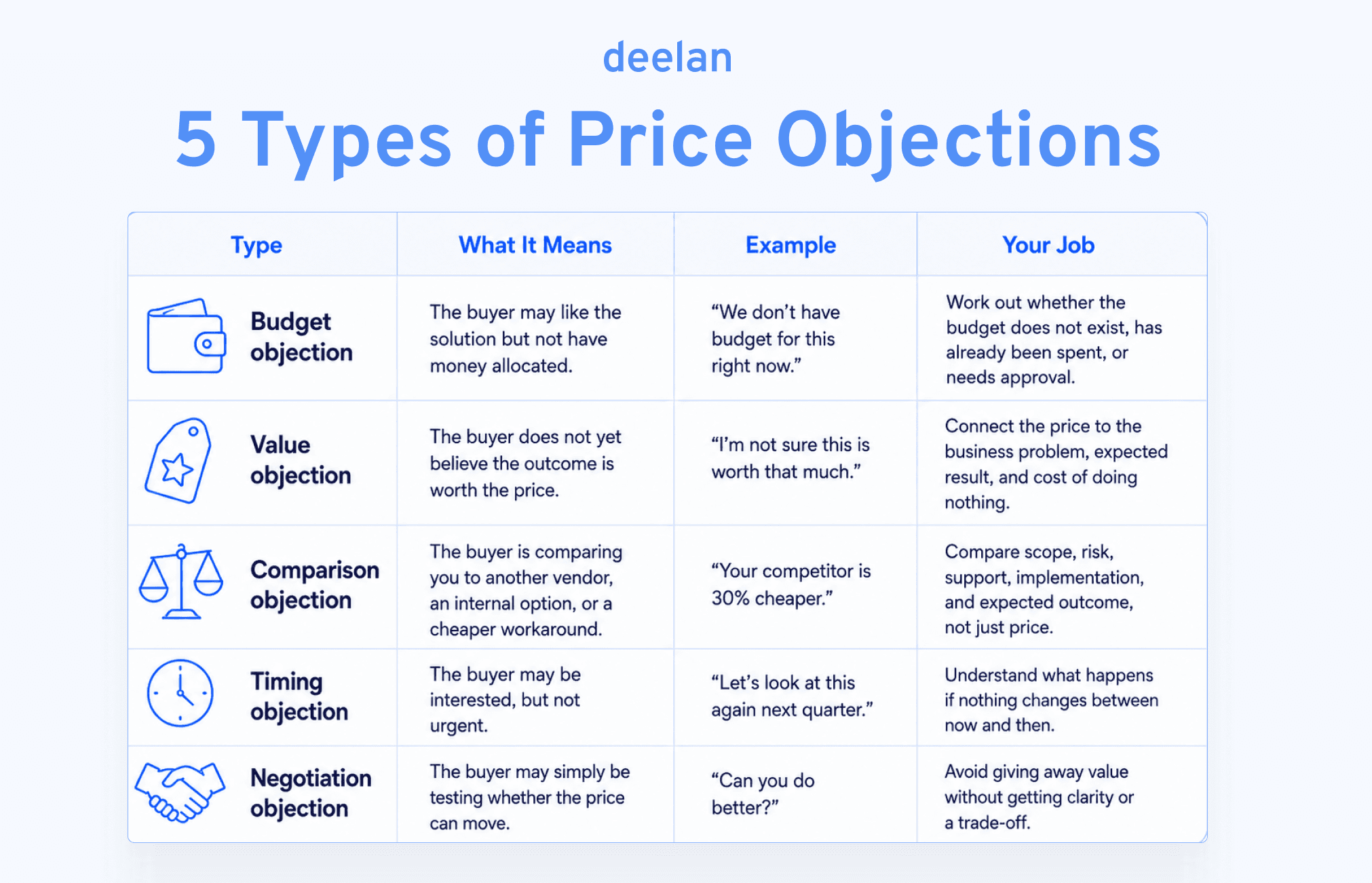
1. Budget objection
The buyer may like the solution but not have money allocated.
Example:
“We don’t have budget for this right now.”
Your job is to understand whether the budget does not exist, has already been spent, or needs to be approved by someone else.
2. Value objection
The buyer does not yet believe the outcome is worth the price.
Example:
“I’m not sure this is worth that much.”
Your job is to connect the price to the business problem, expected result, and cost of doing nothing.
3. Comparison objection
The buyer is comparing you to another vendor, an internal option, or a cheaper workaround.
Example:
“Your competitor is 30% cheaper.”
Your job is to compare scope, risk, support, implementation, and expected outcome. Not just price.
4. Timing objection
The buyer may be interested, but not urgent.
Example:
“Let’s look at this again next quarter.”
Your job is to understand what happens if nothing changes between now and then.
5. Negotiation objection
The buyer may simply be testing whether the price can move.
Example:
“Can you do better?”
Your job is to avoid giving away value without getting clarity or a trade-off.
Build a price objection handling course for your team
This is a useful thing to train, especially with new reps.
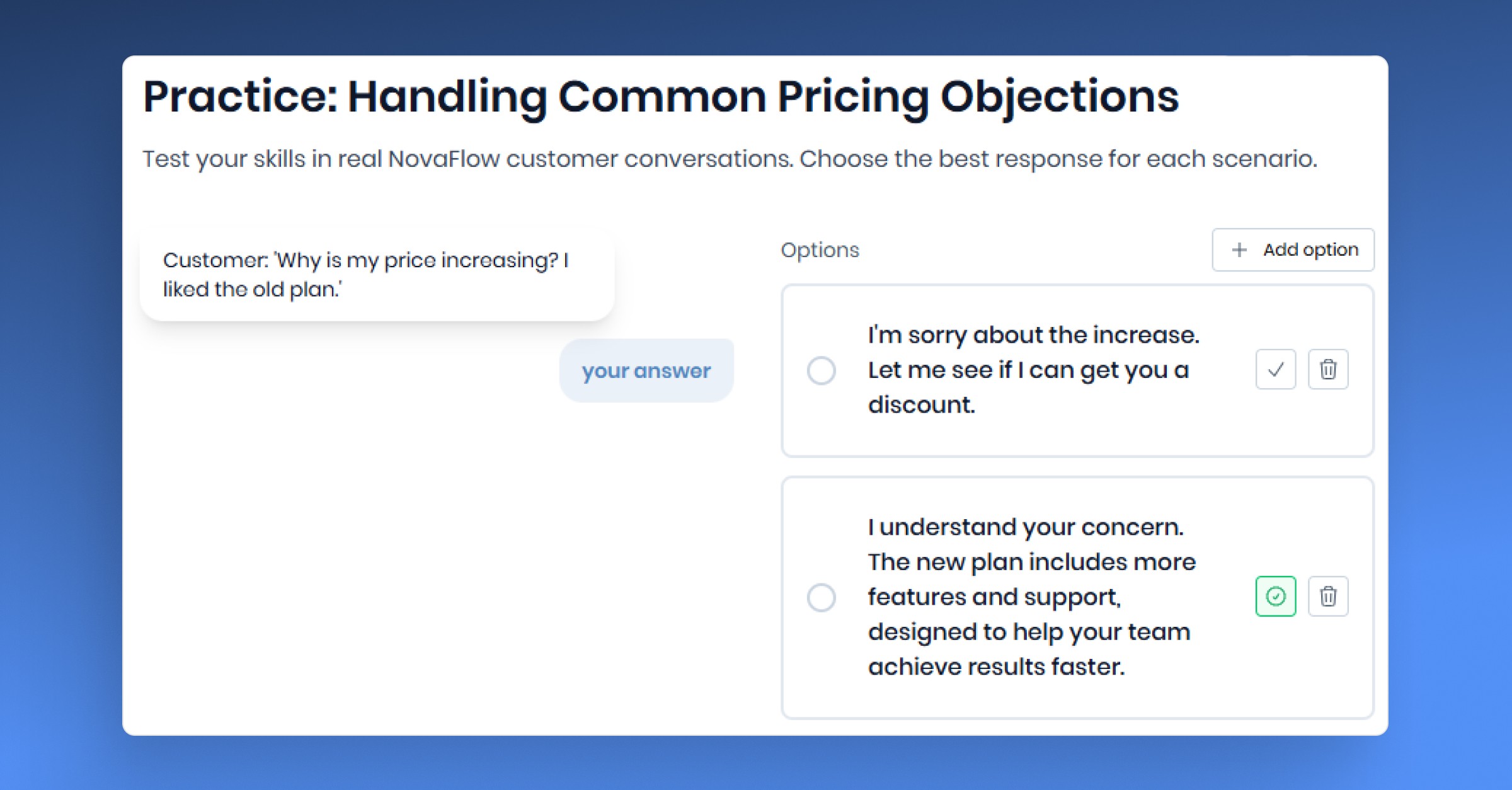
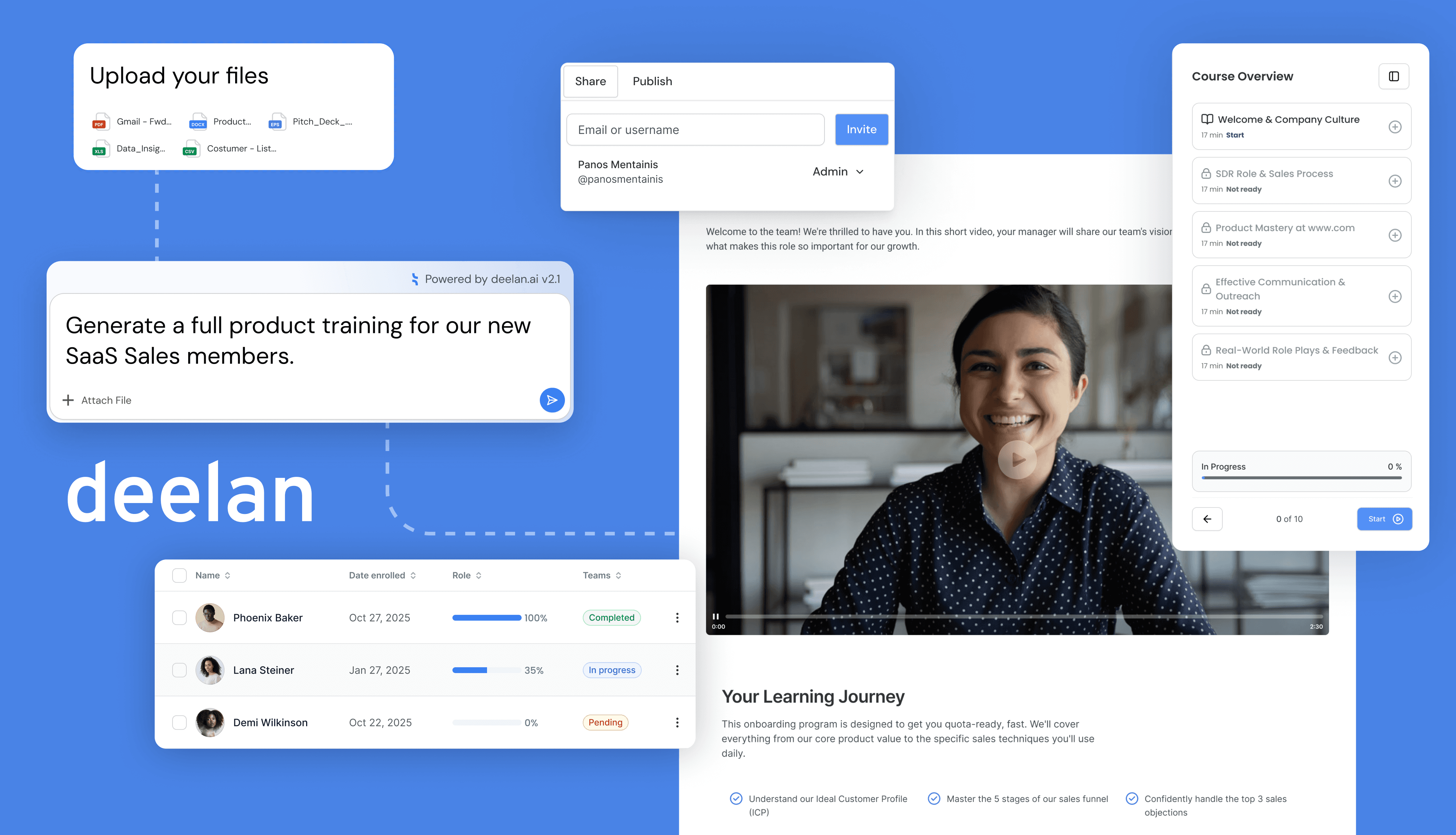
On Deelan, you can turn this into a short training flow for your team: first, a course that explains the five types of price objections, then an assessment where reps have to identify what the buyer really means, and then an AI roleplay where they practice responding live.
15 real responses to price objections
1. “It’s too expensive.”
What to say:
“When you say expensive, do you mean compared with the budget you had in mind, another option you’re considering, or the value you expect this to create?”
Why it works:
It gets the buyer to define the objection. “Too expensive” is vague. This question shows you whether the issue is budget, comparison, or value.
Avoid saying:
“I know, but we’re worth it.”
That sounds defensive and does not move the conversation anywhere.
2. “That’s more than we expected.”
What to say:
“That makes sense. Most teams come in with a rough number before we get into the full scope. Which part feels higher than expected: the package, the rollout, the number of users, or the total investment?”
Why it works:
It helps you find the exact friction point. Sometimes the buyer is reacting to the full number, but one part of the proposal is what actually bothers them.
3. “We don’t have budget.”
What to say:
“Understood. Is that a hard budget limit, or is it more that budget has not been allocated for this yet?”
Why it works:
Those are two different situations. If there is a hard limit, you may need to change scope. If budget has not been allocated, you may need to help the buyer make the internal case.
4. “Can you give us a discount?”
What to say:
“Is price the only thing stopping you from moving forward, or are there other concerns we should address first?”
Why it works:
It stops the rep from discounting too early. It also tests whether the buyer is serious or just negotiating by habit.
Avoid saying:
“I can probably do 10%.”
That may feel helpful in the moment, but it teaches the buyer that the first price was flexible.
5. “Your competitor is cheaper.”
What to say:
“Let’s compare what is included so you are not choosing based only on the headline number. What does their offer include, and what would you still need to handle separately?”
Why it works:
It keeps the conversation professional. You are not attacking the competitor. You are making sure the buyer compares the full picture.
6. “We can get something similar for less.”
What to say:
“You might be right. If the main goal is the lowest upfront cost, they may be the better fit. If the goal is [specific outcome], then we should compare which option is more likely to get you there with less risk.”
Why it works:
It is honest. Some buyers really do want the cheapest option. But if they care about the outcome, the conversation becomes more serious.
7. “Just send me the pricing.”
What to say:
“Can I ask two quick questions first so I send the right range?”
Why it works:
It protects the discovery process without sounding difficult. Pricing without context usually leads to a weak comparison.
8. “I need to show this to my CFO.”
What to say:
“Of course. What will your CFO care about most: payback, budget source, risk, timing, or why this needs to happen now? I can help you prepare that properly.”
Why it works:
A CFO objection is often not about the product. It is about whether the buyer can explain the business case clearly.
9. “I don’t see the ROI.”
What to say:
“Which number would need to improve for this to feel worth it: ramp time, meetings booked, win rate, renewal risk, manager time, or something else?”
Why it works:
ROI becomes easier to discuss when it is tied to one measurable business outcome.
10. “Let’s revisit next quarter.”
What to say:
“We can do that. Before we pause, what happens if nothing changes between now and next quarter?”
Why it works:
It does not pressure the buyer. It simply asks them to think about the cost of waiting.
Follow-up line:
“If the answer is ‘not much,’ waiting may make sense. If the answer is missed targets, slow ramp, or another quarter of manual work, we should probably map the next step now.”
11. “We could build this internally.”
What to say:
“You might be able to. Who would own it after launch, and how soon would you need it working? Internal projects usually involve build time, updates, reporting, adoption, and support.”
Why it works:
Internal builds often sound cheaper until the buyer thinks about the full workload. This response brings those hidden costs into the open.
12. “The price feels high for a team our size.”
What to say:
“For a team your size, we should be strict about scope. Which problem is painful enough to solve now, and which parts can wait?”
Why it works:
It respects the size of the team instead of pushing the full package. It also keeps the conversation focused on the most valuable use case.
13. “Can we start with something smaller?”
What to say:
“Let’s find the smallest version that still gives you a real result. I do not want to cut it down so far that the test becomes too weak to prove anything.”
Why it works:
This gives the buyer flexibility without damaging the value of the solution.
14. “Procurement will push back.”
What to say:
“The best thing we can do is give them a clear scope, a clear business reason, and a few places where we can trade instead of simply cutting price.”
Why it works:
It prepares the buyer for procurement instead of treating it like a surprise. It also opens the door to trade-offs such as contract length, payment terms, rollout timing, or scope.
15. “This feels risky.”
What to say:
“Is the risk about the cost, implementation, team adoption, or whether the results will show up?”
Why it works:
Risk often hides behind price. Once the buyer names the specific risk, you can address the real objection.
Follow-up line:
“If adoption is the concern, let’s talk about rollout. If results are the concern, let’s define what success would need to look like in the first 30 or 60 days.”
How to avoid making price objections worse
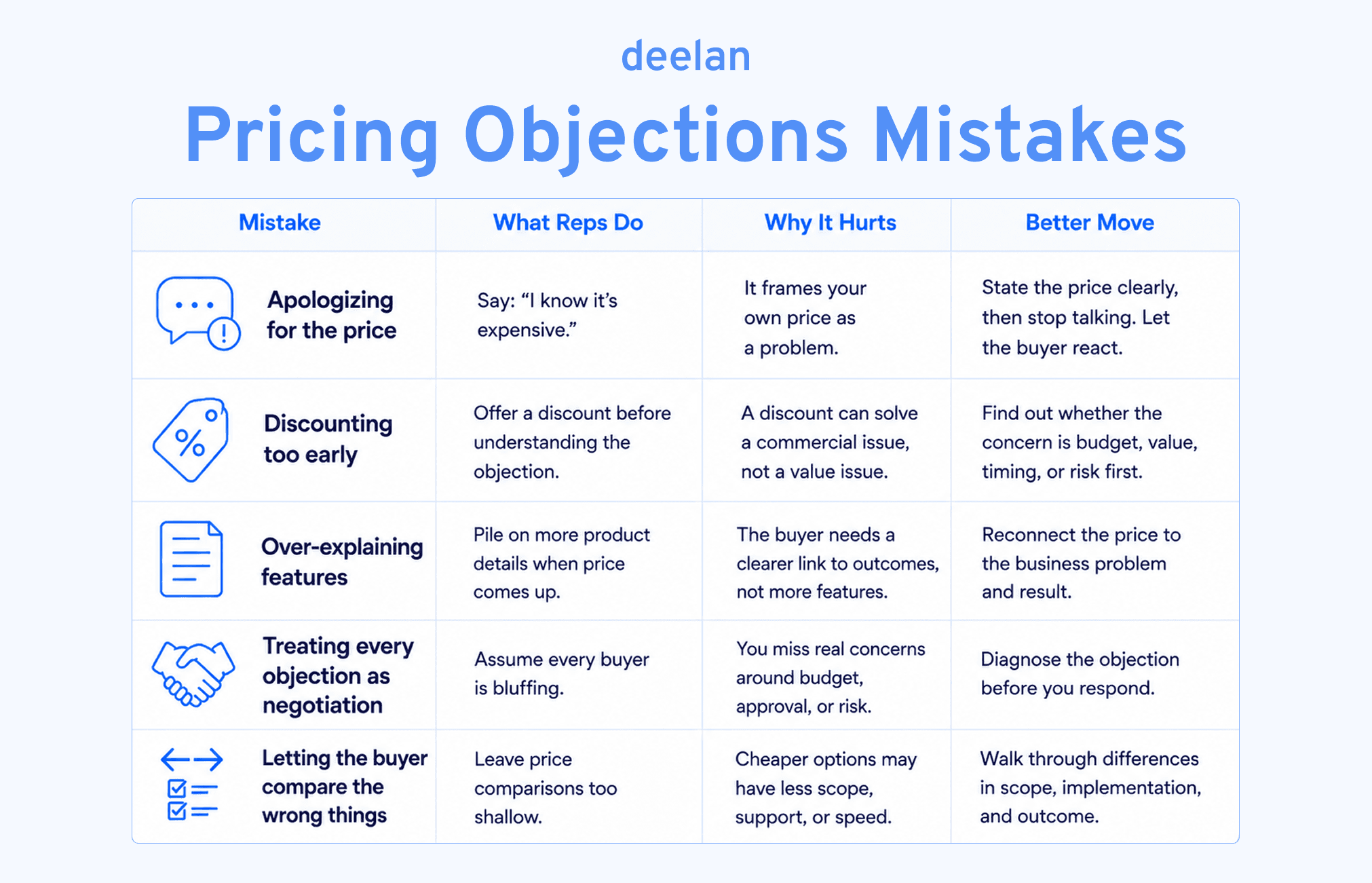
Some reps lose control of the pricing conversation before the buyer has even pushed that hard. The common mistakes are simple.
Apologizing for the price
“I know it’s expensive” sounds harmless, but it frames your own price as a problem.
Say the price clearly. Then stop talking. Let the buyer react.
Discounting before you understand the objection
A discount can solve a commercial issue. It cannot solve a value issue.
If the buyer does not understand why the solution matters, a lower price only makes the deal slightly less confusing.
Over-explaining features
When a buyer questions price, many reps add more product detail.
That often makes the problem worse. The buyer does not need more features. They need a clearer link between the price and the outcome they care about.
Treating every objection as negotiation
Some price objections are negotiation. Some are real concerns.
If you treat every buyer like they are bluffing, you will miss genuine issues around budget, approval, or risk.
Letting the buyer compare the wrong things
A cheaper competitor may have fewer services, slower implementation, weaker reporting, or less support.
Do not assume the buyer has compared the offers properly. Walk through it with them.
A simple price objection framework
Use this when you do not know what to say.
1. Acknowledge
“I understand why you are asking.”
2. Clarify
“What are you comparing the price against?”
3. Reframe
“Based on the problem you described, the question is whether solving [problem] is worth [investment].”
4. Advance
“If it is, the next step would be [next step]. If it is not, we should be honest about that too.”
This keeps the tone calm. It also prevents the conversation from turning into a random discount discussion.
How managers should train reps on price objections
A useful training session should include:
Real price objections from your team’s calls
Examples of weak responses and stronger alternatives
Practice where reps answer out loud, not in writing
Feedback on wording, confidence, pace, and next step
Repetition until the rep can stay calm without sounding rehearsed

Deelan can help teams build this kind of practice faster.
You can turn sales playbooks, call recordings, pricing notes, and objection handling guidelines into AI roleplays, courses, and assessments.
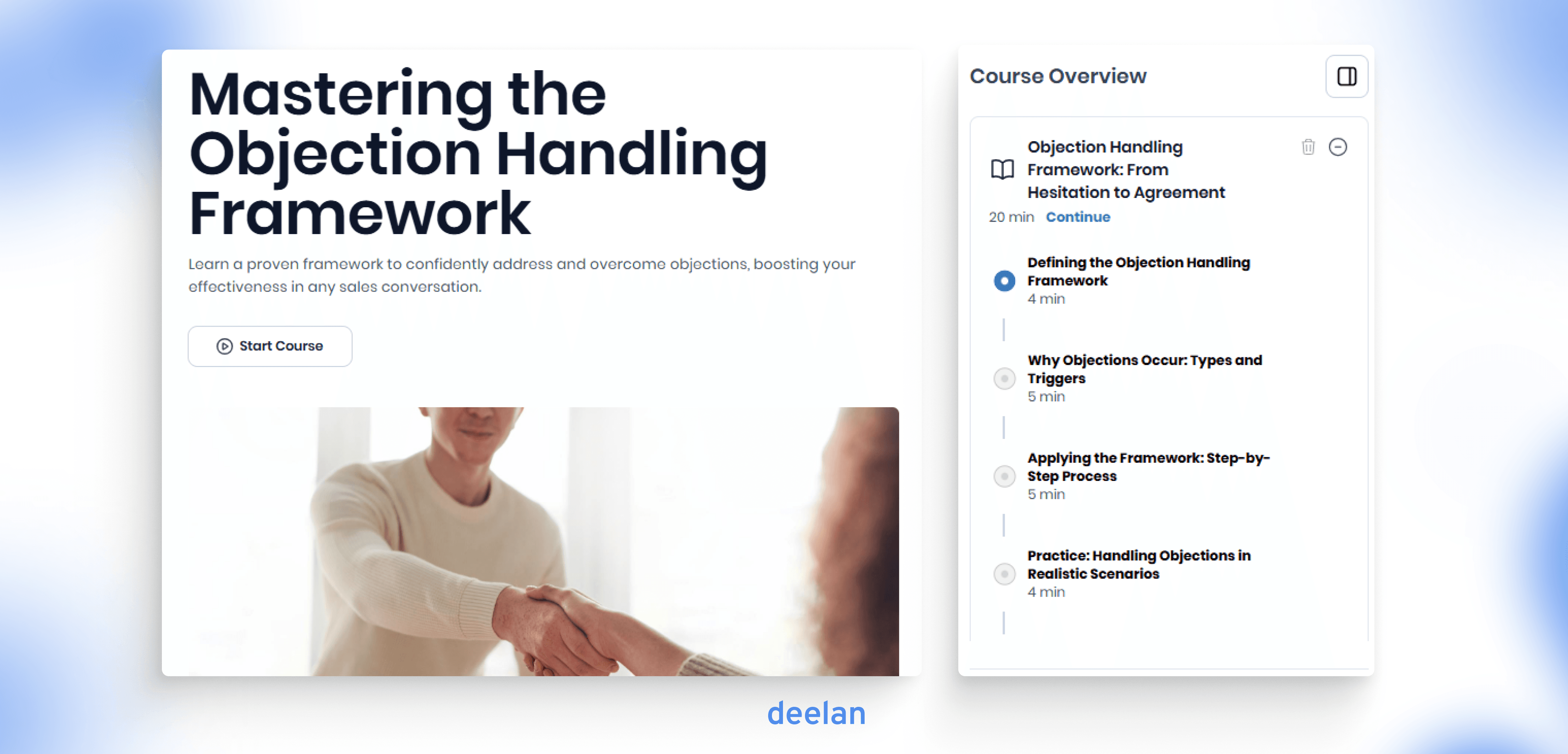
For individual practice, reps can use the free Academy roleplay:
Objection Drills: Handle It Live
Rapid-fire objection drills with an AI buyer. Price, timing, competitor preference, and “just send something over” objections come back-to-back. Reps get scored on composure and reframe quality, so they can see where they hold the conversation and where they lose momentum.
Price objections are part of serious sales conversations.
A buyer who pushes back on price may still be interested. They may be trying to understand the value, reduce risk, compare options, or prepare for an internal conversation.
The rep’s job is to slow down, clarify what the price is being compared against, and bring the conversation back to the business problem.
You do not need a perfect line. You need a calm process.
Listen. Clarify. Reframe. Advance.
That is usually enough to keep the conversation alive and find out whether the deal is real.