
You invested in a sales call recording platform. Your calls are being captured, transcribed and stored. Managers can review conversations, read summaries and identify important moments.
Your sales calls contain real customer questions, objections, messaging, successful behaviours and skill gaps. Instead of using recordings only to review the past, you can turn them into training that improves future conversations.
Here are five practical ways to get more from your sales call recording software.
Use case | What to look for | What to create |
|---|---|---|
Individual skill gaps | Microlearning, courses or roleplays | |
Objection-handling practice | Recurring buyer objections | Realistic AI roleplays |
Strong examples and common mistakes | Onboarding courses and practice | |
Methodology reinforcement | Missing steps or inconsistent application | Assessments and methodology training |
Continuous improvement | Behaviour changes across future calls | Follow-up training and targeted practice |
With Deelan, you can upload a transcript or connect a tool such as Granola or Claap, analyse the conversation against your sales methodology and generate targeted training directly from the findings.

1. Create personalised training for individual reps
Most sales teams assign the same training to everyone.
But two reps can complete the same onboarding programme and still need completely different support. One may struggle to ask strong discovery questions, while another understands discovery but becomes uncomfortable when pricing comes up.

Review several calls from the same rep and look for repeated patterns, such as:
Missing follow-up questions
Weak active listening
Unclear product explanations
Difficulty handling objections
Inconsistent qualification
Calls ending without a specific next step
Choose the skill that would have made the greatest difference to the conversation.
Example
A rep completes several discovery calls but rarely explores the business impact of the customer’s problem.
You could create:
A short microlearning activity on impact questions
Examples of strong follow-up questions
An AI roleplay with a buyer who gives vague answers
A later call review to see whether the behaviour changed
This creates a learning path based on the rep’s real performance rather than a generic training calendar.
2. Turn real objections into roleplay practice
Sales call recordings provide a continuous source of realistic training scenarios.
Your buyers already tell you which objections your team needs to practise. The problem is that these objections are often recorded in call summaries and never reused.

Look across recent calls for repeated concerns around:
Timing
Existing providers
Internal priorities
Product capabilities
Implementation
Security
Lack of urgency
Then use the buyer’s actual context and language to build a practice scenario.
Suppose a prospect says:
“We already have a solution, and switching would create more work for the team.”
A weak training response would be to add this sentence to a list of objections.
A stronger approach is to create a roleplay where the AI buyer already uses another solution, is concerned about implementation and does not believe the cost of switching is justified.
The rep must then practise asking clarifying questions, understanding the real concern and connecting the product’s value to the buyer’s situation.
This is more effective than practising a memorised response because the rep must handle the objection inside a complete conversation.
How to do it
Choose one objection from a real call and define:
Who the buyer is
What they are trying to achieve
Why they are hesitant
What information they will reveal
What a strong response should demonstrate
In Deelan, the scenario can become an AI roleplay that listens, asks questions, reacts and introduces objections during the conversation.
3. Build onboarding from your team’s real calls
Call recordings can make onboarding much more relevant.
New hires often learn from polished presentations, product documents and scripts. These materials explain what the company wants sales conversations to look like, but they do not always show what real conversations actually sound like.
Use selected recordings to demonstrate:
Strong discovery conversations
Effective product explanations
Common buyer objections
Successful next-step agreements
Typical mistakes
Differences between call types
How your methodology works in practice
Avoid sharing only perfect calls. A call with a clear mistake can be useful when learners are asked to identify what happened and decide how they would respond differently.

Example onboarding sequence
Module 1: What a strong discovery call looks like
Use a successful recording and highlight the questions that moved the conversation forward.
Module 2: Common discovery mistakes
Use short moments where reps accepted vague answers or moved too quickly into a product pitch.
Module 3: Apply the approach
Give the learner a roleplay with a similar buyer and problem.
Module 4: Assess performance
Score the learner against the same skills and methodology used for real calls.
4. Reinforce your sales methodology
Many teams train sellers on a methodology such as MEDDICC, SPIN, Challenger or Sandler. The difficulty is knowing whether the methodology is being applied in real conversations.
A completed course or passed assessment proves that the rep understands the framework. It does not prove that they can use it naturally with a buyer.
Analyse recordings against the methodology your team follows.
For example, if your team uses MEDDICC, you might check whether the rep explored:
Metrics
The economic buyer
Decision criteria
The decision process
Identified pain
A champion
Competition
If your team uses SPIN, you might review whether the seller moved beyond situation questions and explored the problem, its implications and the value of solving it.
The goal is not to make every conversation sound scripted. It is to identify where important parts of the process are consistently missing.

Deelan lets you analyse calls against the sales methodology you define. This makes it easier to connect call feedback with the exact framework used in your training.
5. Create a continuous improvement loop
The most valuable use of sales call recordings is not analysing one conversation. It is measuring whether behaviour improves over time.
After identifying a gap and assigning training, return to the rep’s future calls.
Look for evidence that the new behaviour appears in real conversations.
For example:
Are discovery questions becoming more specific?
Does the rep explore buyer answers more deeply?
Are objections handled with greater confidence?
Is the product connected more clearly to customer needs?
Are next steps becoming more specific?
Is methodology performance improving?
Is the same issue still appearing?
This creates a continuous process:
Call recording → Insight → Skill gap → Training → Practice → Next call

Without the final review, you only know that the learner completed training. You do not know whether the training changed performance.
You can also use team-level patterns to decide what should be trained next. If pricing objections appear more frequently, product marketing may need to clarify messaging. If new hires regularly struggle with product demonstrations, onboarding may need more realistic practice.
Call recordings become an ongoing source of training priorities rather than a passive archive.
Tips for using call recordings effectively
Review patterns, not isolated moments
One difficult call may be caused by the customer, timing or context. Look across several conversations before deciding that a rep has a persistent skill gap.
Focus on one priority at a time
A detailed analysis may reveal ten issues. Choose the one behaviour that would have had the greatest impact and build training around it.
Separate deal actions from training actions
A competitor mention may require a follow-up for the opportunity. Failing to explore the competitor may reveal a skill gap. They are related, but they require different actions.
Let reps evaluate themselves first
Before giving feedback, ask the rep what they noticed, where the conversation became difficult and what they would change. This makes call review more collaborative and less like surveillance.
Connect training to future calls
Tell learners what behaviour they should try in their next conversations. Then review whether they applied it.
How Deelan turns call recordings into training
Deelan helps teams move from call analysis to practical performance improvement.
You can:
Connect Granola or Claap or another call recording tool
Upload a recording or transcript
Analyse the conversation against defined sales skills
Evaluate performance against your sales methodology
Identify individual and team skill gaps
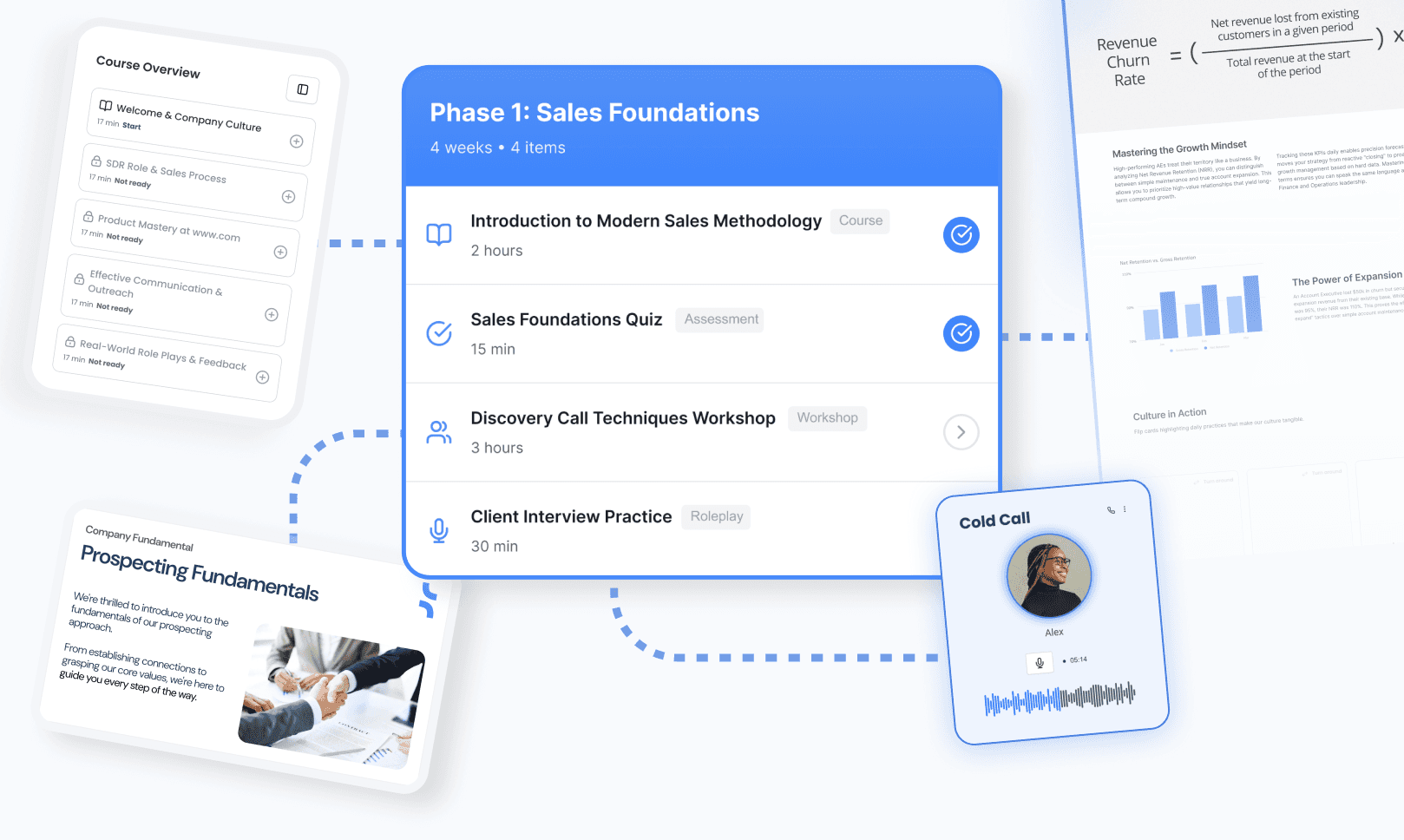
Generate courses, microlearning, assessments and AI roleplays
Use real customer context to make practice more relevant
Instead of reviewing a call and leaving the rep with a list of comments, you can create the learning and practice needed to improve.
Your call recording tool shows what happened.Deelan helps your team train what should happen next.
Get more from your sales call recordings
Do not let valuable customer conversations remain inside a recording library.
Use them to personalise training, create realistic roleplays, strengthen onboarding, reinforce your methodology and measure improvement over time.