
Sales teams have been doing roleplays for decades. One rep pretends to be a prospect, another practices their pitch, and a manager gives feedback.
Now AI can play the prospect, respond to objections, and coach reps immediately afterward. Reps can practice whenever they want, without asking a colleague or manager to join.
It sounds useful. But does practicing with an AI buyer actually make someone better at selling?
The short answer is yes, there is growing evidence that AI roleplay improves sales skills and performance. The results depend on how teams use it.
Does AI Roleplay Actually Work? What the Research Shows
One of the most relevant studies comes from researchers at the University of Houston.
Their 2026 research, Do AI Role Plays Improve Salesperson Performance?, examined almost 2,000 salespeople at a large US industrial company.

Following an AI roleplay training intervention in a quasi-experimental field study of nearly 2,000 salespeople.
The improvement was particularly strong among lower-performing sellers, people with ambitious performance goals, and those supported by stronger supervisors.
The researchers also highlighted an important point: practicing with AI doesn't automatically guarantee that the skills will transfer to real customer conversations.
The takeaway for sales leaders is encouraging. AI roleplay gives teams a way to practice more often and track progress, but it still needs to be connected to real sales performance.
Why Practice Is So Important for Sales Skills
Think about how most sales teams learn a new methodology.
They attend a workshop, read a playbook, watch a few calls, and then start selling.
The problem appears when a prospect says something unexpected.
A rep might know the correct discovery questions but struggle to ask them naturally. They may understand value-based selling but still fall back on product features when a buyer challenges the price.
Knowing what to say and being able to say it during a live conversation are different skills.
A 2025 meta-analysis of 31 effect sizes involving more than 3,000 learners found that spreading practice over time produced better learning outcomes than concentrating it in one session.
Salespeople benefit from opportunities to try a difficult conversation, make mistakes, get feedback, and return to it.
AI makes that easier to organize without requiring a manager to participate in every session.

AI Roleplay vs. Other Traditional Sales Training Methods
Roleplays are one part of sales training. Other methods still have value, but each has limitations.
Training method | What works | Main limitation |
|---|---|---|
Workshops and playbooks | Teach concepts, product knowledge, and methodologies | Limited opportunities to apply knowledge |
Shows how experienced sellers handle real buyers | Watching doesn't guarantee the rep can repeat the behavior | |
Peer roleplay | Allows people to practice together | Feedback and scenario quality vary |
Manager coaching | Provides personal guidance and context | Difficult to deliver frequently to every rep |
Offers on-demand practice, repetition, and feedback | Requires relevant scenarios and a link to real-world performance |
There's an interesting finding about call shadowing, too.
An October 2026 study by Corporate Visions and Florida State University's Sales Institute followed 119 new inside-sales hires for 18 months.
The researchers compared AI-heavy practice, observation of experienced sellers, and a combination of both.
AI-heavy training helped sellers execute expected conversations. But when a buyer introduced an unexpected change, their adaptability score dropped to 25.4 out of 50. The group combining observation and AI practice scored 34.7 on adaptability and achieved the strongest overall balance.
So removing call shadowing entirely may be a mistake. Watching experienced reps can help people understand how good conversations work, while roleplays give them a chance to try those techniques themselves.
The strongest approach combines knowledge, examples, practice, and feedback.
Which AI Sales Roleplays Work Best?
A common mistake is making every rep practice the same generic scenario.
The most useful roleplay is the one that targets a skill the rep actually needs to improve.
Skill gap | Roleplay scenario | What to measure |
|---|---|---|
Discovery | A prospect gives vague answers about their problems | Question depth, active listening |
Qualification | A buyer shows interest but has no clear budget | Qualification, next steps |
Value communication | A prospect doesn't understand why your solution is worth the price | Value articulation |
Objection handling | A buyer says a competitor is 40% cheaper | Objection handling, confidence |
Negotiation | A buyer demands a discount before signing | Negotiation, value protection |

How to Get Better Results From AI Roleplays
Giving reps access to a roleplay tool is easy. Getting them to improve requires a little more structure.
1. Start with the actual skill gap
Before assigning practice, review sales calls and performance data.
Are reps missing important discovery questions? Talking too much? Struggling to explain the product's value?

Use that information to decide what they should practice.
If every rep receives the same training, your strongest sellers spend time on skills they've already mastered, while others may never address what is holding them back.
2. Give reps the knowledge before asking them to practice
Someone cannot handle pricing objections well if they don't understand the product's value, positioning, or pricing strategy.
A short course, a good example from a real call, or a relevant playbook can provide that foundation.
Then the roleplay gives them a chance to use what they've learned.

3. Make the AI buyer realistic
A useful buyer should ask unexpected questions, have limited patience, and occasionally disagree.
The roleplay should reflect the buyer's industry, job title, goals, and likely objections.
If the AI agrees with everything the rep says, there isn't much to learn.

4. Follow every roleplay with coaching
Feedback is one of the most important parts of practice.
A meta-analysis of simulation-based skills training found that feedback had a moderately strong positive effect on skill outcomes, with a pooled effect size of 0.74.

5. Repeat practice and check progress on real calls
Are they asking better discovery questions? Handling objections more confidently? Moving more qualified opportunities forward?

How to Build a Complete AI Roleplay Training System With deelan
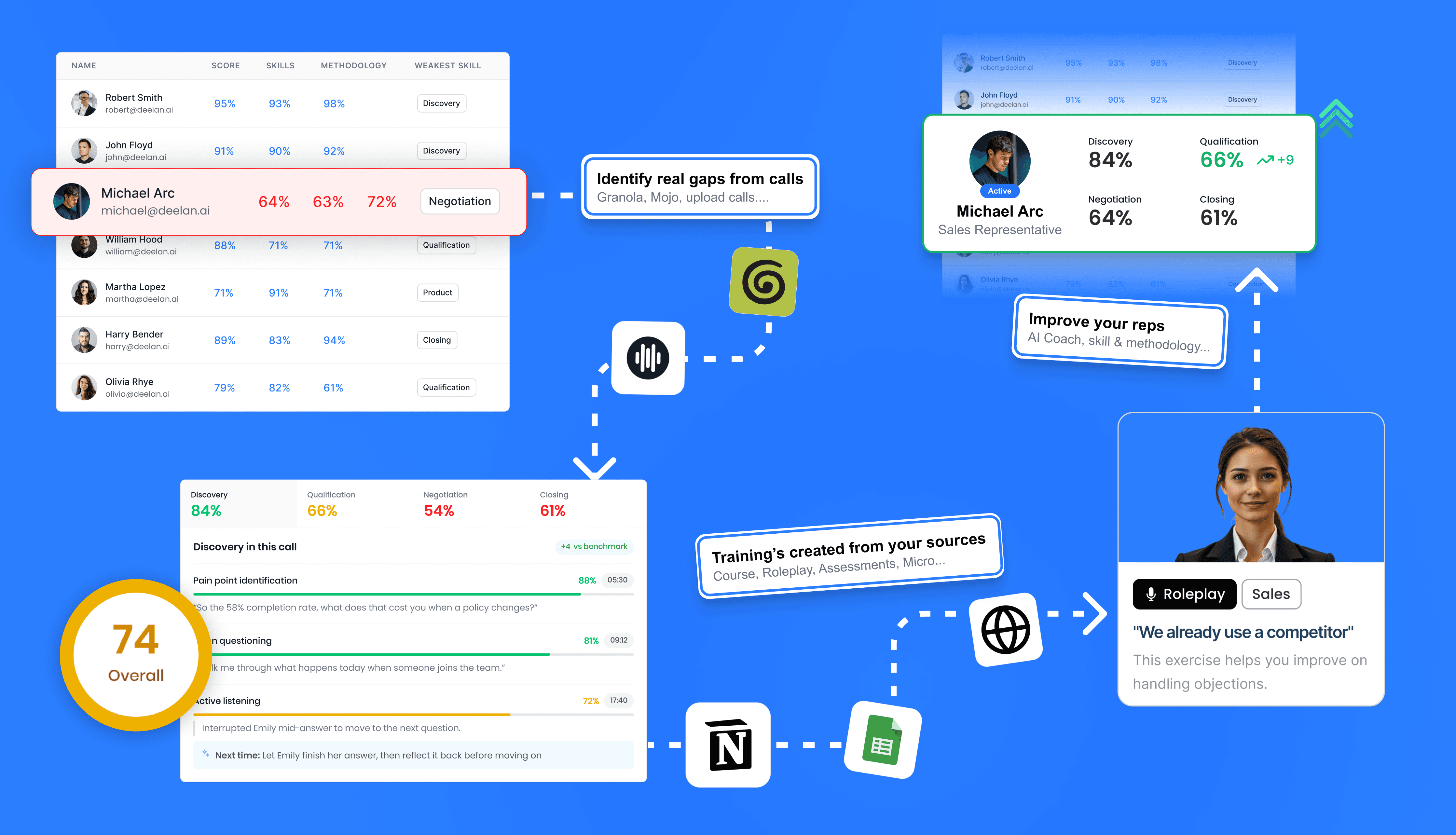
With deelan, teams can connect AI roleplays with courses, coaching, and skill tracking.
1. Identify the skill gaps
Analyze real sales calls, playbooks, and performance data, or define the skills your team needs to improve.
2. Create focused training
Turn a specific gap into a roleplay, a short course, a quiz, or a complete training program in minutes.
3. Practice and get coached
Reps practice with realistic AI buyers, receive feedback, and can debrief with an AI coach through voice or chat.
4. Track improvement
Follow skill readiness over time, identify who needs more support, and adjust training as new gaps appear.

You can create roleplays from your existing materials, use a template, or describe the scenario you want.
Adjust the buyer's personality, difficulty, objections, and other details to match the conversations your reps are likely to face.
And since every rep has different weaknesses, their training can adapt individually.
Practice cold calls, discovery, and objection handling with realistic AI buyers.
How to Measure Whether AI Roleplay Is Working
Better scores inside a roleplay tool are a good starting point. But sales leaders should look at three levels of improvement.
What to measure | Example |
|---|---|
Practice progress | Objection handling score improves across sessions |
Real call behavior | Reps handle objections more effectively in recorded customer calls |
Business results | Higher conversion rates, faster ramp time, better win rates |
Compare results before and after training, ideally against a similar group that hasn't received the same intervention. This helps separate the effect of training from other changes in the sales process.
For example, deelan customer Kidola reported reducing sales rep ramp time by more than 30% after introducing structured, adaptive onboarding and training.
So, Is AI Roleplay Worth It?
For sales teams that want to improve individual selling skills, AI roleplay is a promising investment.
The research shows measurable improvements in simulated conversations and early evidence of gains in real sales performance. It also shows that AI practice works better when supported by coaching and learning from experienced sellers.
The best results are likely to come from teams that treat practice as an ongoing part of sales development.
Find where reps struggle. Teach the relevant knowledge. Give them realistic conversations to practice. Coach them on the results. Then check whether they're improving on real calls.
That's how roleplay becomes part of a training system that helps sellers keep getting better.
Ready to put your team's sales skills into practice? Explore deelan's adaptive sales training platform and start building personalized AI roleplays and coaching for your team.