
Sales meetings can help your team move deals forward, solve problems and improve skills.They can also waste a lot of selling time.
The difference usually comes down to the agenda. Each meeting needs one clear purpose, a time limit and a decision about what happens next.
This guide gives you practical templates for the five sales meetings most teams run.
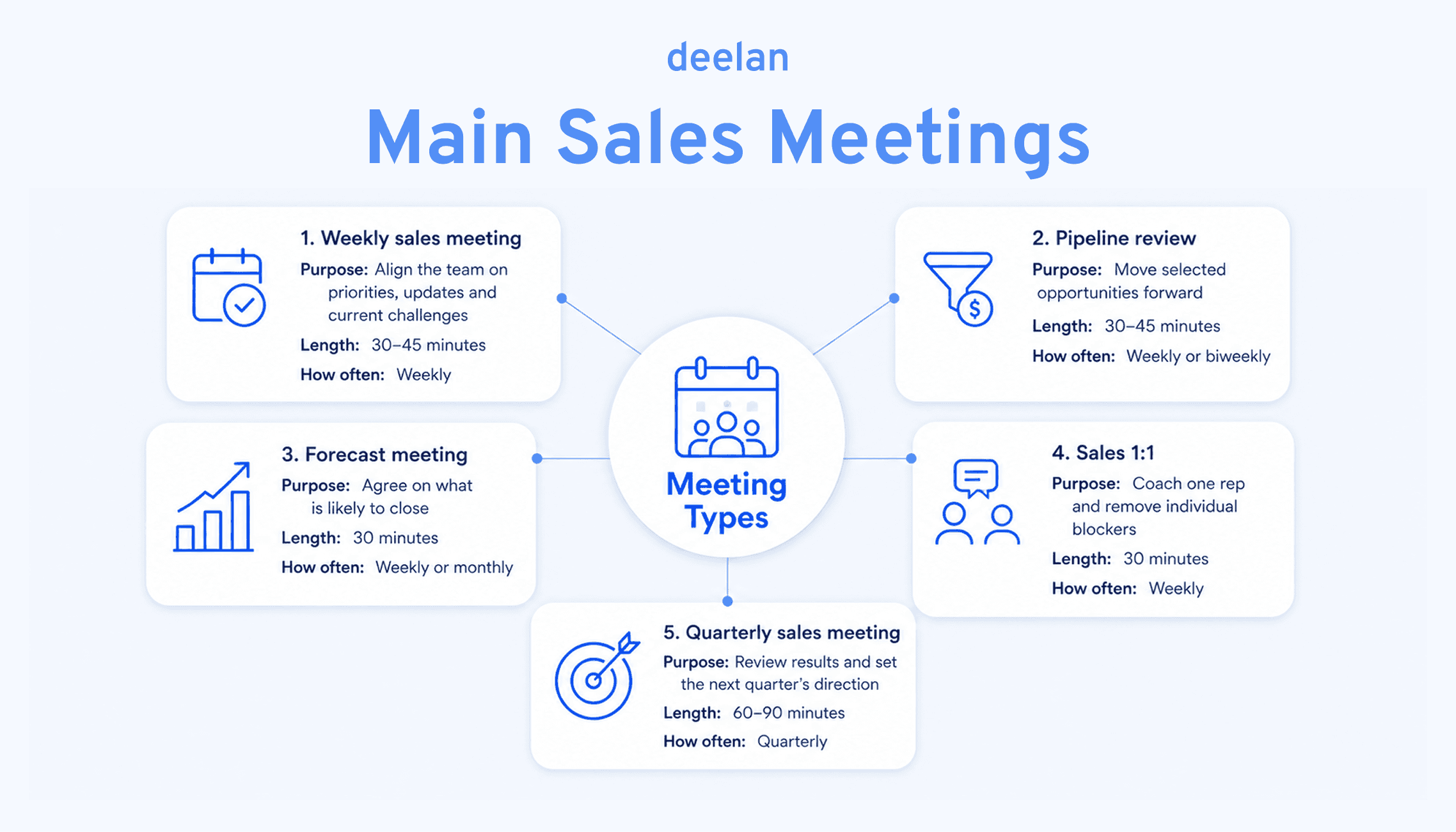
Meeting | Main purpose | Suggested length | How often |
|---|---|---|---|
Weekly sales meeting | Align the team on priorities, updates and current challenges | 30–45 minutes | Weekly |
Pipeline review | Move selected opportunities forward | 30–45 minutes | Weekly or biweekly |
Forecast meeting | Agree on what is likely to close | 30 minutes | Weekly or monthly |
Sales 1:1 | Coach one rep and remove individual blockers | 30 minutes | Weekly |
Quarterly sales meeting | Review results and set the next quarter’s direction | 60–90 minutes | Quarterly |
1. Weekly Sales Meeting Agenda
The weekly sales meeting keeps the team aligned on what matters over the next few days.
Use it for short business updates, team performance, shared problems and focused training. Avoid reviewing every deal or every metric.
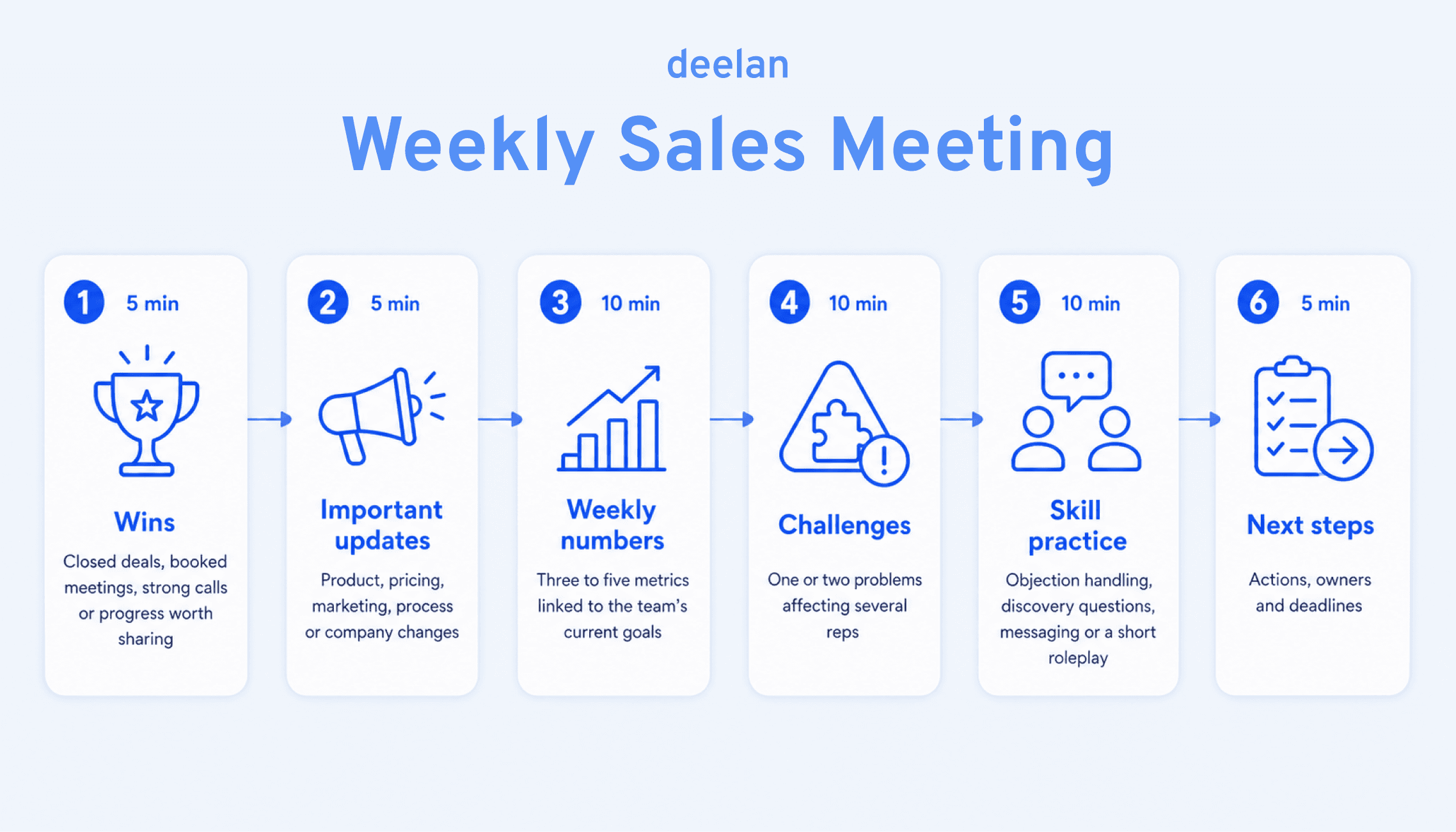
Weekly Sales Meeting Template
Time | Agenda item | What to cover |
5 min | Wins | Closed deals, booked meetings, strong calls or progress worth sharing |
5 min | Important updates | Product, pricing, marketing, process or company changes |
10 min | Weekly numbers | Three to five metrics linked to the team’s current goals |
10 min | Challenges | One or two problems affecting several reps |
10 min | Skill practice | Objection handling, discovery questions, messaging or a short roleplay |
5 min | Next steps | Actions, owners and deadlines |
Example
Meeting goal: Improve the quality of first discovery calls.
The manager reviews the previous week’s booked meetings and conversion rate. Two reps share objections they heard from prospects. The team then practises how to respond when a buyer says, “We already have a training platform.”
The meeting ends with one commitment: each rep will test the revised response in their next five calls.
Keep the meeting focused
Share simple updates in Slack or email. Use live meeting time for discussion, decisions and practice.
Send the agenda before the meeting so reps know whether they need to prepare a deal, call example or question. A clear agenda also helps stop the conversation from drifting.
2. Pipeline Review Meeting Agenda
A pipeline review helps reps move active opportunities forward.
It should not be a full reading of every opportunity in the CRM. Choose the deals that need a decision, support or a clearer next step.
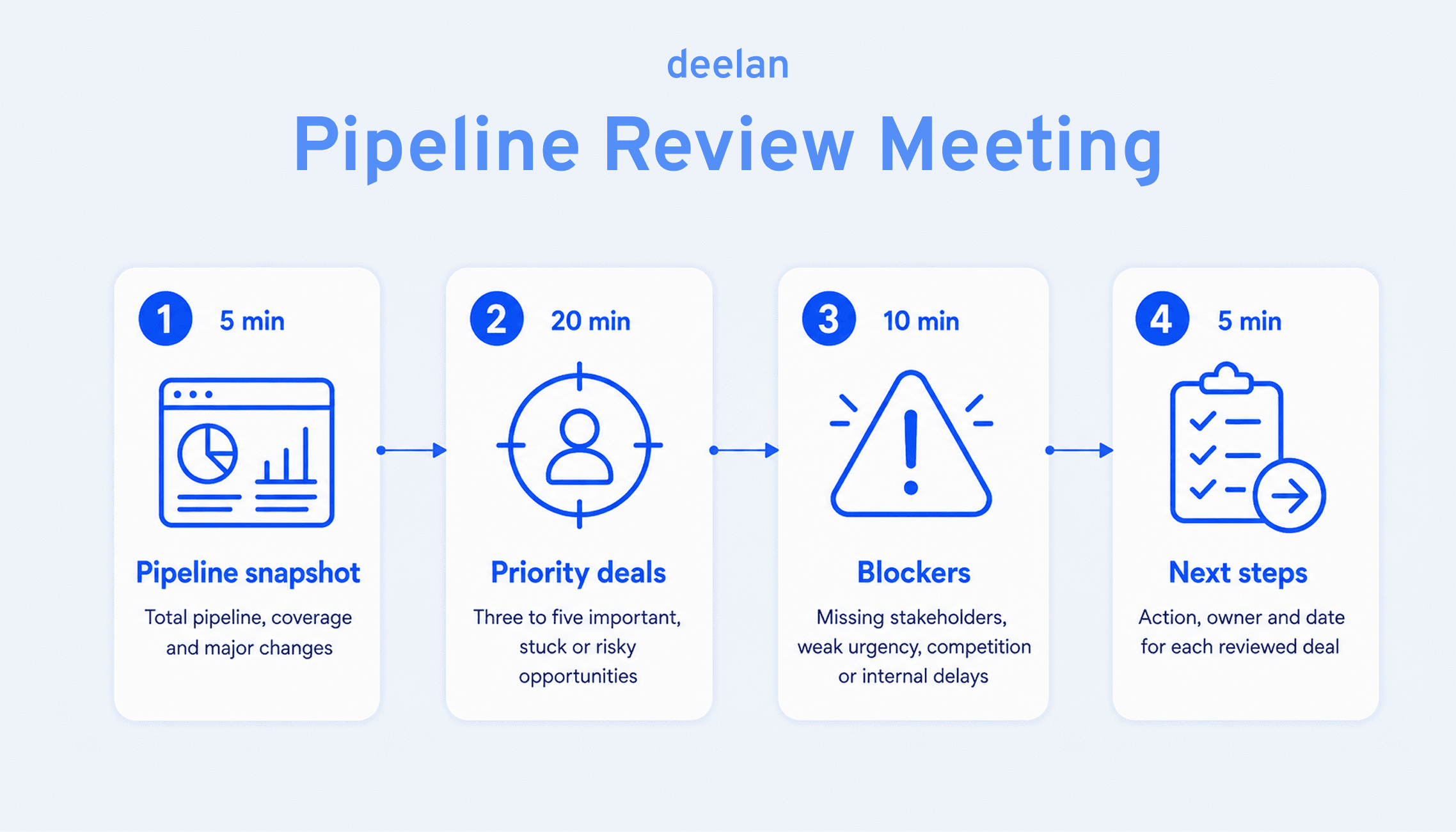
Pipeline Review Template
Time | Agenda item | What to cover |
5 min | Pipeline snapshot | Total pipeline, coverage and major changes |
20 min | Priority deals | Three to five important, stuck or risky opportunities |
10 min | Blockers | Missing stakeholders, weak urgency, competition or internal delays |
5 min | Next steps | Action, owner and date for each reviewed deal |
For each opportunity, ask for the same information:
Current stage
Business problem
Decision-makers involved
Latest customer action
Main risk
Exact next step
Expected close date
Example
A rep has a €25,000 opportunity sitting in the proposal stage for three weeks.
Instead of asking for a general update, the manager checks what has happened since the proposal was sent. The team learns that the rep has only spoken with one user and has no access to the budget owner.
The next step is not “follow up.” The rep will ask the current contact to schedule a meeting with the budget owner by Thursday.
Pipeline meetings work best when each discussion ends with a specific action. If nobody owns the next step, the deal will probably stay where it is.
3. Sales Forecast Meeting Agenda
The forecast meeting is about revenue expected to close during a specific period.
It is narrower than a pipeline review. The goal is to agree on realistic numbers, understand risk and avoid surprises at the end of the month or quarter.

Forecast Meeting Template
Time | Agenda item | What to cover |
5 min | Target and current result | Quota, closed revenue and remaining gap |
10 min | Commit deals | Opportunities the team expects to close |
10 min | Best-case deals | Opportunities that may close but still have meaningful risk |
5 min | Changes | Deals added, delayed, reduced or removed |
5 min | Final forecast | Agreed number and main risks |
The discussion should be based on customer evidence, not the rep’s confidence alone.
Useful evidence includes:
A confirmed decision date
Budget approval
Access to the decision-maker
A clear buying process
Legal or procurement progress
A scheduled next meeting
A reason the customer needs to act now
Example
A rep says a deal is likely to close this month because the prospect liked the demo.
That is not enough for a strong forecast.
The manager checks whether the prospect has confirmed the budget, who signs the contract and when the buying committee will meet. If those details are missing, the deal may belong in best case rather than commit.
Keep coaching discussions for the pipeline review or 1:1. The forecast meeting should stay focused on the number.
4. Sales 1:1 Meeting Agenda
A sales 1:1 gives the manager and rep space to discuss individual performance, deals, skills and support.
It should feel like a working session, not a weekly performance interrogation.
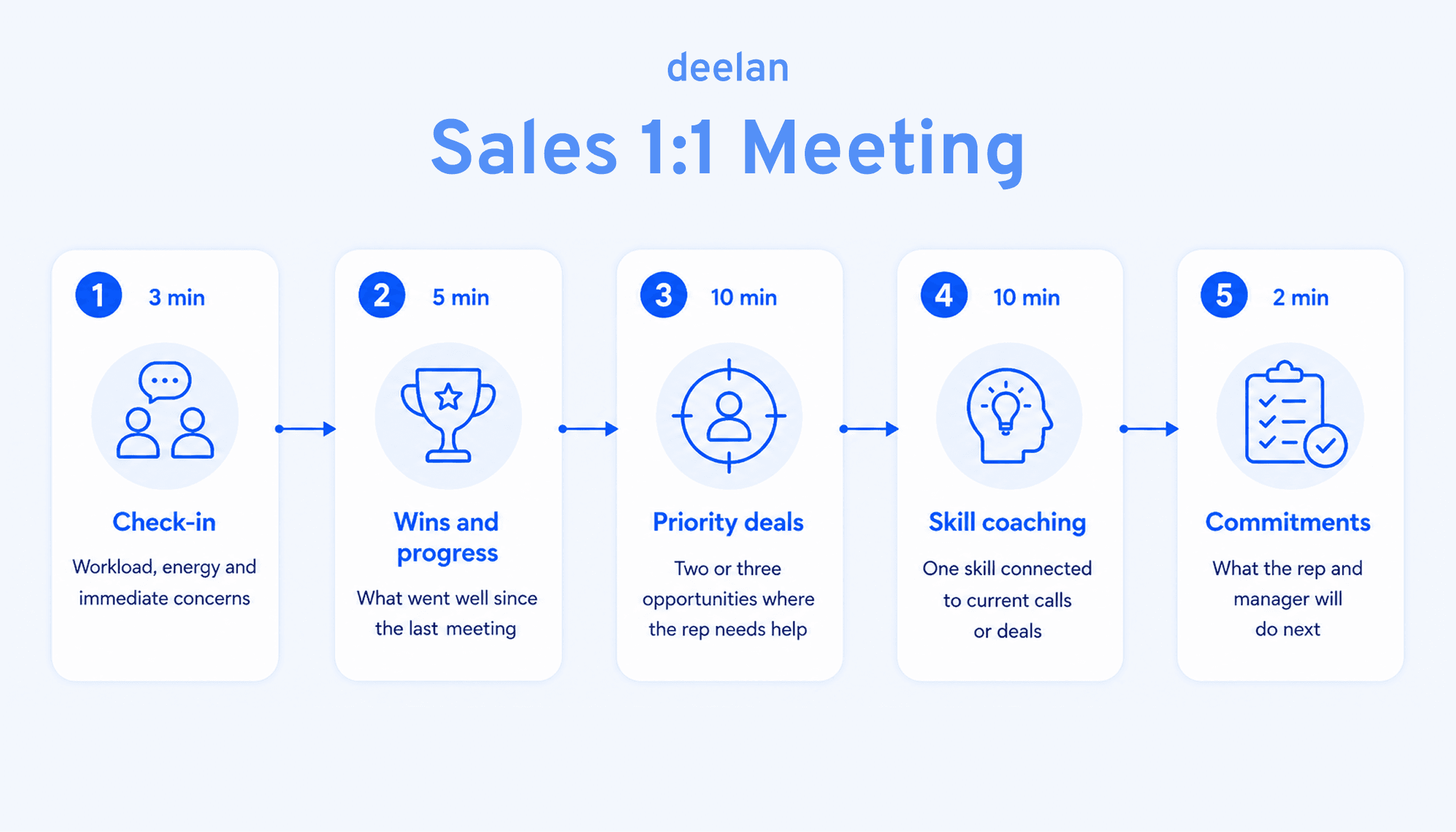
30-Minute Sales 1:1 Template
Time | Agenda item | What to cover |
3 min | Check-in | Workload, energy and immediate concerns |
5 min | Wins and progress | What went well since the last meeting |
10 min | Priority deals | Two or three opportunities where the rep needs help |
10 min | Skill coaching | One skill connected to current calls or deals |
2 min | Commitments | What the rep and manager will do next |
A practical 1:1 combines deal support with skill development. One commonly used structure gives most of the meeting to a small number of important deals, followed by coaching tied to those opportunities.
Example
A rep is booking enough discovery calls but few move to the demo stage.
The manager reviews one recent call and notices that the rep asks many product questions but does not explore the cost of the buyer’s problem.
They spend ten minutes practising follow-up questions:
“What happens if this problem continues for another six months?”
“Who else is affected by this?”
“How are you handling it today?”
The rep leaves with one skill to practise, not ten unrelated comments.
Add practice after the meeting
Talking about a skill once rarely changes how a rep performs on the next call.
Use short roleplays between meetings. The rep can practise the same buyer situation, receive feedback and repeat it before speaking with a real prospect.
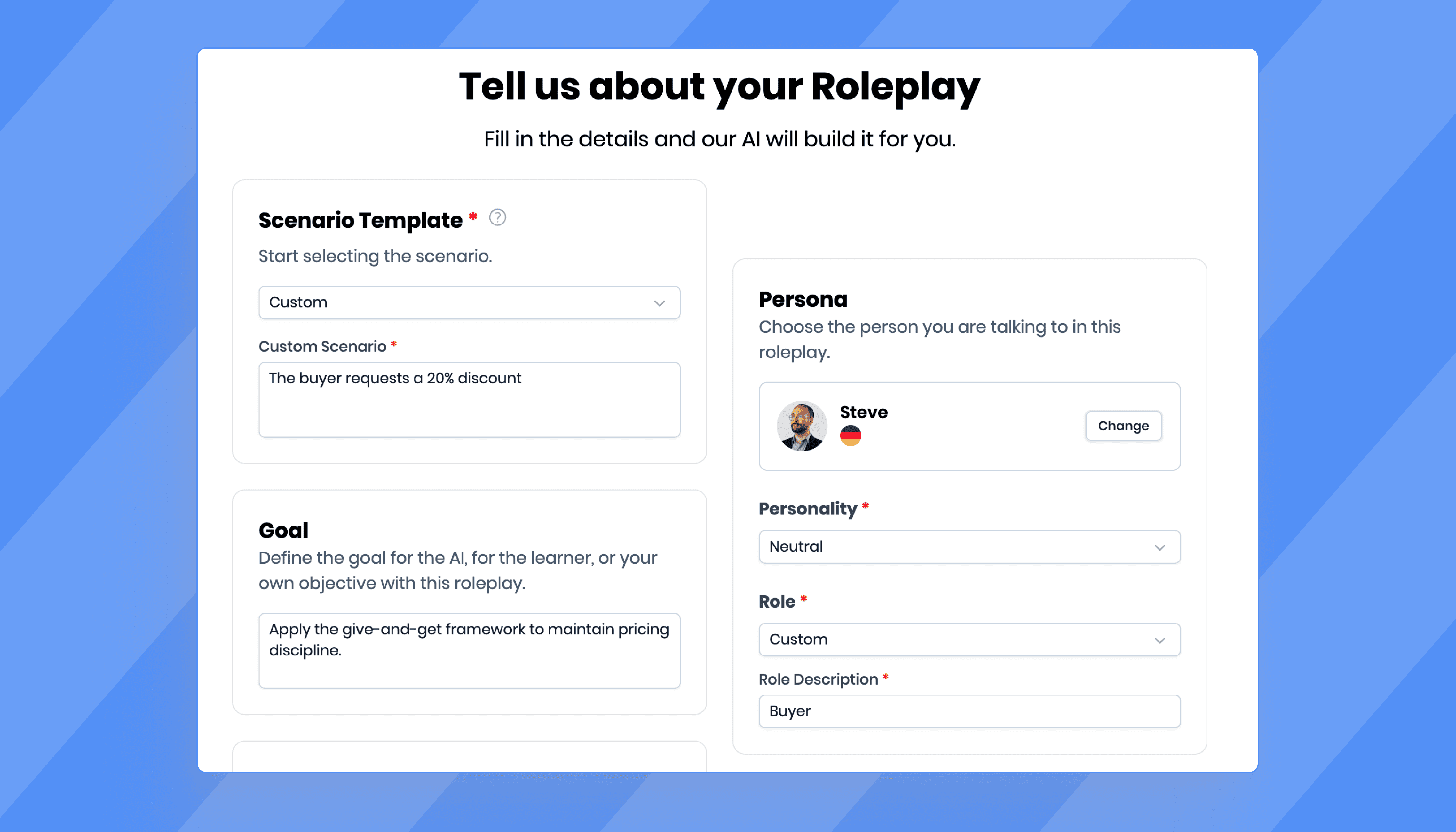
With Deelan, teams can create AI roleplays from their own playbooks, call recordings and sales methodology. Reps practise realistic conversations and receive feedback on their responses, communication and missed opportunities.
Give feedback the rep can use
Keep feedback specific and tied to one real moment from the call. Explain what the rep did, why it affected the conversation and what they could try instead.
Avoid comments such as “ask better questions” or “be more confident.” Give an example of a stronger question or response the rep can use on the next call.
For more practical examples, read our guide to giving sales feedback that reps can understand and apply.
5. Quarterly Sales Meeting Agenda
A quarterly sales meeting gives the team time to step back from individual deals.
Review what happened during the quarter, what the team learned and what needs to change. Do not spend the whole session presenting charts.
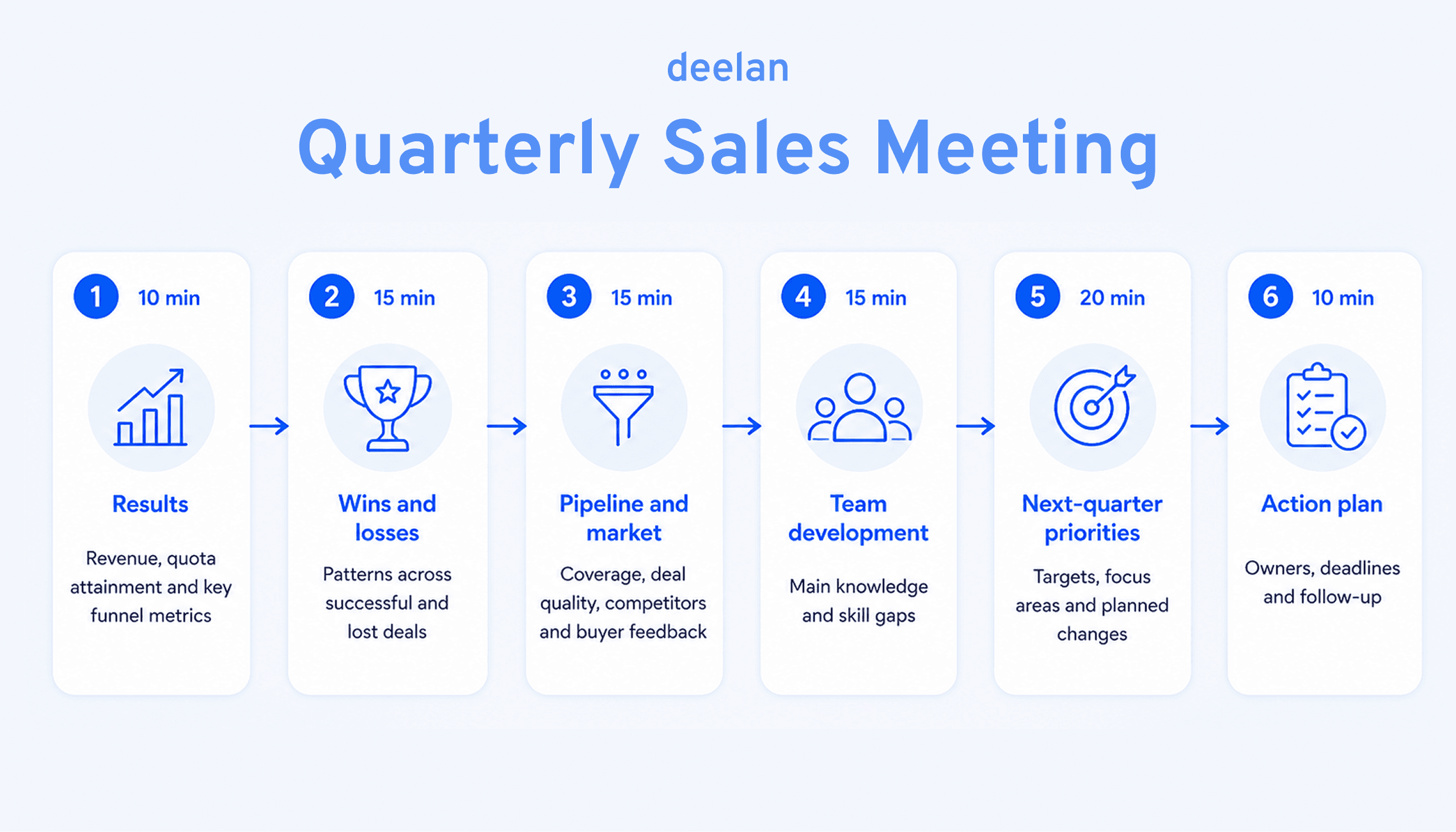
Quarterly Sales Meeting Template
Time | Agenda item | What to cover |
10 min | Results | Revenue, quota attainment and key funnel metrics |
15 min | Wins and losses | Patterns across successful and lost deals |
15 min | Pipeline and market | Coverage, deal quality, competitors and buyer feedback |
15 min | Team development | Main knowledge and skill gaps |
20 min | Next-quarter priorities | Targets, focus areas and planned changes |
10 min | Action plan | Owners, deadlines and follow-up |
Example
The team missed its quarterly target even though pipeline volume was high.
A closer review shows that many opportunities entered the pipeline after short qualification calls. Reps booked demos before confirming budget, urgency or access to the decision-maker.
The next-quarter plan may include:
A stricter qualification checklist
Call reviews focused on discovery
Weekly discovery roleplays
Manager coaching for reps with low stage conversion
Quarterly meetings should connect the numbers to changes in behaviour, process and training.
Turn Meeting Problems Into Sales Training
Sales meetings often reveal the same problems repeatedly:
Reps struggle with price objections
Discovery calls stay too shallow
Demos focus too much on features
Next steps are unclear
Reps do not reach the right stakeholders
Do not stop at discussing the problem.
Choose one skill, give reps a good example and let them practice it.
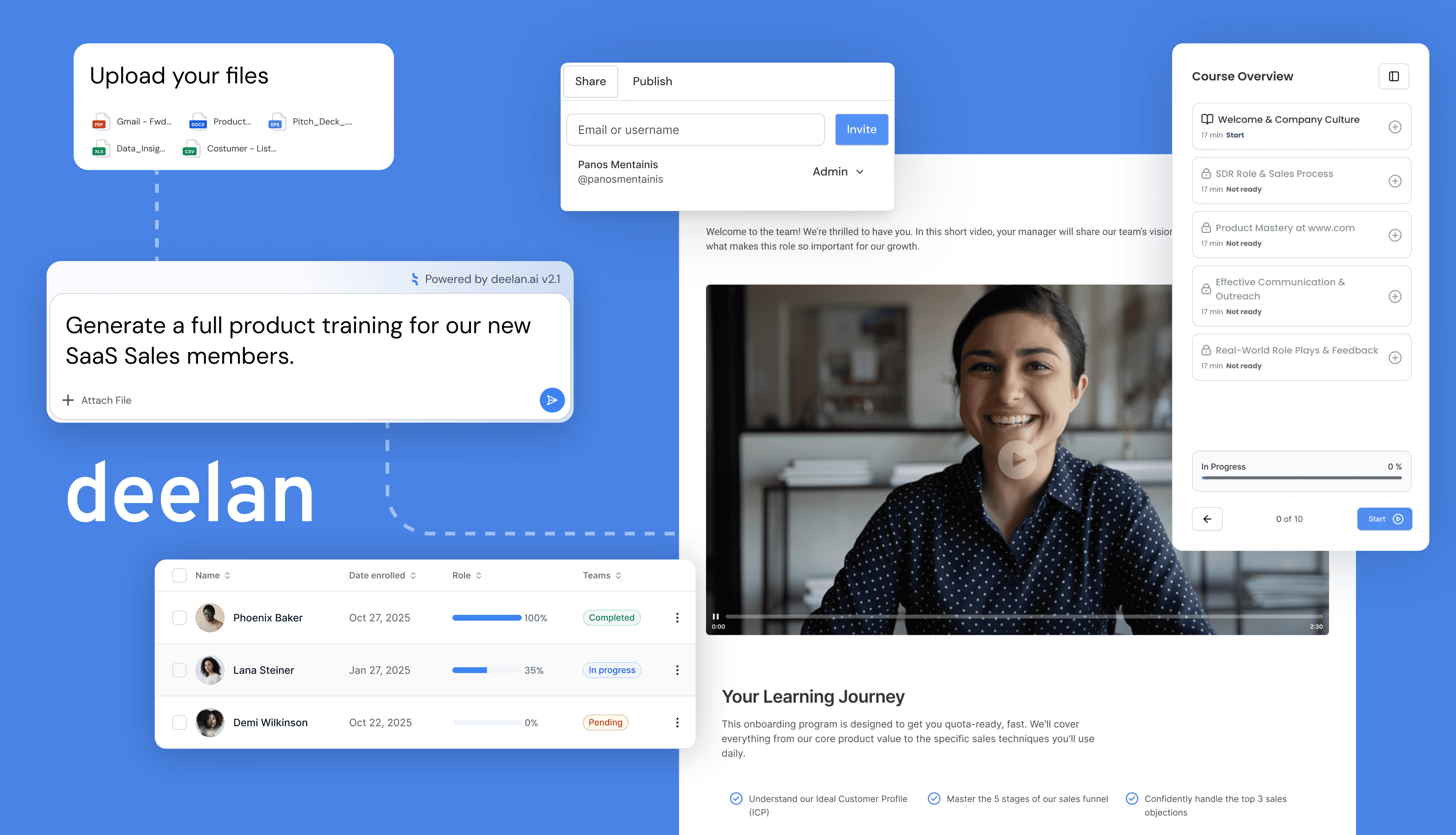
Deelan turns your existing sales material into courses, assessments and AI roleplays. You can also upload call recordings, identify skill gaps and create training based on what happened in real conversations.
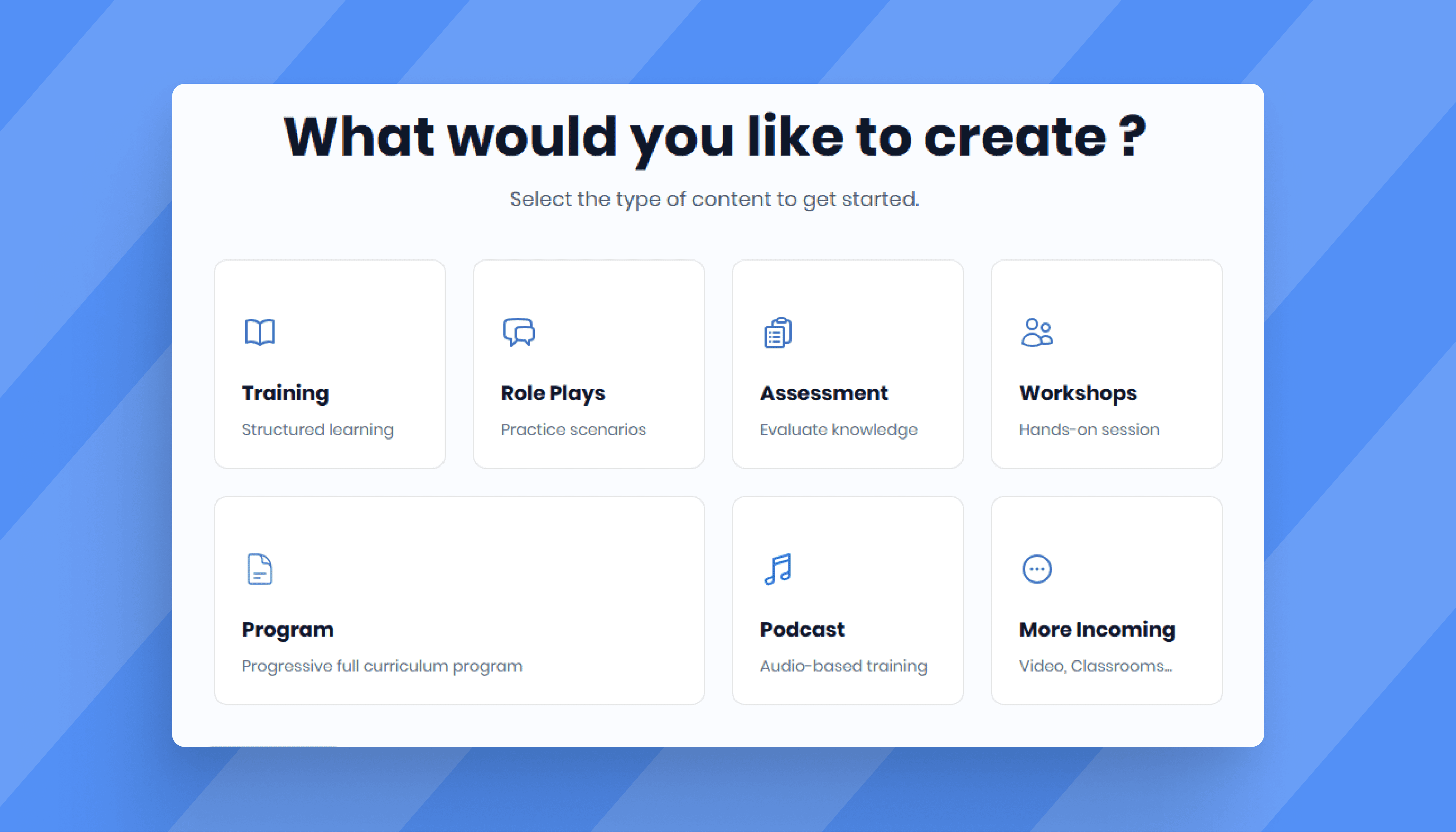
Reps receive practice and feedback without managers having to run every session themselves.
Teams looking for ready-made training can also use the Deelan Sales Academy, with free sales courses and resources for reps and managers.
Simple Rules for Better Sales Meetings
Keep each meeting tied to one purpose. Send the agenda early and invite only the people who need to be there.
Choose a few metrics or deals rather than reviewing everything. Start and finish on time. Leave the final minutes for actions, owners and deadlines.
Roleplay only situations the team is likely to face. A short, relevant exercise is more useful than a long general training session.
Most importantly, check the actions at the next meeting. Decisions lose value when nobody follows up.
A good sales meeting should help the team decide, practise or move something forward. Everything else can usually be sent in a message.