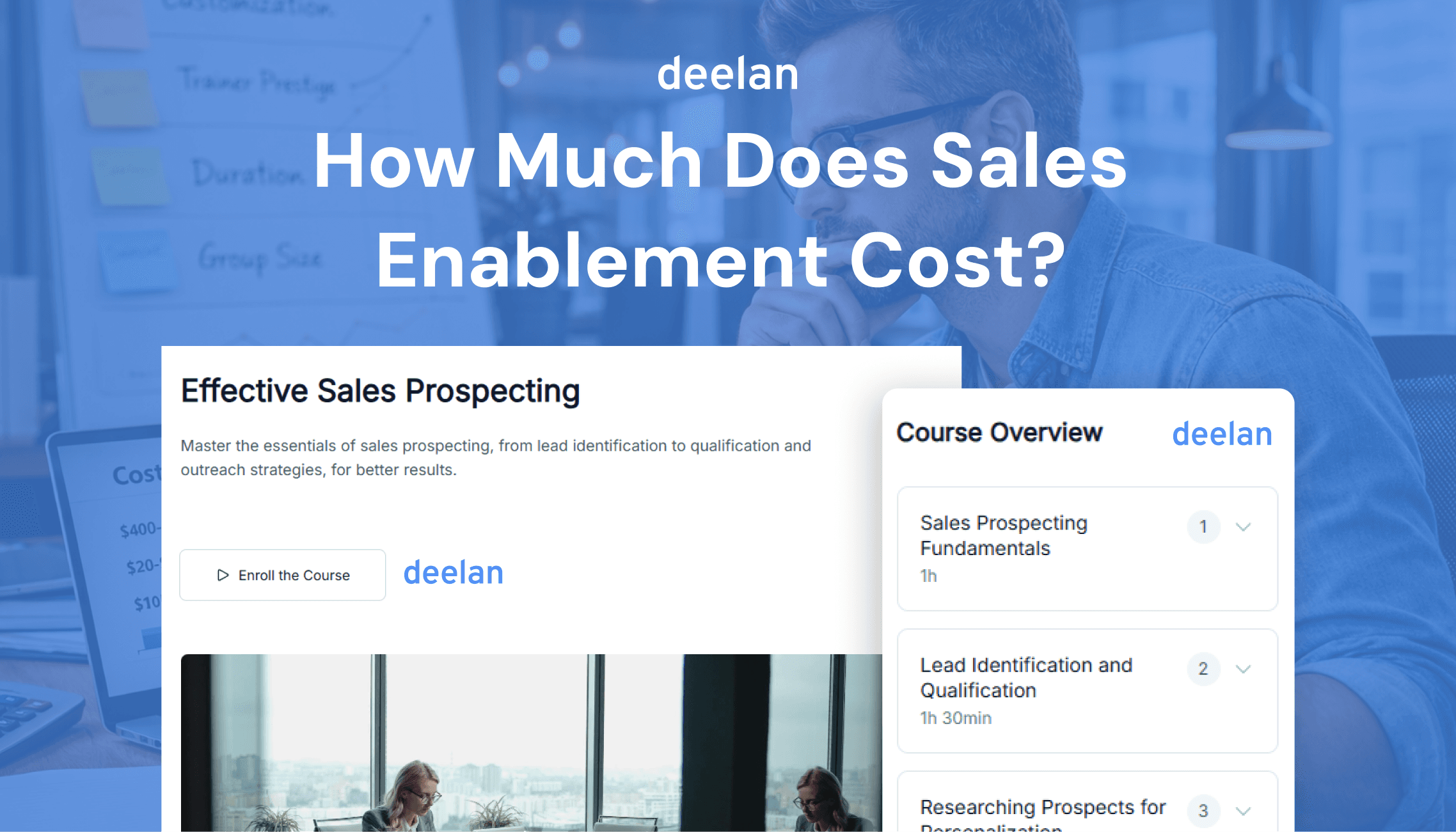
Sales enablement is the discipline of equipping your reps with the right content, training, data, and tools to close deals faster and more consistently. A proper enablement strategy covers four layers: content management (pitch decks, battle cards), training and coaching (onboarding, role-plays, certifications), sales engagement (email sequences, cadences), and data quality (contact enrichment, ICP scoring).
The cost is high for a simple reason: most vendors bundle everything into one platform and charge for all of it, whether you use it or not. Enterprise contracts regularly bundle conversation intelligence, content management, coaching modules, and digital sales rooms into one annual commitment — even if your team only needs one or two of those capabilities.
Sales Enablement Pricing Ranges by Tier
Pricing depends on four main variables: the category of tool, the size of your team, the contract length, and how deeply customized the implementation needs to be. Here's how the market breaks down in 2026:
Category | Typical Price Range | What You're Paying For | Best For |
|---|---|---|---|
| Organizing, delivering, and tracking sales collateral | Teams with large, frequently updated content libraries | |
| Role-plays, certifications, onboarding programs | Fast-growing teams with high rep turnover or long ramp time | |
Conversation Intelligence |
| Call recording, AI analysis, deal intelligence | High-value consultative sales with long cycles |
Sales Engagement |
| Email sequences, cadences, multi-channel outreach | SDR teams running structured outbound motions |
Enterprise Suites |
| Full methodology implementation, global deployment | 100+ rep organizations needing unified enablement |
| Unlimited learners, AI coaching, adaptive programs | Growing teams that need training to scale without scaling costs |
Top Sales Enablement Tools and Their Real Prices
Here's what the leading platforms actually cost:
~$75/user/month · Annual contract required
Market leader in AI-powered content management. Strong buyer engagement analytics and guided selling playbooks. Expensive for teams under 20 reps. No monthly billing option.
Seismic
$60–$100/user/month · Custom pricing
Enterprise-grade content automation with dynamic personalization. Implementation typically takes 3–6 months. Overkill for teams under 50 reps and priced accordingly.
$40–$70/user/month · Custom pricing
Purpose-built sales readiness: AI role-plays, certifications, skill assessments. Strong for reducing ramp time. Does not include content management — you'll need a separate tool.
Gong
$100–$150/user/month · Annual contracts
Gold standard for conversation intelligence. Records and analyzes every call and email. Hard to justify the cost for transactional or high-volume sales motions.
Salesloft
~$125/user/month
Leading sales engagement platform for multi-channel cadences. Best when paired with a data quality tool. Content management is minimal — plan to add a separate tool there too.
~$35/user/month · Coach + Content tiers
Mid-market sweet spot combining content and coaching. Coaching features are useful but not as deep as Mindtickle. Analytics less granular than Highspot or Seismic.
The math for a 25-rep team:
A coaching platform at $55/user + a content tool at $75/user + an engagement platform at $100/user = $230/user/month = $69,000/year before implementation fees, onboarding, or annual increases.
Hidden Costs You Should Be Aware Of
The invoice from the platform is only a fraction of what sales enablement actually costs. Here's what gets left out of every comparison article:
Implementation & onboarding - Enterprise platforms like Seismic typically take 3–6 months to implement. Even mid-market tools often charge a one-time setup fee of $5,000–$20,000 that doesn't appear in the per-seat price.
Opportunity cost during ramp-up - Every hour a rep spends in a training session or learning a new platform is time not spent selling. For a 10-person team at a $150k OTE, even two days of training has a real productivity cost.
Admin and RevOps overhead - Someone has to manage users, update content, configure workflows, and integrate the platform with your CRM. Mid-market companies typically need 0.5–1 FTE of enablement-specific ops time per major platform.
The reinforcement void - Research consistently shows that 70% of training content is forgotten within 24 hours without reinforcement. If you buy a platform but don't budget for ongoing use, you're paying for content your team won't retain.
Annual price increases - Most enterprise contracts include a 7–12% annual renewal increase. A $60,000/year contract becomes $75,000+ within two years. Factor this into multi-year budget planning.
Tool sprawl - A coaching tool that doesn't handle content. A content tool that doesn't do engagement. An engagement tool that needs a separate data quality layer. Each tool is "affordable" — until you add them up.
The Per-Seat Pricing Problem
The standard per-user-per-month pricing model creates a structural problem for growing teams: your training costs scale directly with headcount, even when your training needs don't.
Think about what actually changes when you go from 20 reps to 40 reps. Your playbooks are the same. Your objection-handling library doesn't double. Your coaching methodology doesn't need to be reinvented. But with per-seat pricing, your bill does double.
# Per-seat cost at 20 reps20 reps × $75/user/mo × 12 = $18,000/year# Per-seat cost at 50 reps (same platform, same content)50 reps × $75/user/mo × 12 = $45,000/year# Your training program didn't change. Your bill grew 150%.
Is Sales Enablement Worth the Cost? A Real ROI Framework
The honest answer is: it depends entirely on whether you measure the right things. Most companies track platform usage (logins, completions) rather than revenue impact. Here's a better framework:
Scenario A — Small Team
Metric | Value |
|---|---|
Team size | 20 reps |
Deal profile | $80k ACV deals |
Current win rate | 18% |
After enablement (target) | 21% |
Monthly qualified opportunities | 60 |
Additional deals/month | 1.8 |
Additional ARR/year | $172,800 |
Enablement spend | $36,000/yr |
Net ROI | ~4.8× |
Scenario B — Scale-up
Metric | Value |
|---|---|
Team size | 75 reps |
Deal profile | 6-month avg. ramp |
Monthly cost of slow ramp | $18,750/rep |
Ramp reduction (target) | −5 weeks |
Hires per year | 30 |
Recovered productivity | $703,000/yr |
Enablement spend | $108,000/yr |
Net ROI | ~6.5× |
The average reported ROI on sales training investment is $4.53 for every $1 spent — but only when the program includes reinforcement and behavioral change tracking. One-time workshops without follow-up rarely move the needle long-term.
What to Measure
If you can't connect your enablement spend to these metrics, you can't justify the budget — and you probably shouldn't renew:
Metric | What It Tells You | Target Improvement |
|---|---|---|
Rep ramp time | Days from hire to first closed deal | 20–30% reduction |
Win rate by stage | Where deals are being lost in the cycle | 3–5% absolute lift |
Average deal size | Whether reps can defend price and expand | 8–12% increase |
Content influence rate | Which assets appear in won vs. lost deals | Baseline, then optimize |
Coaching adoption | % of reps completing programs per quarter | >80% |
Deelan Pricing: One Flat Fee. Your Entire Sales Team.
Most sales training tools charge per user — so your training costs grow with every hire, whether your content, methodology, or coaching approach changed or not. Deelan takes a different position: one flat monthly fee, unlimited learners, everything you need in a single adaptive training platform.
How Deelan Compares to Per-Seat Pricing
Here's what a 40-rep team actually pays on typical per-seat platforms versus Deelan's flat fee:
Platform Model | Price | 40 Reps / Year | 80 Reps / Year | Unlimited Learners |
|---|---|---|---|---|
Coaching tool (per-seat) |
| $26,400 | $52,800 | ✗ |
Content tool (per-seat) |
| $36,000 | $72,000 | ✗ |
Engagement tool (per-seat) |
| $48,000 | $96,000 | ✗ |
Deelan (flat fee, Growth) |
| $7,188 | $7,188 | ✓ |
How to Choose the Right Sales Enablement Platform
Before you sign anything, get clear on what problem you're actually trying to solve. Most companies start with the wrong tool because they evaluate platforms before diagnosing the bottleneck.
Start with your biggest revenue leak
If your main problem is… | Start with… |
|---|---|
Reps take 6+ months to ramp | Training & coaching platform (onboarding, roleplay, certifications) |
Inconsistent messaging across the team | Adaptive learning + AI roleplay to build muscle memory |
Reps can't find the right content | Content management platform (Highspot, Showpad) |
Emails bounce / data quality issues | Data enrichment tool before layering anything else |
Can't coach enough 1:1 | AI coaching platform to scale without burning out managers |
Deal inspection is blind | Conversation intelligence (Gong, Chorus) |
Questions to ask every vendor before you sign
"What does the onboarding timeline look like, and what's included vs. what costs extra?"
"What happens to our bill when we hire 10 more reps next quarter?"
"Can you show us a case study with a similar team size and average contract value?"
"How do you measure behavioral change — not just completion rates?"
"What does reinforcement look like 30, 60, and 90 days after initial training?"
Red flags in any sales enablement pitch
🚩 No reinforcement plan. A workshop with no follow-up. Research shows 70% of training is forgotten within 24 hours without reinforcement built in.
🚩 Can't explain how they track behavior change. If they only measure logins and course completions, they can't show you ROI — and they know it.
🚩 Per-seat pricing with no volume transparency. If they won't tell you the per-seat price until after a discovery call, expect that number to be high and the contract to be inflexible.
Frequently Asked Questions
How much does sales enablement cost per employee?
On average, companies pay between $35 and $150 per user per month depending on the category of tool. A content management platform like Highspot starts around $75/user/month, while coaching platforms like Mindtickle typically run $40–70/user/month. For a flat-fee alternative, Deelan's Growth plan covers an unlimited number of learners for $599/month regardless of team size.
What is the average ROI of sales enablement?
Organizations that implement sales enablement with proper reinforcement report an average return of $4.53 for every $1 invested.
Do I need to buy multiple sales enablement tools?
Not necessarily, but most high-performing teams end up with 2–4 tools covering different layers: a CRM, a training or coaching platform, an engagement tool, and a data quality tool.
Why is enterprise sales enablement so expensive?
Enterprise pricing reflects the cost of global deployment, deep CRM integration, custom onboarding, dedicated customer success management, and the SLAs that large organizations require. Many enterprise contracts also bundle features most teams never use — conversation intelligence, digital sales rooms, and advanced forecasting — into a single annual commitment.
What's the difference between sales enablement and sales training?
Sales training — courses, certifications, and workshops that teach a methodology. Sales enablement is the broader discipline: training plus coaching, content management, data quality, and engagement tools. Training is typically a one-time or periodic investment; full enablement is an ongoing operational function.
Can AI reduce the cost of sales enablement?
Yes, significantly. AI-powered platforms can replace or supplement expensive in-person trainers with role-play simulations, give every rep 1:1 coaching feedback without burning out managers, and identify individual skill gaps so you're not running generic programs for everyone. Platforms like Deelan use adaptive AI to deliver personalized learning paths at a flat fee — rather than charging per user for access to AI features the way many legacy platforms do.
See What Deelan Costs for Your Team Size
Flat-fee pricing, unlimited learners, and AI-powered coaching that scales with your headcount — not against it. Book a 30-minute demo and we'll show you exactly how it maps to your current enablement gaps.