Your sales team probably already has plenty of content: playbooks, battlecards, product decks, call recordings, and case studies. But how much of it actually helps reps perform better?
The best sales enablement content isn't just easy to find. It's practical, relevant to real sales conversations, and helps reps know what to say and how to say it.
Here are 10 sales enablement content examples worth creating, what makes them effective, and how to get more value from them.

There are two main categories:
Type | Purpose | Examples |
|---|---|---|
Internal sales enablement content | Help sales teams learn, prepare, and improve | Playbooks, battlecards, call recordings, scripts, training courses |
External sales enablement content | Help prospects understand the solution and make buying decisions | Case studies, one-pagers, product demos, ROI calculators |
Both matter. But creating more content doesn't automatically lead to better sales performance. Reps also need to understand when to use each resource and practice applying what they've learned.

10 Best Sales Enablement Content Examples
These are some of the most useful sales enablement content types for B2B sales teams.
Content type | Best use case |
1. Sales playbooks | Consistent sales execution |
2. Objection handling guides | Handling difficult prospect questions |
3. Competitive battlecards | Positioning against competitors |
4. Call recordings | Learning from real sales conversations |
5. Product knowledge content | Onboarding and product launches |
6. Buyer persona guides | Personalized messaging and discovery |
7. Case studies | Building trust and proving value |
8. Email and call templates | Consistent outreach and follow-ups |
9. Product demos and one-pagers | Explaining solutions to buyers |
Practicing, testing, and improving skills |
1. Sales Playbooks
A sales playbook documents how your team approaches different selling situations, from the first cold call to negotiation and closing.
What a good sales playbook should include:
Sales stages and expected outcomes
Discovery questions and qualification criteria
Messaging for different buyer personas
Common objections and recommended responses
Examples of successful sales conversations
Tip: Don't create one enormous PDF that nobody wants to open. Break playbooks into short sections based on specific sales activities.
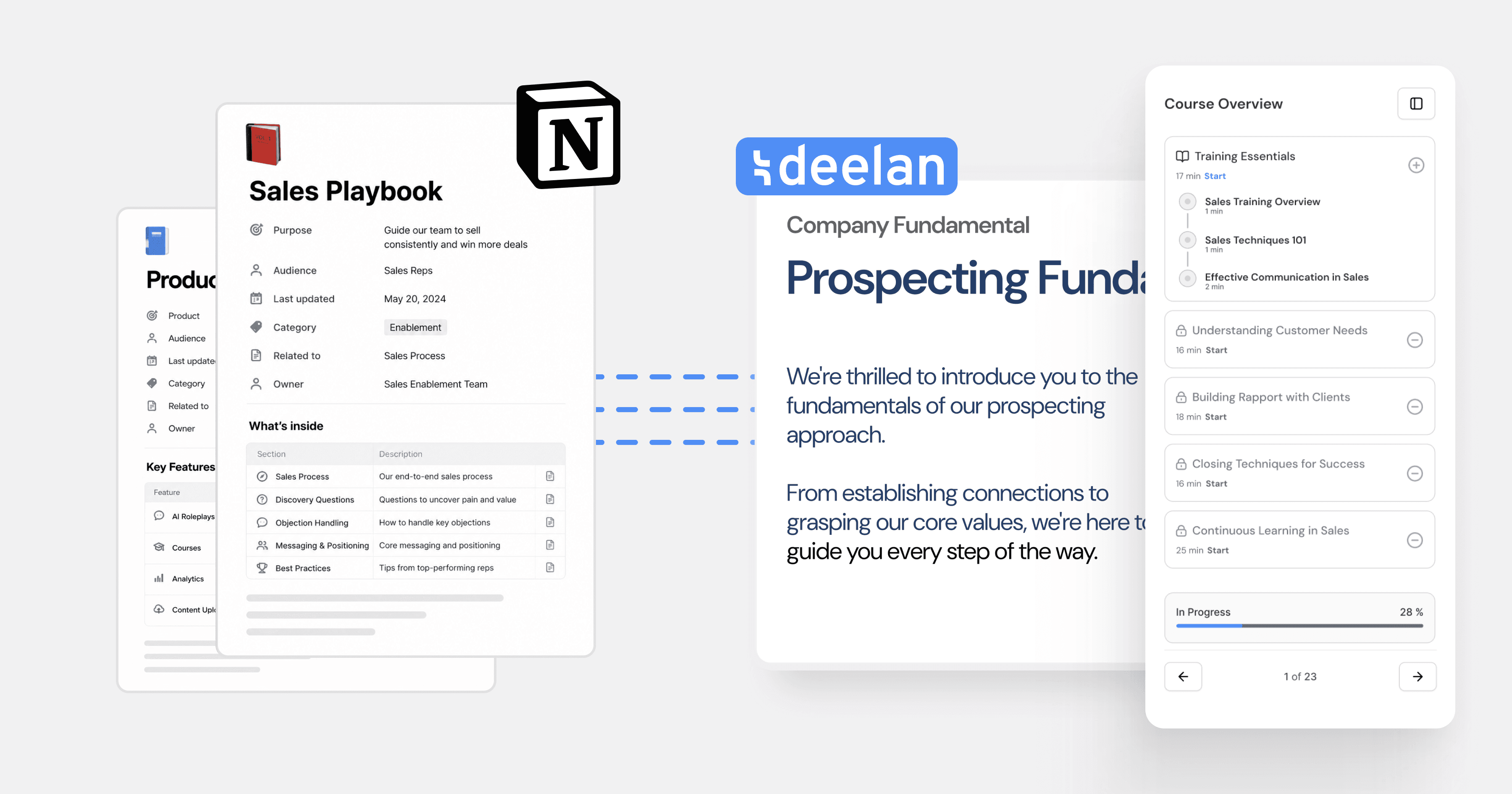
How to use it in deelan: Upload your sales playbook and use it as context to create structured training courses, assessments, and AI roleplays. Reps can learn your sales methodology and then practice applying it in simulated conversations.
2. Objection Handling Guides
Objection handling guides prepare reps to respond to concerns about pricing, implementation, competitors, or timing.
A useful guide goes beyond listing objections and scripted answers.
For example:

Tip: Build objection guides from actual lost deals and call recordings rather than hypothetical situations. Your team will recognize the conversations.
How to use it in deelan: Upload an objection list, relevant playbook, or real call transcript to create AI roleplays. Reps can practice handling objections, receive feedback on their performance, and repeat the scenarios they struggle with.
3. Competitive Battlecards
Competitive battlecards help reps explain why a prospect should choose your solution over another. A good battlecard should fit on one easily scannable page.
Include:
Competitor overview
Key positioning differences
Your strongest differentiators
Common competitive objections
Discovery questions to uncover buyer priorities
Relevant customer proof
Tip: Update battlecards whenever competitor positioning, products, or pricing changes. Assign an owner to maintain each document.
How to use it in deelan: Upload competitor documentation and battlecards, then build roleplays where the simulated buyer mentions a competing solution. Reps can practice explaining differentiation without simply listing features.
4. Real Sales Call Recordings
Your best sales calls are some of your most valuable enablement assets.
They show how successful reps ask questions, respond to objections, explain value, and adapt to unexpected conversations.
Instead of storing recordings in a large call library, select examples that teach specific skills.
Useful recording examples:
A strong discovery call that uncovers the buyer's real problem
A successful price objection response
A product demo tailored to a specific buyer
A lost deal that reveals a recurring sales mistake
Tip: Organize recordings by skill rather than just by date or salesperson. Highlight what the rep did well and what others should learn.
How to use it in deelan: Upload sales calls or transcripts to analyze conversations, identify skill gaps, and create targeted training. A difficult objection from a real call can become an AI roleplay that prepares the team for similar situations.

5. Product Knowledge and Launch Materials
Product documentation, feature descriptions, FAQs, and release notes help reps understand what they're selling.
This becomes especially important when launching new products, entering new markets, or onboarding sales hires.
Example: When launching a new product feature, create a short enablement package containing:
What the feature does
Which buyer problems it solves
How to explain its business value
Common questions and objections
A short demo talk track
Tip: Don't measure product training only by whether reps have watched a presentation. Test whether they can explain the feature to a real buyer.
How to use it in deelan: Upload product documentation or a launch presentation to generate a course with lessons and quizzes. Add a product demo roleplay to test whether reps can communicate the new messaging in practice.

6. Buyer Persona Guides
Buyer persona guides help reps adapt sales conversations to different stakeholders.
A VP of Sales, RevOps leader, and frontline sales manager may evaluate the same product for different reasons.
Example:
Persona | Main concern | Messaging focus |
|---|---|---|
VP of Sales | Team performance and revenue | Productivity, ramp time, sales outcomes |
Sales Manager | Rep performance and coaching time | Skill gaps, coaching, consistent execution |
RevOps | Processes and data | Visibility, integrations, operational efficiency |
Tip: Use customer interviews, discovery calls, and CRM notes to update personas with real objections and priorities.
How to use it in deelan: Use persona documents as context for roleplay scenarios. Reps can practice adapting discovery questions and value propositions to different buyer types.
7. Customer Case Studies
Case studies help prospects understand how your solution solves problems for companies like theirs.
The most useful examples explain the customer's situation, what changed, and the results.
A simple case study structure:
Customer profile and challenge
Solution implemented
Measurable outcomes
Customer quote or supporting evidence
Tip: Organize case studies by industry, company size, or use case so reps can choose the most relevant customer story.
How to use it in deelan: Upload case studies to your training context and build exercises that teach reps to select the right proof points. Use roleplays to practice introducing customer success stories naturally during discovery or demos.
8. Email Templates and Sales Scripts
Email templates and talk tracks give reps a starting point for outreach, follow-ups, and common sales conversations.
Examples include cold outreach, post-demo follow-ups, meeting confirmations, and re-engagement emails.
Tip: Provide personalization guidance alongside each template. A strong template should help reps communicate clearly without sounding scripted.
How to use it in deelan: Turn approved messaging and scripts into short training modules or assessments. Use AI roleplays to practice the spoken version of a cold call, discovery opener, or meeting request.
9. Product Demos and One-Pagers
Product demos and one-pagers help buyers understand your solution without going through every feature.
A useful one-pager should answer four questions: What problem does this solve? Who is it for? How does it work? Why should the buyer care?
Tip: Build different versions for different buyers and sales stages. A first-call overview shouldn't look the same as a technical evaluation document.
How to use it in deelan: Upload your demo messaging or product materials to create training around the most important features. Build a demo roleplay where the prospect interrupts, raises concerns, or asks unexpected questions.
10. Interactive Sales Training and Roleplays
Interactive training is where existing sales enablement content becomes practical skill development.
Instead of simply reading about discovery, reps run a simulated discovery call. Instead of memorizing objection responses, they practice handling them.
Examples include AI sales roleplays, micro-courses, quizzes, coaching sessions, and assessments.
Tip: Keep training focused on one skill at a time. A rep who struggles with uncovering customer pain points needs targeted discovery practice, not another generic sales fundamentals course.
How to use it in deelan: Combine training formats into personalized learning programs. Use real call performance and skill assessments to identify what each rep should work on next.

How Deelan Turns Sales Content Into Training That Reps Actually Use
Deelan takes your existing sales content, documentation, and call recordings and converts them into interactive training experiences: roleplays, microlearning modules, quizzes, onboarding paths, and certifications.
Reps don't just read about how to handle a pricing objection. They practice it.
Managers see where gaps actually exist.
Content stays current because it's tied to real knowledge.

At Deelan, we believe that the future of sales enablement content is interactive, personalized, and continuously updated. Teams that build that system first will be the ones that ramp faster, retain knowledge longer, and close more deals.
Ready to see what this looks like in practice? Book a free demo with Deelan and see how your existing content becomes a full training system.