
A new quarter is coming. Your sales targets are set, your team is ready, but looking at last quarter's results, you know there's room for improvement.
Maybe your reps are booking meetings but struggling to close deals. Maybe your new hires take too long to ramp up. Or maybe you're spending hours coaching your team without seeing much progress.
A sales performance improvement plan helps you identify what's holding your team back, decide what needs to change, and create a clear path to better results.
In this guide, you'll learn how to build an effective sales improvement plan, explore five practical examples, and get a free template to use with your team.

What Is a Sales Performance Improvement Plan?
A sales performance improvement plan is a structured roadmap for improving a sales rep's or team's results.
It connects three things:
The problem: What's preventing better sales performance?
The solution: What actions, training, or coaching will address it?
The measurement: How will you know whether performance is improving?
Unlike a regular sales plan focused on revenue targets, a performance improvement plan focuses on what needs to change to reach those targets.
It can support individual rep development, team-wide improvements, or formal performance management. A formal performance improvement plan (PIP) may also involve HR requirements and consequences, so it should follow your company's policies.

Step 1: Identify What's Really Hurting Sales Performance
Before you create an improvement plan, you need to understand why performance is falling short.
Start by looking at your sales data, reviewing real conversations, and talking to your reps.
Here's a simple diagnostic table to help you get started.
Sales performance problem | Possible cause | What could help |
|---|---|---|
Low meeting booking rate | Weak cold call openings or messaging | |
Low discovery-to-demo conversion | Poor qualification and questioning | Discovery call coaching, call reviews |
Deals lost to competitors | Weak differentiation and value communication | Product training, competitive objection roleplays |
Long sales cycles | Poor follow-up or negotiation skills | Deal coaching, negotiation practice |
New reps ramping too slowly | Unstructured onboarding | Personalized onboarding, courses, assessments |
Reps repeating the same mistakes | Lack of consistent feedback | Regular coaching, targeted practice |
Low activity across the team | Workflow, motivation, or capacity issues | Process review, realistic goals, manager support |

Step 2: Build Your Sales Improvement Plan
Once you've identified the problem, create an improvement plan that answers five simple questions.
1. What needs to improve?
Pick one or two priorities rather than trying to fix everything at once.
2. What's the goal?
Make it specific and measurable. Instead of "get better at discovery," try "increase the discovery-to-demo conversion rate from 30% to 40% over the next 60 days."
3. What actions will help?
Choose the right intervention: sales training, AI roleplays, one-to-one coaching, mentoring, or process changes.
4. Who's responsible?
Clarify what the rep needs to do and what support the manager will provide.
5. When will you review progress?
Use weekly check-ins and a realistic 30, 60, or 90-day timeline.
The key is connecting every performance goal to concrete actions.
Turn skill gaps into targeted sales training
If a rep struggles with objection handling, assigning another general sales course probably won't solve the problem.
They need to practice the objections they're actually struggling with, receive feedback, and repeat until they improve.

With deelan, you can identify skill gaps from sales conversations and create personalized training, AI roleplays, and coaching around those specific weaknesses.
5 Sales Performance Improvement Plan Examples
Here are five common situations sales managers face, with example improvement plans you can adapt.

Example 1: Low Discovery Call Conversion Rate
The problem: An account executive books plenty of discovery calls, but only 25% progress to the next stage.
Possible cause: The rep jumps into pitching before understanding the prospect's needs.
60-day improvement plan:
Goal: Increase discovery-to-next-stage conversion from 25% to 35%.
Week 1: Review five discovery calls and identify missed questions.
Weeks 2–4: Complete discovery training and practice three AI roleplays weekly.
Weeks 5–8: Apply the new questioning approach in live calls and review progress weekly.
Measure: Conversion rate and discovery question quality.
Recommended training: Discovery calls, active listening, qualification, and questioning techniques.

Example 2: Reps Struggling With Sales Objections
The problem: Prospects frequently respond with "too expensive" or "we already use a competitor," and reps struggle to move conversations forward.
Possible cause: Reps know the product but aren't confident explaining its value or handling objections.
30-day improvement plan:
Goal: Improve objection-handling assessment scores from 60% to 80%.
Week 1: Identify the five most common objections from lost deals and call recordings.
Week 2: Build a shared objection-handling guide with strong response examples.
Weeks 3–4: Practice realistic buyer conversations and receive personalized coaching.
Measure: Roleplay scores, objection-handling quality, and subsequent deal progression.
Recommended training: Value-based selling, competitive positioning, and objection-handling roleplays.

Example 3: New Sales Reps Taking Too Long to Ramp
The problem: New hires take five months to become productive, putting additional pressure on managers.
Possible cause: Onboarding depends heavily on shadowing experienced reps, with limited structured practice.
90-day improvement plan:
Goal: Reduce the average time to reach agreed sales readiness milestones.
Days 1–30: Complete product knowledge, ICP, and sales methodology training.
Days 31–60: Practice cold calls, discovery, demos, and common objections.
Days 61–90: Run live conversations with coaching and track performance.
Measure: Knowledge assessments, roleplay readiness scores, and time to first qualified opportunity.
Recommended training: Structured sales onboarding with personalized courses, assessments, and roleplays.
Example 4: Too Many Deals Stalling Before Closing
The problem: Opportunities enter the pipeline but remain there for months without progressing.
Possible cause: Reps struggle to identify decision-makers, create urgency, or secure clear next steps.
60-day improvement plan:
Goal: Reduce the share of opportunities stalled beyond the team's agreed threshold.
Week 1: Review ten stalled opportunities and their call history.
Weeks 2–3: Train reps on deal qualification, stakeholder mapping, and next-step commitments.
Weeks 4–8: Run weekly deal coaching sessions and negotiation roleplays.
Measure: Stalled-opportunity rate, stage duration, and next-step completion.
Recommended training: Deal execution, negotiation, qualification, and multistakeholder selling.
Example 5: Sales Reps Repeating the Same Mistakes
The problem: Managers provide feedback regularly, but reps continue making the same mistakes.
Possible cause: Coaching identifies problems but doesn't include enough follow-up practice.
30-day improvement plan:
Goal: Improve each rep's weakest assessed skill by an agreed amount.
Week 1: Review calls and identify one priority skill gap per rep.
Week 2: Assign personalized training and practice scenarios.
Weeks 3–4: Repeat roleplays, review new calls, and provide targeted feedback.
Measure: Skill assessment scores and improvement in live conversations.
Recommended training: Personalized coaching, focused roleplay practice, and ongoing skills assessment.
Step 3: Make Sales Improvement Continuous
A sales performance improvement plan shouldn't become another document that gets forgotten after a quarterly review.
The most effective approach is a continuous cycle.

How deelan Helps Sales Managers Build Better Improvement Plans
Deelan connects sales performance analysis with personalized training and coaching.
Instead of manually creating a separate training plan for every rep, managers can:
Spot skill gaps: Identify weaknesses from sales conversations, assessments, or manager input.
Create training: Generate focused courses, roleplays, and coaching activities.
Personalize development: Adapt training to each rep's role, experience, and skill gaps.
Track readiness: Monitor skills and progress to identify who needs additional support.
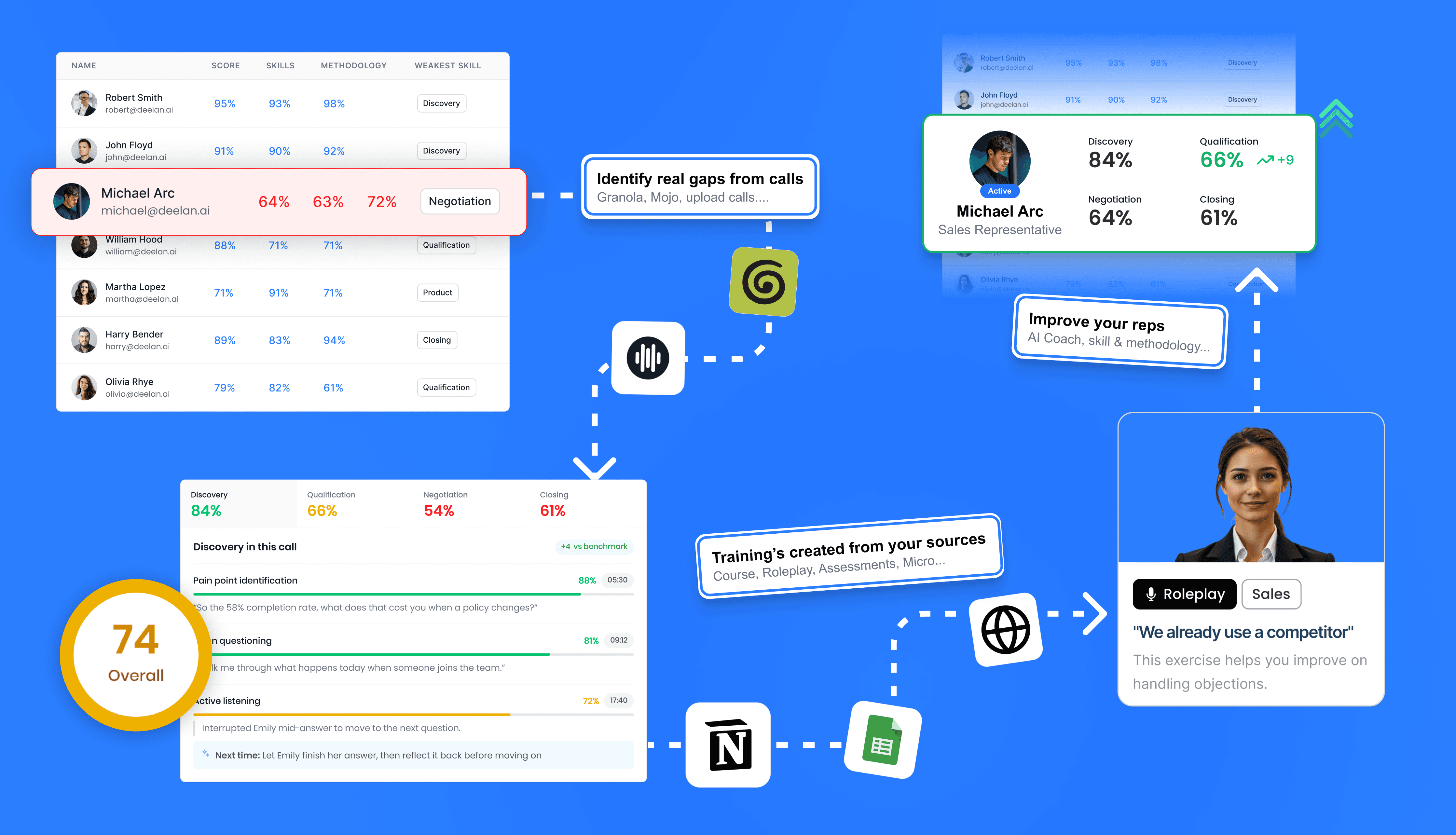
Your sales improvement plan becomes something your team can act on, rather than another spreadsheet to maintain.
Book a demo to see how Deelan helps sales leaders turn skill gaps into personalized training and coaching.
Free Sales Performance Improvement Plan Template
You don't need a complicated spreadsheet or a 20-page document to improve sales performance.
We've created a simple, reusable template that works for individual sales reps or entire teams.
Download the Free Sales Performance Improvement Plan Template
Here's what it includes:
Section | What to fill in | Example |
|---|---|---|
1. Performance gap | What's not working? | Low discovery conversion |
2. Current performance | What's the baseline? | 25% conversion |
3. Target | What needs to improve, and by when? | Reach 35% in 60 days |
4. Root cause | Why is it happening? | Weak discovery questions |
5. Improvement actions | What training, coaching, or support is needed? | Discovery course + 3 weekly roleplays |
6. Owner & timeline | Who does what, and when? | Rep + manager, 60 days |
7. Progress tracking | How will success be measured? | Weekly call reviews + conversion rate |
You can duplicate the template for each rep or add several performance gaps for a team-wide plan.
For formal employee PIPs, include any additional documentation, review, and HR requirements defined by your organization.
Ready to improve your team's sales performance?
Start a free trial or book a demo to see how Deelan makes personalized sales training and coaching easier to scale.