
Sales is probably one of the clearest examples of a profession where practice makes the difference.
People often think top sales reps succeed because they are naturally charismatic, confident, or great communicators.
In reality, most great salespeople got there through repetition.
They've handled hundreds of objections.
They've run countless discovery calls.
They've learned from conversations that went well - and many that didn't.
Let's look at the different ways sales teams are using AI to practice, coach, and improve performance.
Different ways to use AI sales practice
Sales skill to practice | What reps can practice | How AI helps |
|---|---|---|
Openers, first 30 seconds, pushback | AI plays a busy prospect and tests how the rep reacts | |
Price, timing, competitors, “not interested” | Reps can repeat the same objection until they improve | |
Questions, listening, follow-ups | AI answers like a buyer and shows where the rep stayed too shallow | |
Product explanation, technical questions, value | Reps practice turning features into business outcomes | |
Unhappy customers, budget concerns, churn risk | AI creates harder customer conversations without risking accounts | |
Tone, confidence, talk-to-listen ratio | AI gives feedback after each session | |
Onboarding, product knowledge, playbooks | AI turns company materials into training faster |
Reps do not get enough safe practice
Sales confidence comes from repetition.
A rep gets better at cold calls by doing more cold calls.
They get better at pricing conversations by practicing pricing conversations.
They get better at discovery by asking better questions again and again.
AI sales practice gives reps that space. They can try, fail, repeat, and improve without burning real opportunities.
That is especially useful for new reps, but it is not only for onboarding. Even experienced reps need practice when there is a new product, a new pitch, a new buyer persona, or a new competitor in the market.
1. Practice cold calls
Cold calls are a good place to start because they are short, stressful, and easy to repeat.
With AI roleplay, SDRs and BDRs can practice common cold call moments like:
“We are not interested.”
“Send me an email.”
“I am busy.”
“We already have a vendor.”
“This is not a priority.”
Do not just tell the rep to “practice cold calls.” Give them a clear scenario.
For example:
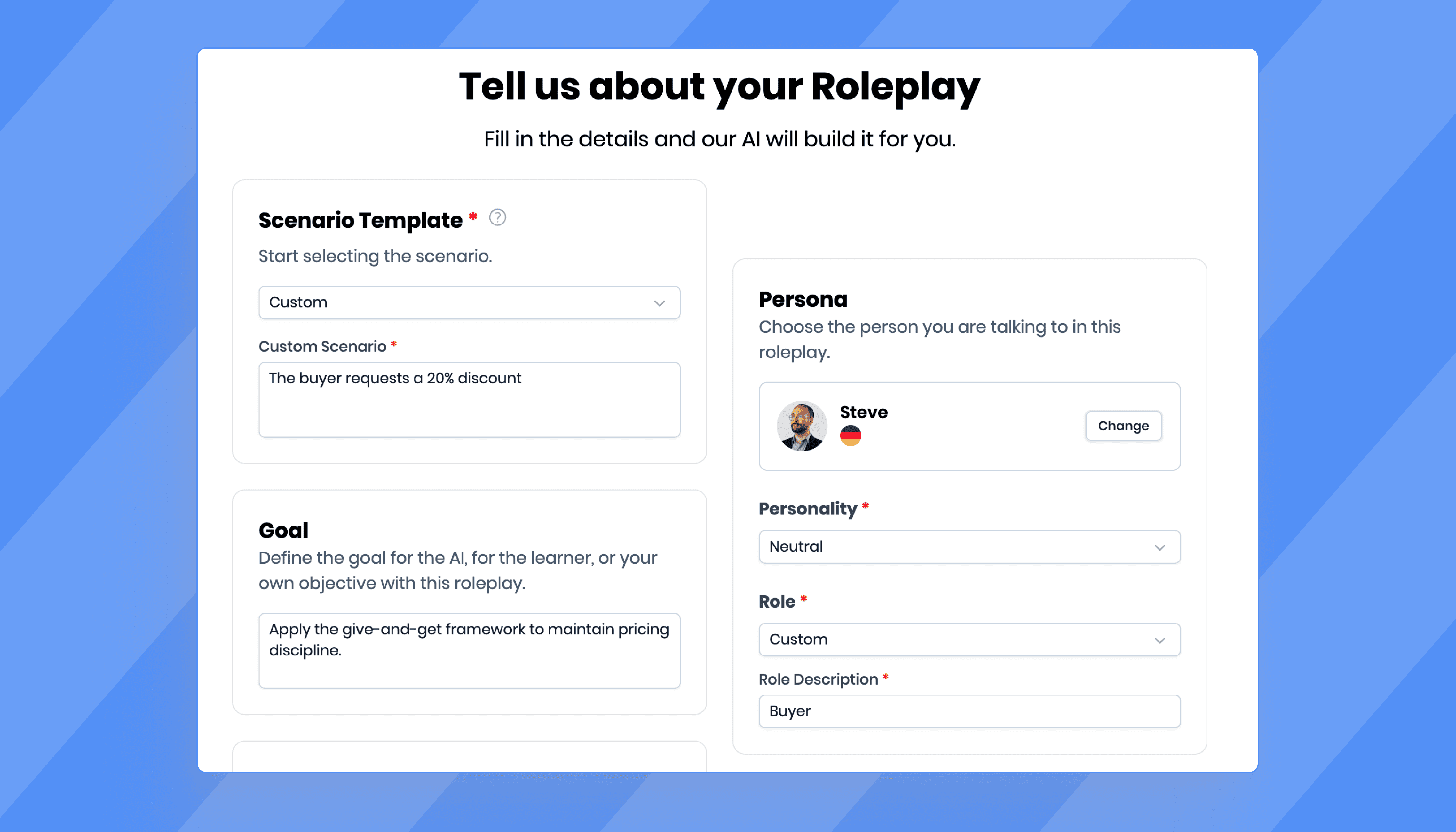
Scenario: Cold call a VP of Sales at a SaaS company.
Goal: Book a discovery call.
Difficulty: Medium.
Persona: Busy, skeptical, only has two minutes.
Main objection: “We already have sales training.”
This makes the roleplay feel closer to a real call.
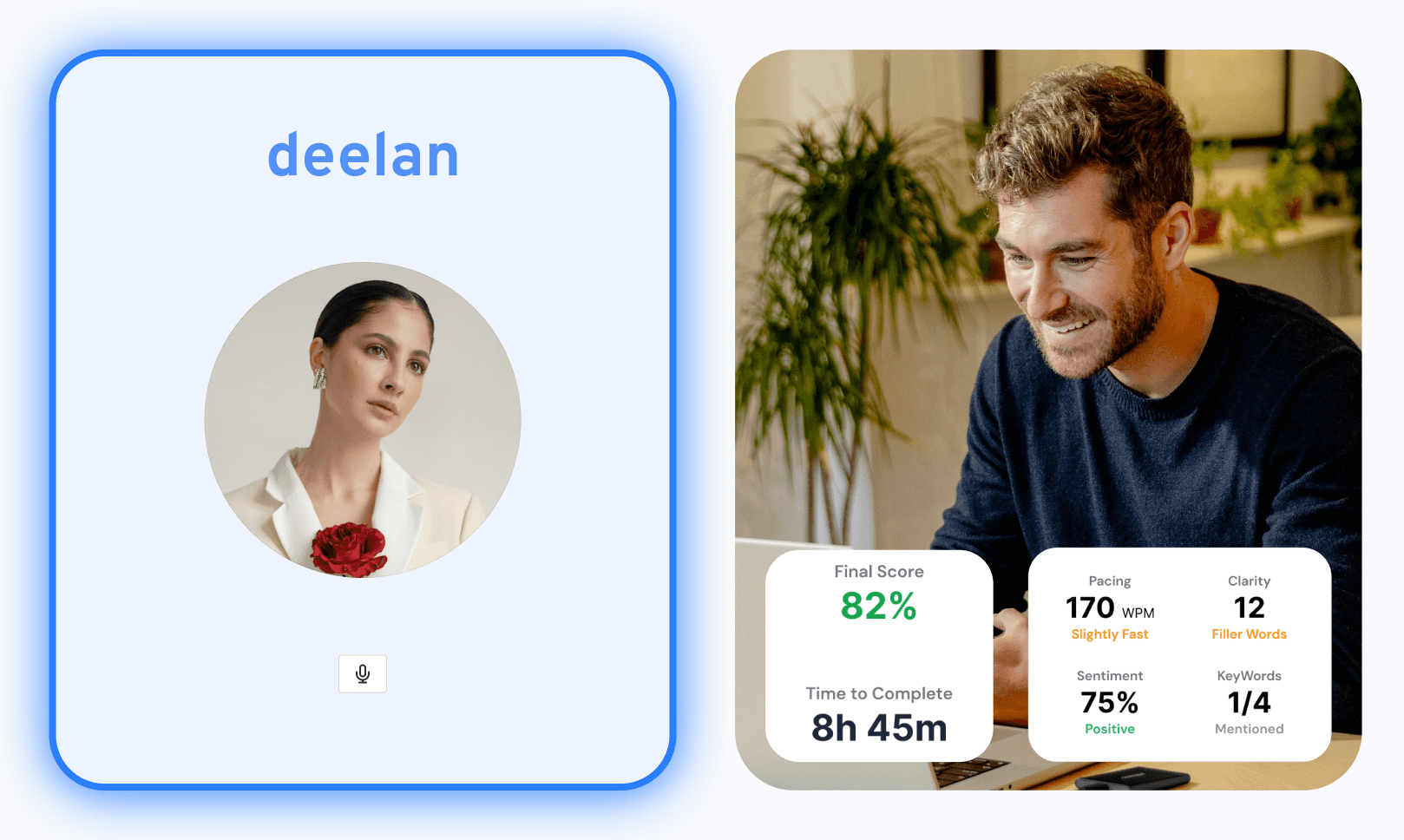
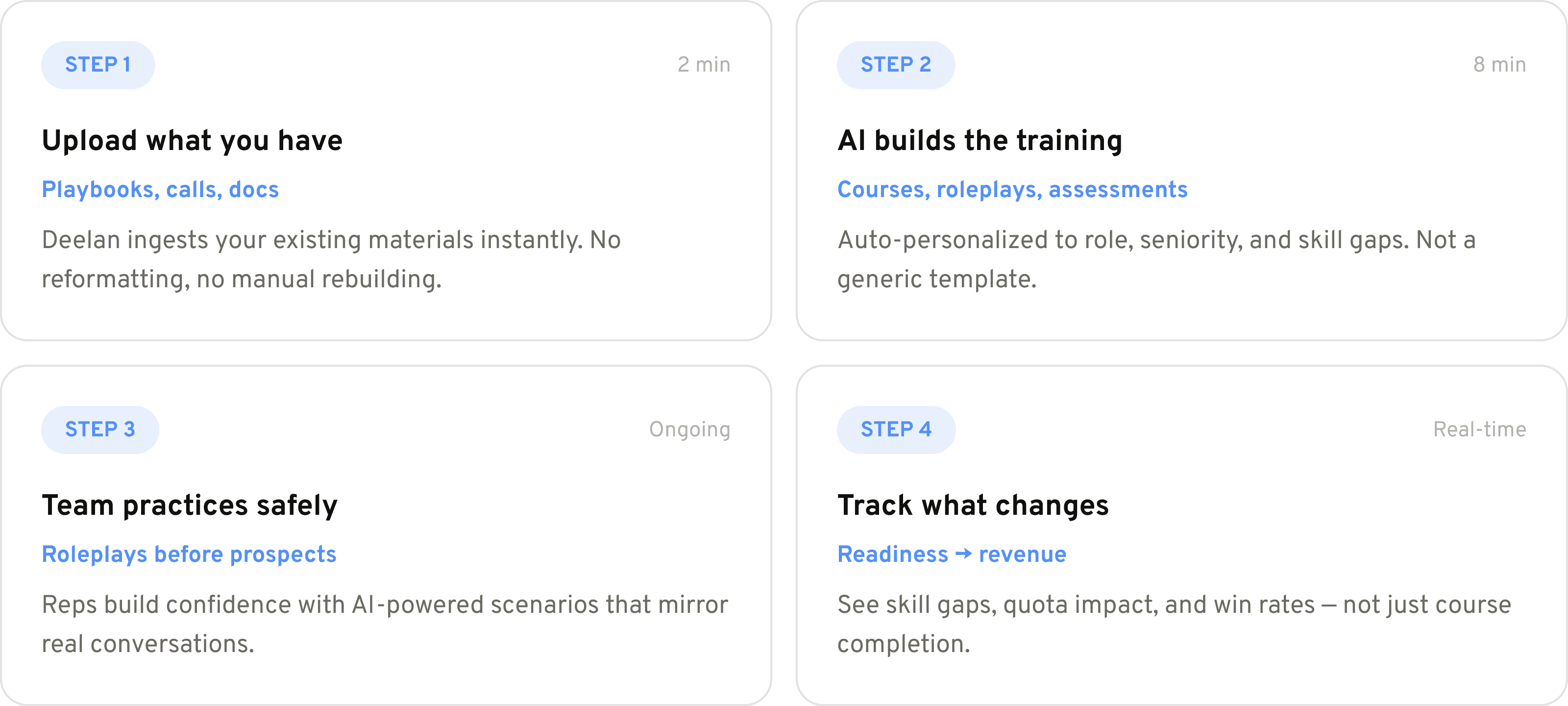
In Deelan, teams can set up scenarios like this from scratch, from templates, or from existing sales materials.
2. Practice objection handling
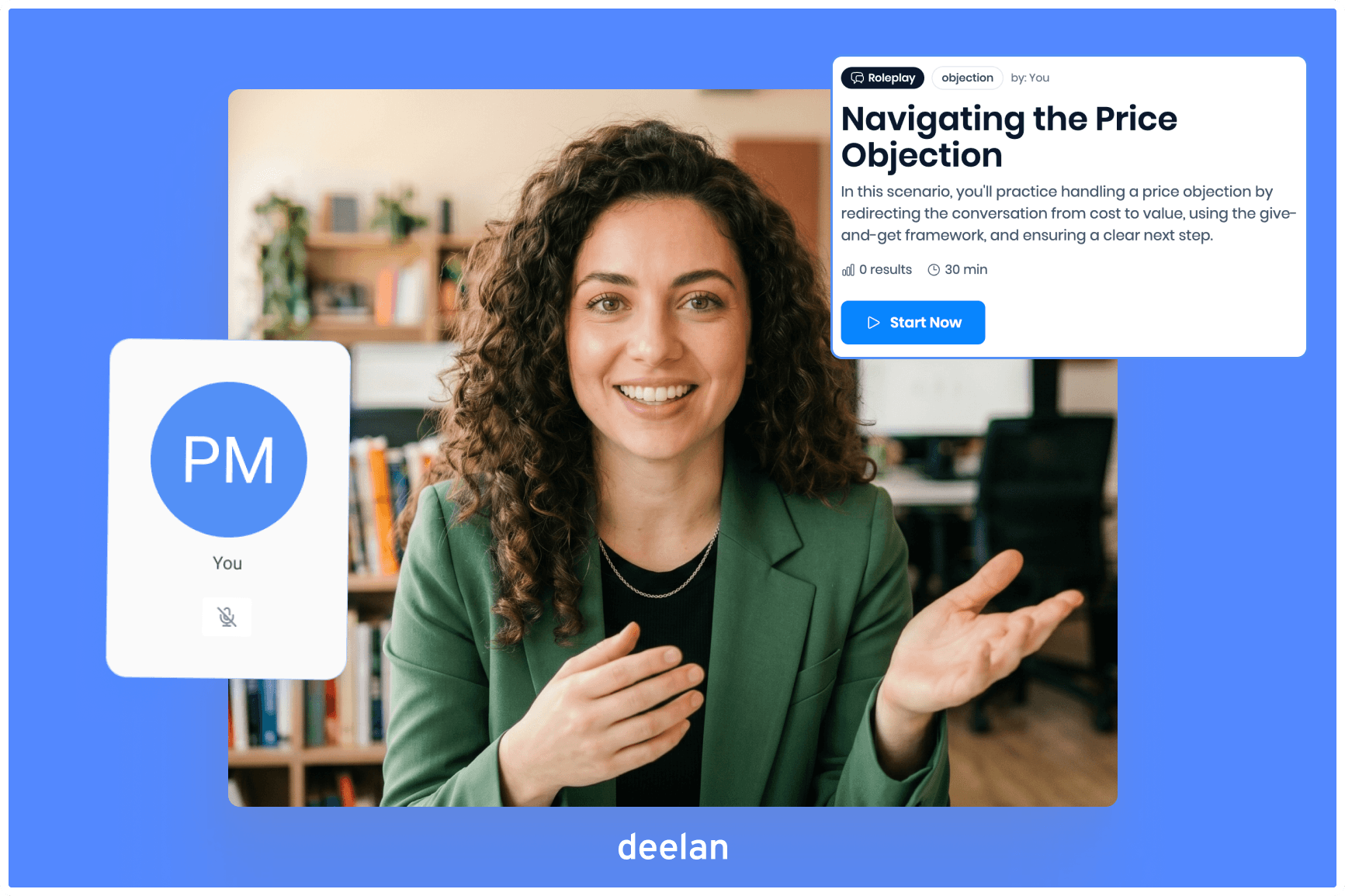
Objection handling is one of the best uses of AI sales practice because reps can repeat the same difficult moment many times.
Common objections include:
“Your competitor is cheaper.”
“We do not have budget.”
“This is not urgent.”
“We are already using another tool.”
“I need to talk to my team.”
“Send me more information.”
AI roleplay helps reps practice calm response. They can learn to ask better questions instead of rushing to defend the product.
With Deelan, the AI persona can push back, raise follow-up questions, and make the rep work through the conversation.
3. Practice discovery calls
Discovery is where many deals are won or lost.
A weak discovery call feels like a checklist. The rep asks a few basic questions and then jumps into the pitch. A strong discovery call feels more like a real conversation. The rep listens, follows up, and finds the real problem behind the first answer.
AI sales practice can help reps improve things like:
Asking open questions
Not interrupting
Going deeper after vague answers
Understanding pain points
Connecting problems to business impact
Knowing when to move forward
Deelan can create these AI personas and adapt the conversation based on the scenario, industry, difficulty, and goal.
4. Practice demos and product conversations
AI sales practice can help reps prepare for demo moments like:
Explaining a feature in simple words
Answering technical questions
Handling “Does it integrate with our tools?”
Connecting the product to business outcomes
Staying focused on the buyer’s main problem
Many reps talk too much during demos. AI coaching can help them see where they over-explained, where they lost the buyer, and where they could have been clearer.
Deelan can use product docs, call recordings, and playbooks to help teams build more relevant demo practice.
5. Practice renewals and upsells
AI sales practice is not only for SDRs and account executives. Customer success teams can use it too.
Renewal and upsell conversations can be sensitive. The customer may be unhappy, unsure, or comparing other options.
Teams can practice scenarios like:
A customer says they are not seeing value
A client asks for a discount
Usage has dropped
A champion has left the company
A customer is considering a competitor
There is an opportunity to expand the account
AI roleplay gives CS teams a way to prepare for these moments before they happen with real accounts.
6. Use AI coaching after each practice session
Practice is useful, but feedback makes it much better. Without feedback, reps may repeat the same bad habits.
AI coaching can help reps understand what happened in the conversation. For example, Deelan can show:
Strengths
Weaknesses
Talk-to-listen ratio
Tone
Confidence level
Question quality
Silence points
Objection handling
Specific quotes to improve
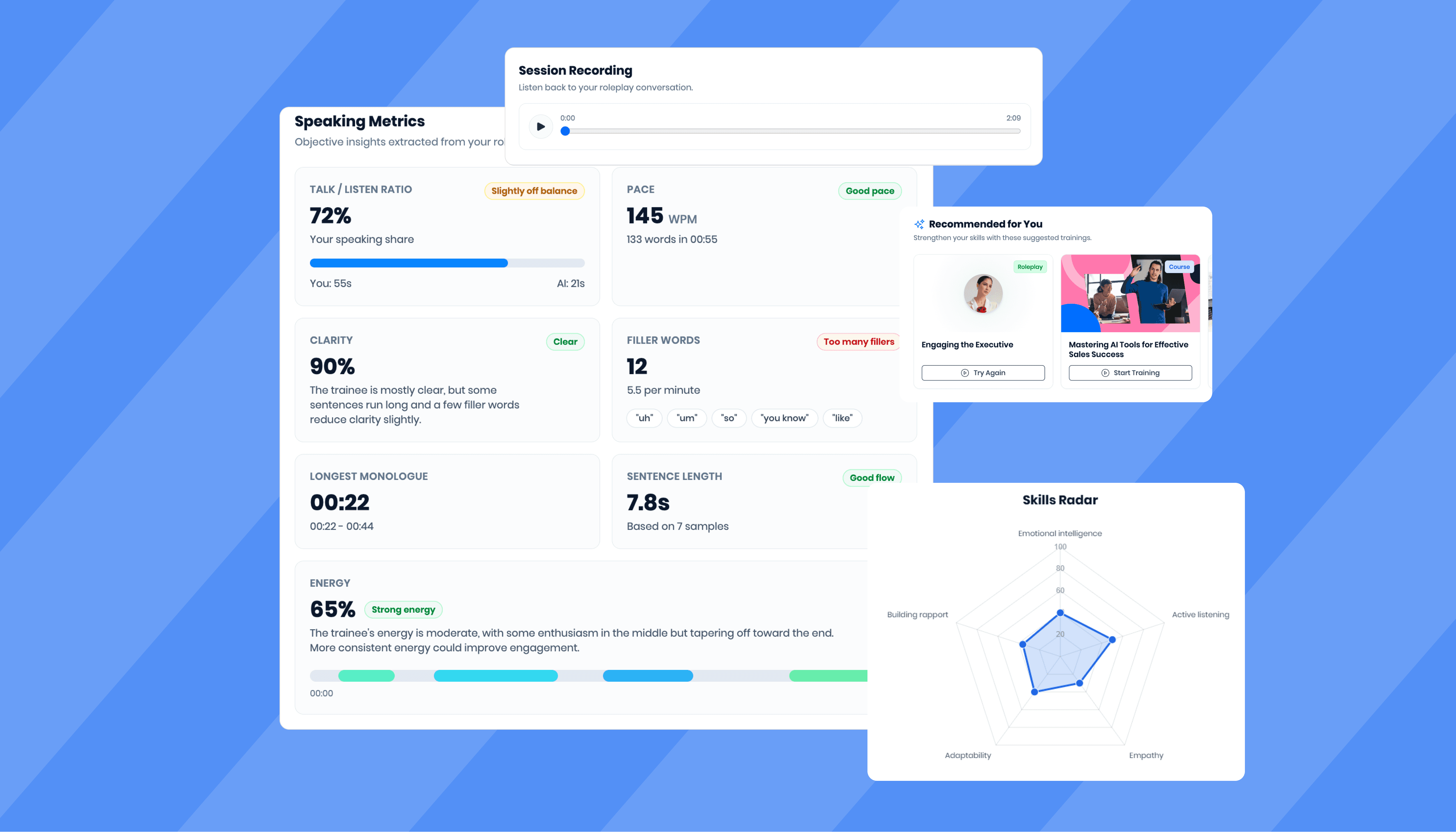
This is useful because the feedback is not vague.
Instead of saying, “Be more confident,” the rep can see where they sounded unsure and what they could say differently next time.
Managers can also use this information to coach better. They do not need to guess where the rep is struggling. They can see patterns.
7. Turn sales training into regular practice
For SDRs:
Cold call opener, objection handling, qualification, follow-up.
For AEs:
Discovery, demo questions, pricing, negotiation.
For customer success:
Renewals, upsells, unhappy customers, product adoption.
For managers:
Coaching conversations, feedback sessions, difficult employee conversations.
Deelan helps teams build this kind of training in different formats: roleplays, courses, workshops, assessments, micro-learning, and programs.
That means sales training does not have to be one big course. It can become a simple practice system that reps use often.
Want to test this with your own sales playbook?
How Deelan helps sales teams practice and train
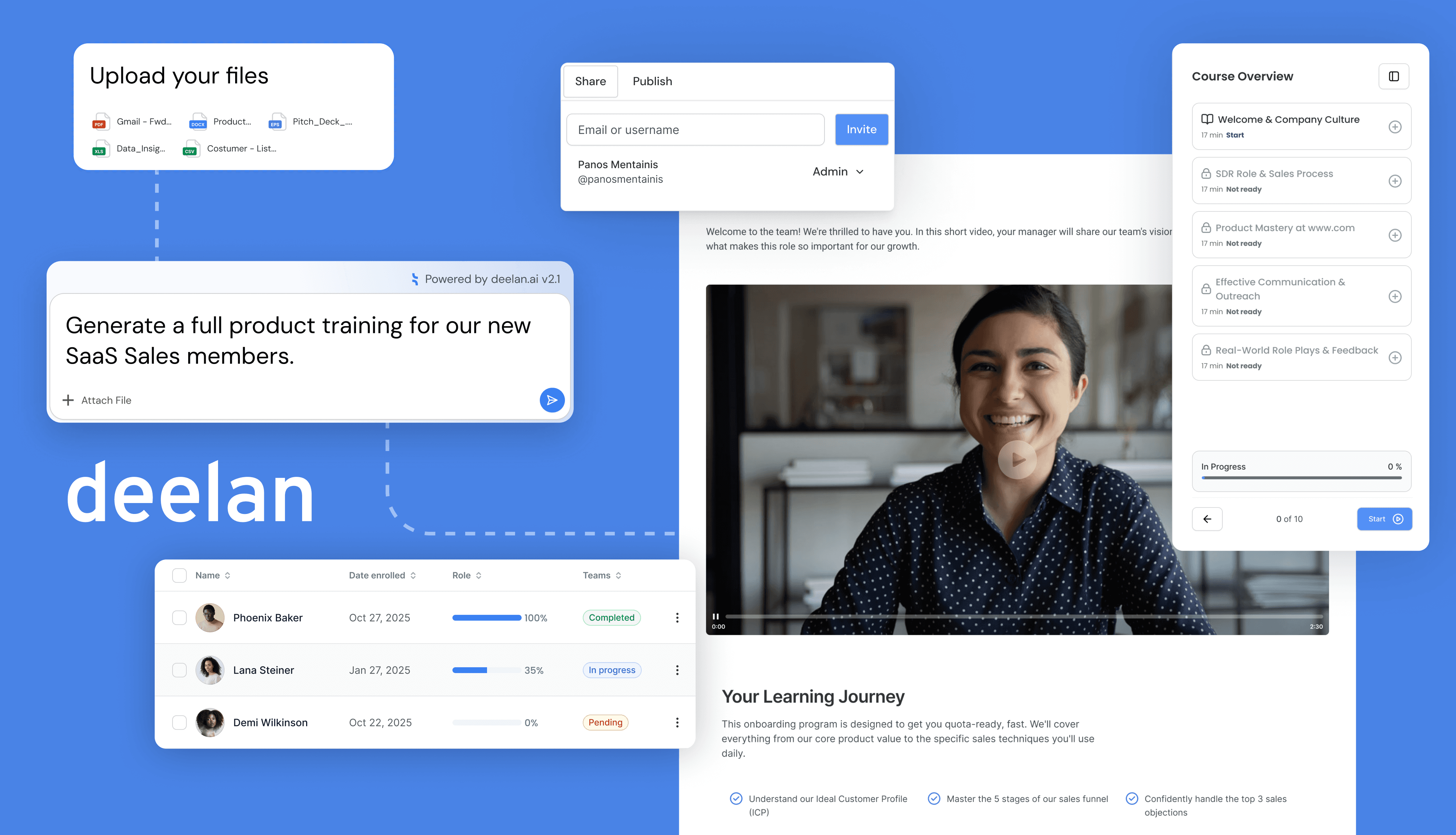
Deelan is built for revenue teams that want to create training faster and make it more useful.
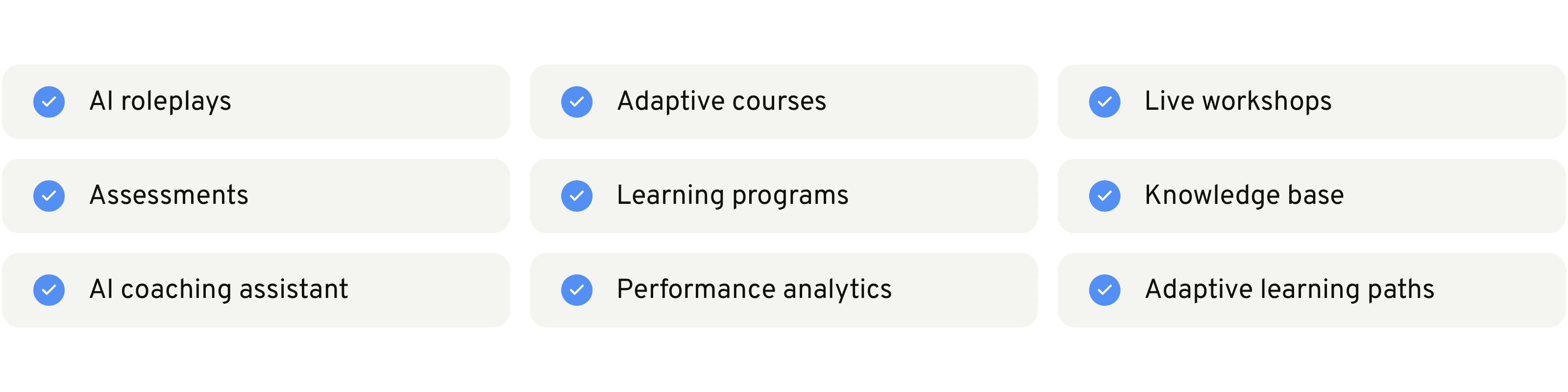
Teams can create:
AI roleplays
Courses
Workshops
Assessments
Micro-learning
Learning programs
For AI roleplays, teams can create a scenario, choose the persona, set the goal, define the difficulty, and let reps practice.
After the session, reps get coaching and managers can track progress.
This helps with three big problems:
First, training is faster to create.
Second, reps get more practice.
Third, managers can see who needs help.
It is not about replacing sales managers. It is about removing the repetitive part of coaching so managers can focus on the conversations that need human judgment.
A simple AI sales practice plan
Here is an easy way to start. Do not try to build every scenario at once. Start with the five conversations your team has most often.
For example:
First cold call
Discovery with a skeptical buyer
Price objection
Demo with technical questions
Renewal risk conversation
Then create one roleplay for each.
Ask reps to practice one or two short sessions per week. Keep the sessions focused. Review the coaching reports. Look for patterns.
Once you see the patterns, you can build better training around them.
That is where AI sales practice becomes useful. It is not only a roleplay tool. It becomes a way to understand where the team needs help and how to improve sales training over time.
Time to start practicing!
AI sales practice helps sales teams make practice more normal.
Reps can repeat hard conversations.
Managers can coach with better information.
New hires can ramp faster.
Teams can keep training updated when the product or market changes.
It works best when it is simple and consistent.
Pick the most common sales situations.
Turn them into roleplays.
Let reps practice.
Use the coaching reports.
Improve the training as you go.
With Deelan, teams can build roleplays, coaching, and sales training from the materials they already use every day.
Start a free trial or book a demo to see how it could work for your team.